Blog
How Do Commercial Automatic Door Openers Work? A Complete Technical Guide
Author
Ray
Published
Category
Automatic Door Opener
Learn how commercial automatic door openers work — from motors and sensors to ANSI A156.10 and UL 325 standards. A technical guide for U.S. suppliers, distributors, and installers.

Author
Ray
An experienced automation specialist with a strong background in motor technology and industrial solutions. With years of expertise in central motors, tubular motors, and automation systems, the author is dedicated to sharing insights that connect engineering innovation with real-world applications. Passionate about advancing reliable, energy-efficient, and high-performance automation products for global markets.
What’s better than insider perks, pro tips, and surprises?
Sign up to get the most recent blog articles in your email every week.
Join now.
WHY I WRITE THIS
About my business
Our company’s main product lines include tubular motors, sliding gate motors, swing gate motors, roller shutter motors, and other door automation solutions, all manufactured by trusted partner factories we have worked with for many years.
Our Services
I help them with sales and export operations, while our company also provides sourcing and procurement services in China to help international clients solve supply-related challenges. If you need assistance with procurement, please feel free to contact us.
Commercial automatic door openers are sophisticated electromechanical systems designed to provide hands-free access while maintaining strict safety standards. At their core, they combine sensors, control boards, motors, and gearboxes to detect approaching users, open the door smoothly, protect pedestrians, and close the door safely.
Key Takeaways
Commercial automatic door operators use a combination of motion sensors, safety beams, and microprocessors to control door movement.
Most systems rely on brushless DC motors paired with planetary gearboxes for quiet, reliable operation.
U.S. installations must comply with ANSI A156.10, UL 325, and ADA requirements.
Low energy operators are suited for moderate traffic, while full energy operators are built for high-cycle environments.
Proper integration of safety sensors and manual override systems is non-negotiable for legal compliance and liability protection.

The Core Answer: How Commercial Automatic Door Openers Work
A commercial automatic door opener works by processing signals from activation sensors through a control board that commands a motor and gearbox to open or close the door at a controlled speed. When a motion sensor or activation switch detects a user, the control board activates the motor. An encoder monitors door position and speed in real time. Safety beams and presence sensors continuously monitor the door’s swing or slide path. If an obstruction is detected, the system reverses or stops to prevent contact.
This entire sequence must happen within strict parameters defined by ANSI A156.10 and UL 325 to ensure both accessibility and entrapment protection.
Core Components of a Commercial Automatic Door System
Every commercial automatic door system contains five essential elements:
Activation Sensors: Microwave, infrared, or passive infrared sensors that detect motion or presence.
Control Board (Microprocessor): The “brain” that interprets sensor data, manages logic, and sends commands to the motor.
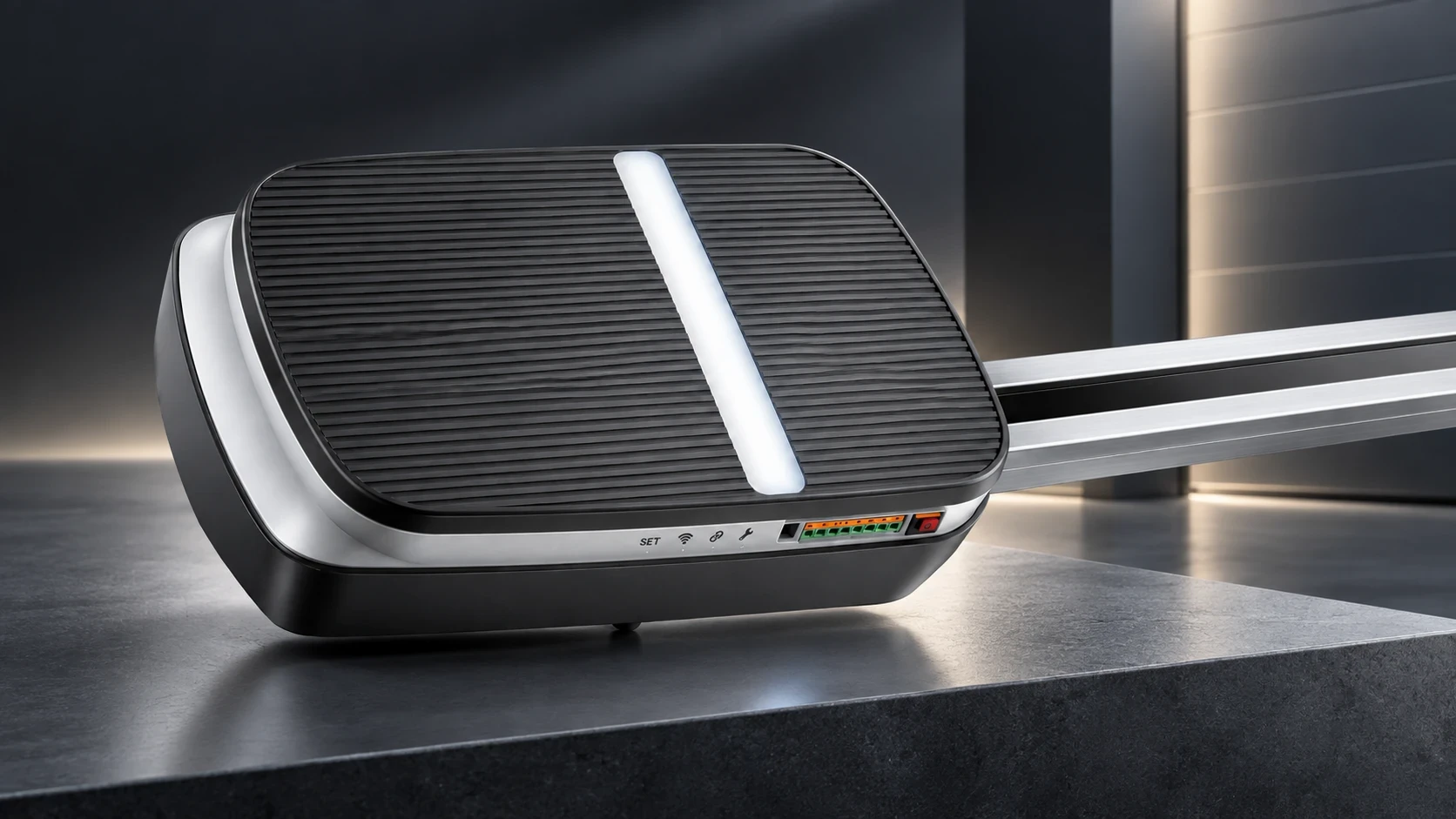
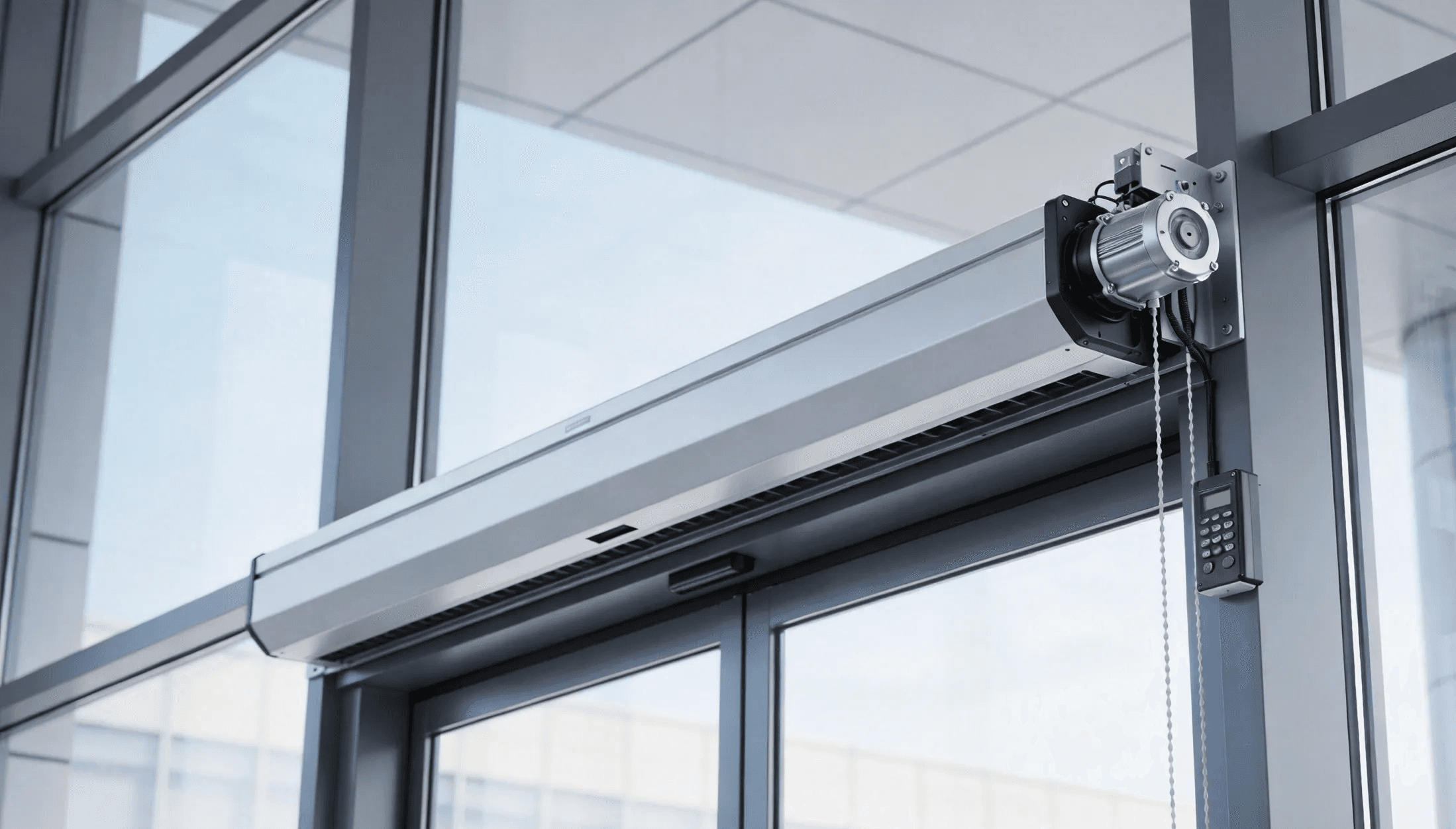
Drive Unit (Motor + Gearbox): Typically a brushless DC motor coupled with a planetary or worm gear reduction system.
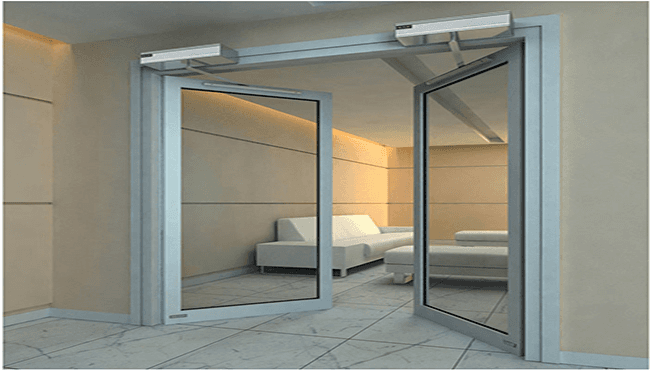
Door Operator Arm or Track: Transfers mechanical force to the door leaf (sliding, swinging, or folding).
Safety Sensors: Infrared safety beams and presence sensors that create a protective field around the door’s path.
These components must be precisely calibrated to work together under varying environmental conditions.
Step-by-Step: The Operating Sequence of an Automatic Door
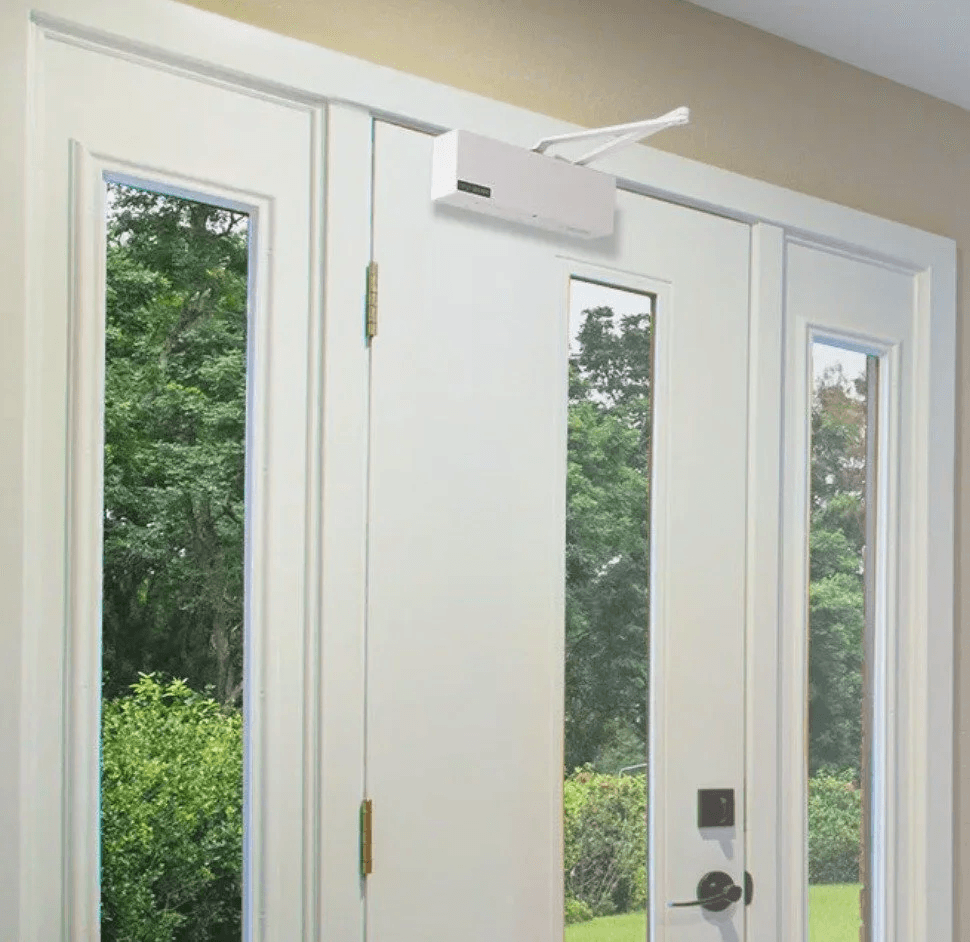
Detection: A motion sensor identifies an approaching pedestrian within its detection zone.
Signal Processing: The control board receives the signal and determines whether to open the door based on programmed logic and safety inputs.
Motor Activation: The brushless DC motor engages, driving the gearbox to move the door at the programmed speed.
Monitoring: Encoders and position sensors provide continuous feedback to maintain smooth acceleration and deceleration.
Safety Check: Throughout the cycle, safety beams and presence sensors monitor for obstructions. Any detection triggers an immediate stop or reversal.
Closing Cycle: After a programmable hold-open time, the operator reverses direction, again monitoring for safety.
This sequence repeats thousands of times per week in high-traffic commercial entrances.
Motion Sensors, Safety Beams, and Activation Methods
Modern automatic door operators use multiple layers of detection. Microwave sensors excel at long-range motion detection, while infrared sensors provide precise presence detection near the threshold. Safety beams (typically 2–3 sets) create an invisible curtain that stops the door instantly if broken.
Touchless activation methods have become significantly more popular since 2020, with wave-to-open switches and advanced infrared presence sensors reducing physical contact.
Low Energy vs Full Energy Door Operators: Key Differences
Feature | Low Energy Operator | Full Energy Operator |
|---|---|---|
Typical Use | Offices, retail exits, assisted living | High-traffic entrances, hospitals, airports |
Opening Speed | Slower, meets ADA push force limits | Faster, higher force |
Activation | Often push-and-go or light activation | Full sensor activation |
ANSI Standard | ANSI A156.19 | ANSI A156.10 |
Power Consumption | Lower | Higher |
Cost | Generally lower | Higher |
Understanding this distinction is critical for suppliers when recommending solutions to architects and facility managers.
Power Failure Operation and Manual Override Systems
Commercial installations require fail-safe or fail-secure behavior during power outages. Most quality operators incorporate a spring return mechanism or electromagnetic lock that allows the door to be manually opened from either side when power is lost.
Suppliers should verify that any operator they import includes a clearly marked manual override and meets UL 325 requirements for battery backup or mechanical egress.
Critical Safety Standards: ANSI A156.10, UL 325, and ADA
In the United States, automatic door operators must comply with:
ANSI A156.10: Governs power-operated pedestrian doors, including opening speed, force, and safety sensor requirements.
UL 325: Standard for door, drapery, gate, louver, and window operators and systems — focuses on entrapment protection.
ADA (Americans with Disabilities Act): Requires specific opening force, width, and activation height parameters.
Non-compliant products create serious liability exposure for distributors and installers.
Common Failure Points and Troubleshooting for Suppliers
The most frequent issues reported by field technicians include:
Misaligned or dirty safety sensors causing constant reopening
Faulty control board logic leading to erratic operation
Worn brushes on older motors (increasingly replaced by brushless DC units)
Improper spring tension on swing operators
Encoder failure resulting in inaccurate positioning
A reliable supplier maintains technical support resources that help customers quickly diagnose these problems rather than simply replacing entire units.
What U.S. Suppliers Should Consider When Sourcing Operators
When evaluating wholesale automatic door operators or OEM solutions, experienced distributors look beyond basic functionality. They assess duty cycle ratings, availability of spare parts, quality of the control board firmware, sensor compatibility, and — most importantly — documentation supporting ANSI/UL certification.
Suppliers who understand these technical details can command higher margins and build stronger relationships with contractors and facility managers.
FAQ
Q1: What is the difference between a low energy and full energy automatic door operator?
Low energy operators open more slowly and require less activation force to comply with ADA standards for assisted use. Full energy operators are designed for high-traffic applications and move faster with greater force while still meeting stringent safety requirements under ANSI A156.10.
Q2: How do automatic door safety sensors work?
Safety sensors (usually infrared beams or presence sensors) create a detection field around the door’s path. If the field is interrupted while the door is moving, the control board immediately stops or reverses the door to prevent contact.
Q3: Do automatic door operators work during a power outage?
Most commercial operators include either a battery backup or a mechanical spring return system that allows manual operation when power is lost. The specific behavior (fail-safe vs fail-secure) should be selected according to the building’s egress requirements.
Q4: What does UL 325 certification mean for automatic door openers?
UL 325 is a safety standard that tests entrapment protection. Certified operators have passed rigorous testing to ensure they will not cause injury if a person or object is in the door’s path.
Q5: Can existing manual doors be retrofitted with automatic operators?
Yes, in many cases. However, the door structure, hinges, and header must be evaluated for compatibility, and the final installation must still meet current ANSI A156.10 and ADA standards.
Q6: How long do commercial automatic door operators typically last?
With proper maintenance, quality commercial operators regularly exceed 1 million cycles. High-end units from established brands often achieve 5–10 years of heavy use before major service is required.
Conclusion
Understanding how commercial automatic door openers work is no longer optional for serious suppliers and distributors in the U.S. market. The combination of sophisticated sensors, precise motor control, and rigorous safety standards creates a complex but highly reliable system that demands technical knowledge from everyone in the supply chain.
By mastering these principles — from sensor logic to ANSI compliance — suppliers can reduce callbacks, improve specification win rates, and provide genuine value to their contractor and facility customers.
Other Blogs