Blog
Sliding Gate Opener Not Working? 10 Common Problems and Solutions
Author
Ray
Published
Category
Sliding Gate Opener
Troubleshoot 10 common sliding gate opener problems, including remote, photocell, limit switch, rack, motor, control board, and closing issues.


Author
Ray
An experienced automation specialist with a strong background in motor technology and industrial solutions. With years of expertise in central motors, tubular motors, and automation systems, the author is dedicated to sharing insights that connect engineering innovation with real-world applications. Passionate about advancing reliable, energy-efficient, and high-performance automation products for global markets.
What’s better than insider perks, pro tips, and surprises?
Sign up to get the most recent blog articles in your email every week.
Join now.
WHY I WRITE THIS
About my business
Our company’s main product lines include tubular motors, sliding gate motors, swing gate motors, roller shutter motors, and other door automation solutions, all manufactured by trusted partner factories we have worked with for many years.
Our Services
I help them with sales and export operations, while our company also provides sourcing and procurement services in China to help international clients solve supply-related challenges. If you need assistance with procurement, please feel free to contact us.
A sliding gate opener that suddenly stops working does not always mean the motor has failed. In many cases, the actual cause is much simpler: a power problem, discharged remote battery, blocked photocell, incorrect limit switch, engaged manual release, dirty gate track, misaligned gear rack, or a control input that is preventing movement.
The most effective way to troubleshoot an automatic sliding gate is to identify the exact symptom first and then separate mechanical problems from electrical and control problems.
This guide covers 10 of the most common sliding gate opener problems, explains their likely causes, and shows what should be checked before replacing the motor or control board.
For homeowners, installers, property managers, and professional gate automation buyers, understanding these problems can reduce unnecessary repairs and help identify when a sliding gate opener actually needs professional service or replacement.
Sliding Gate Opener Troubleshooting: Quick Diagnosis Table
Problem | Most Likely Areas to Check |
|---|---|
Gate completely unresponsive | Power supply, fuse, control board, emergency stop |
Remote does not work | Battery, programming, receiver, radio interference |
Gate opens but will not close | Photocell, safety device, open command, auto-close settings |
Gate reverses unexpectedly | Photocell, obstacle detection, excessive resistance |
Gate stops halfway | Track resistance, limit system, motor force, low voltage |
Motor runs but gate does not move | Manual release, pinion, gear rack, gearbox |
Gate moves slowly | Mechanical resistance, motor capacity, voltage, battery |
Gate makes grinding or jumping noise | Rack alignment, pinion, track, rollers |
Gate does not stop correctly | Limit switch, limit magnet, programming |
Gate works intermittently | Wiring, sensors, radio interference, control board, overheating |
These are starting points rather than universal diagnoses. Automatic gate designs vary between manufacturers, so the installation and troubleshooting manual for the specific operator should always take priority.
Before Troubleshooting: Check Whether the Gate Moves Freely
Before assuming the sliding gate motor is defective, check the mechanical condition of the gate.
With power isolated and the gate safely placed in manual mode according to the manufacturer's instructions, move the gate through its complete travel by hand.
A correctly installed sliding gate should move relatively smoothly from fully closed to fully open.
If the gate is extremely difficult to move manually, the opener may not be the main problem.
Mechanical resistance can come from a dirty or damaged track, worn rollers, gate misalignment, damaged guide rollers, deformation of the gate frame, debris, or incorrect rack installation.
This step is important because professional sliding gate operator manuals also require installers to verify free gate movement before programming or setting limits. LiftMaster troubleshooting documentation, for example, recommends manually disconnecting the operator and verifying that the gate moves freely through its entire range when limit-setting or movement problems occur.
A more powerful sliding gate opener should not be used simply to compensate for a gate that does not move correctly.
Safety Before Working on an Automatic Sliding Gate
Automatic gates can create crushing, drawing-in, shearing, and entrapment hazards.
Disconnect electrical power before opening a motor enclosure, checking internal wiring, replacing control components, or working near the pinion and gear rack.
Do not bypass photocells, safety edges, or other entrapment protection devices simply to make the gate operate.
In North America, UL 325 addresses hazards associated with automatic gate operators, including electric shock, fire, casualty, and entrapment. ASTM F2200 separately addresses construction requirements for automated vehicular gates, including horizontal sliding gates.
Internal electrical work and safety-system diagnosis should be performed by a qualified gate automation technician when the cause is not obvious.
1. Sliding Gate Opener Does Not Respond at All
One of the most common problems is a completely unresponsive sliding gate.
You press the remote control, keypad, push button, or access-control device and nothing happens. The motor does not run, the warning light does not activate, and the gate remains stationary.
Start with the power supply.
Check whether the operator is receiving the correct AC supply. Confirm that the circuit breaker has not tripped and that any external isolator or emergency stop has not been switched off.
If the system includes batteries, check their condition as well. A battery-powered or backup system with insufficient voltage may prevent operation.
Next, inspect any accessible fuse according to the manufacturer's instructions.
If power reaches the operator but the control board appears completely dead, possible causes include a blown internal fuse, damaged power supply, wiring failure, or control-board fault.
LiftMaster's sliding gate troubleshooting documentation lists loss of control-board power, open fuses, discharged batteries, and control-board failure among possible causes when the operator is completely unresponsive.
Do not replace the motor simply because the gate does not respond. If the control board has no power, the motor may be perfectly functional.
2. Sliding Gate Remote Control Is Not Working
If the gate works correctly from a wired push button or control panel but does not respond to the remote, the problem is probably within the radio-control system rather than the motor.
Start by replacing the remote-control battery.
A remote may still illuminate its LED while producing a signal that is too weak for reliable communication.
If a new battery does not solve the problem, move closer to the gate operator and test again.
If the remote works only at very short range, inspect the receiver antenna and look for possible radio-frequency interference.
If no remote works but wired controls operate normally, the receiver, programming, antenna, or control-board radio system should be checked.
The transmitter may also need to be re-learned after control-board replacement, memory reset, or certain programming changes.
Different manufacturers use different programming procedures, so do not follow a generic “learn button” procedure unless it applies to your specific model.
Professional gate operator troubleshooting guides similarly recommend comparing wireless operation with wired controls, checking transmitter recognition, re-learning the transmitter where required, and inspecting antenna performance when remote range is poor.
3. Sliding Gate Opens but Will Not Close
A gate that opens normally but refuses to close often points to the safety system rather than the motor.
Check the photocells first.
Automatic sliding gate systems commonly use photocells or other entrapment protection devices to detect vehicles, objects, or people in the gate path.
If the photocell beam is blocked, misaligned, dirty, damaged, or incorrectly wired, the control board may interpret this as an obstruction and prevent closing.
Clean the photocell lenses and check that the transmitter and receiver are correctly aligned.
Also look for vegetation, parked vehicles, building materials, insects, dirt, or other objects that may interrupt the beam.
Do not overlook reflected sunlight or environmental conditions if the fault occurs only at particular times.
Next, check whether an OPEN command is continuously active.
A stuck push button, access-control relay, vehicle detector, loop detector, fire-control input, or other connected device may continuously tell the control board to keep the gate open.
Auto-close or Timer-to-Close settings should also be checked.
LiftMaster identifies active open inputs, vehicle detectors, low battery conditions, fire-department inputs, Timer-to-Close settings, and active entrapment devices among reasons a gate can open but fail to close automatically.
4. Sliding Gate Starts Closing and Then Reverses
A gate that begins closing and immediately reverses is usually responding to a safety input or excessive resistance.
Start with the photocells.
Make sure nothing crosses the detection area during closing.
Then inspect the gate mechanically.
A stone in the track, damaged roller, bent rail, poorly aligned gate, or incorrectly meshed rack can increase resistance enough for some control systems to interpret the load as an obstruction.
Modern control boards may monitor motor force or current and stop or reverse the gate when resistance exceeds the programmed threshold.
Nice sliding gate documentation, for example, uses diagnostic warning signals to distinguish between photocell intervention and motor-force-limiter activation.
If a gate reverses repeatedly at exactly the same point, inspect that section of the track and rack carefully.
If it reverses randomly, sensors, wiring, voltage, or control settings become more likely causes.
Avoid simply increasing motor force until the problem disappears. Excessive force can mask a mechanical defect and reduce gate safety.
5. Sliding Gate Stops Halfway
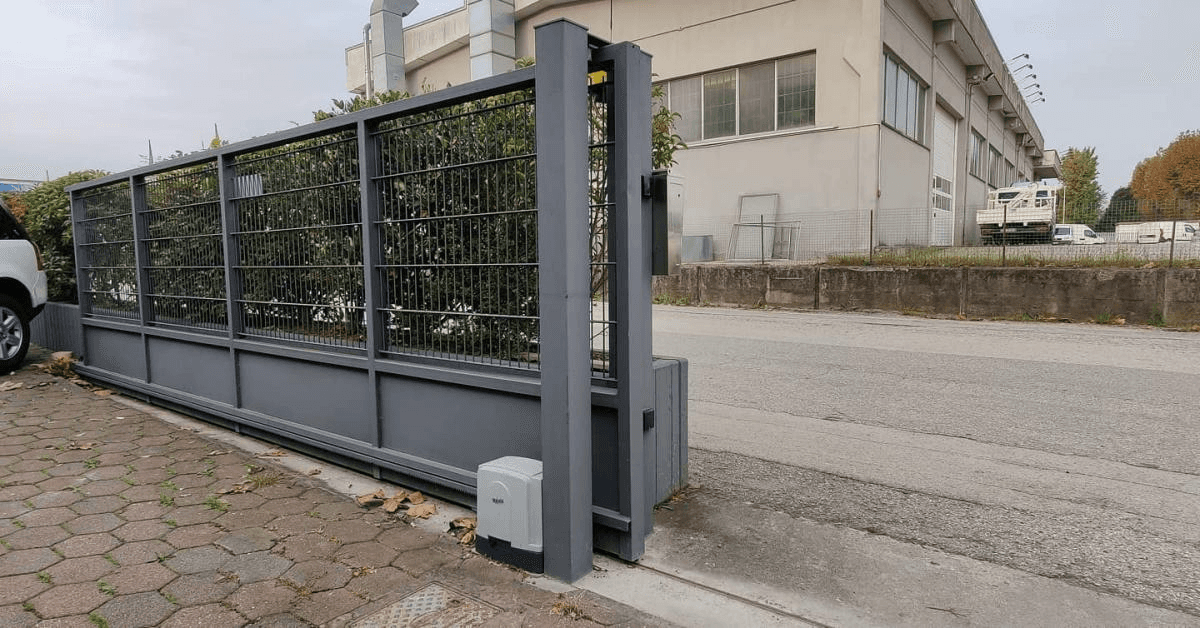
A sliding gate that opens or closes partway and then stops can have several possible causes.
One of the first things to determine is whether it stops in approximately the same position every time.
If it always stops at the same point, inspect the track, rack, rollers, limit devices, and gate structure around that location.
The gate may encounter increased mechanical resistance.
If the stopping position changes, investigate power supply, battery voltage, motor overheating, obstacle-detection settings, wiring, and control-board inputs.
Incorrect limit programming can also cause premature stopping.
Some systems use mechanical limit switches, while others use magnetic limits, encoders, electronic position learning, or combinations of these technologies.
Do not assume that the motor is too small until you have confirmed the gate moves freely manually.
For a correctly sized operator, an abrupt change in performance often indicates that something in the gate or automation system has changed.
6. Motor Runs but the Sliding Gate Does Not Move
This symptom is particularly useful for diagnosis because the motor is clearly receiving a command.
If you can hear the motor or gearbox operating but the gate remains stationary, inspect the mechanical connection between the operator and gate.
First check whether the manual release mechanism is still engaged.
Sliding gate motors normally include an emergency release that disconnects the drive so the gate can be moved manually during a power failure or service operation.
If the motor has not been fully re-engaged afterward, the motor may run without driving the gate.
Next inspect the pinion and gear rack.
A damaged rack, stripped teeth, loose rack section, worn pinion, gearbox failure, or incorrect rack-to-pinion engagement can prevent motion.
The rack should mesh correctly with the pinion without forcing the entire gate weight onto the motor gear.
For example, Nice specifies a small clearance between rack and pinion on some industrial sliding gate operators so that gate weight is not transferred directly onto the gearmotor. The exact required clearance is model-specific and should come from the operator manufacturer.
If the motor runs normally but the pinion itself does not rotate correctly, an internal gearbox or drive problem may require professional service.
7. Sliding Gate Moves Slowly or Struggles Under Load
A gate that has become noticeably slower should not immediately be assumed to need a larger motor.
First perform the manual movement test.
If the gate has become harder to move by hand, look for mechanical causes.
The track may contain debris. Rollers may be worn. The gate may have dropped out of alignment. The rack may be pressing too tightly against the pinion.
For battery-powered DC operators, low battery voltage can also reduce performance.
For AC systems, abnormal supply voltage should be investigated.
Motor temperature can also matter. A sliding gate opener that performs normally when cold but slows or stops after repeated cycles may be approaching its thermal or duty-cycle limit.
This is particularly important in apartment complexes, factories, parking facilities, and commercial entrances where the gate operates far more frequently than a typical residential gate.
Gate weight capacity alone does not determine whether a sliding gate motor is suitable for high-frequency operation.
Professional buyers should compare maximum gate weight with duty cycle, operating speed, motor technology, gearbox design, thermal protection, and expected daily cycles.
8. Sliding Gate Makes Grinding, Clicking, or Jumping Noises
Unusual noise is one of the best early warning signs of a mechanical problem.
A grinding sound near the motor can indicate poor engagement between the pinion and gear rack, worn gear teeth, gearbox wear, or excessive load.
A repetitive clicking sound may occur if teeth are damaged or the rack is incorrectly positioned.
A gate that physically jumps as it travels often indicates rack alignment problems or inconsistent engagement with the pinion.
Inspect the complete rack length.
Individual rack sections should remain aligned with one another, and the spacing between rack and drive gear should remain consistent as the gate moves.
Also inspect the track and rollers.
A worn wheel can cause the gate height to change as it travels, which in turn changes rack-to-pinion engagement.
Loose motor mounting can create additional vibration.
This is why installation quality has a direct effect on sliding gate opener reliability. Even a high-quality motor will wear prematurely if the gate, rack, track, and mounting foundation are incorrectly aligned.
9. Sliding Gate Does Not Stop at the Correct Position
If the gate stops too early, travels too far, or fails to stop at the fully open or fully closed position, inspect the limit system.
Depending on the operator, the system may use mechanical microswitches, magnetic limit switches, electronic limits, or encoder-based position control.
Mechanical limit brackets can move.
Magnets can become displaced.
Wiring can become damaged.
Limit switches can fail.
Programming can also be lost or incorrectly changed.
Nice's sliding gate commissioning instructions specifically require installers to verify the opening and closing limit-switch signals and check their wiring and operation when expected limit indications are not present.
Do not continue repeatedly operating a gate that runs beyond its intended end position.
The gate could strike a mechanical stop, damage the rack or pinion, overload the motor, or create an unsafe condition.
Limit adjustments should be made according to the exact manufacturer's procedure rather than by trial and error.
10. Sliding Gate Opener Works Intermittently
Intermittent faults are often the most difficult problems to diagnose because everything may appear normal when a technician arrives.
The best approach is to identify a pattern.
Does the failure occur only with the remote?
Does it happen after several consecutive operating cycles?
Does it happen during rain?
Does it happen at one particular gate position?
Does it happen only when the gate closes?
Does direct sunlight reach a photocell at that time?
Does the control board show a diagnostic LED or error code when the problem occurs?
Intermittent failures can be caused by loose wiring, water ingress, failing relays, damaged sensors, overheating, low battery voltage, radio interference, control-board faults, or electrical connections that fail only when vibration occurs.
Outdoor gate automation systems operate in a demanding environment.
Temperature changes, moisture, insects, dust, corrosion, vibration, and electrical surges can all contribute to intermittent problems.
Recording the exact symptom, time, weather, gate position, control method, and diagnostic indication can make professional troubleshooting much faster.
How to Tell Whether the Problem Is the Gate or the Opener
This is one of the most valuable diagnostic steps.
Place the gate into manual release mode according to the manufacturer's instructions and move it through its complete travel.
If the gate is difficult to move manually, the mechanical gate system should be corrected before the opener is blamed.
Possible mechanical problems include track damage, wheel wear, gate misalignment, rack problems, guide roller issues, debris, foundation movement, or gate-frame deformation.
If the gate moves smoothly manually but automatic operation remains unreliable, investigate the motor, gearbox, limit system, photocells, power supply, control board, receiver, and connected accessories.
This distinction prevents an installer from replacing a functional gate opener when the real problem is mechanical.
How to Tell Whether the Problem Is the Photocell, Motor, or Control Board
Different symptoms often point toward different components.
Symptom | Most Likely Area |
|---|---|
Gate opens but refuses to close | Photocell or safety input |
Gate does not detect remote but wired button works | Receiver / remote |
Motor makes no sound and control board is dead | Power supply |
Control board works but motor does not respond | Motor circuit / control input / board |
Motor runs but gate stays still | Mechanical drive / manual release |
Gate repeatedly reverses | Photocell / force detection / obstruction |
Gate stops at exactly the same place | Track / rack / limit system |
Gate becomes slow after repeated cycles | Motor temperature / duty cycle |
Gate does not stop at open or close position | Limit switch / magnet / programming |
Random operation | Sensor / wiring / receiver / control board |
This table provides only a diagnostic starting point. The exact control logic varies between brands.
Check the Control Board Diagnostic LEDs Before Replacing Parts
Modern sliding gate control boards often provide one of the most useful troubleshooting tools: diagnostic LEDs, displays, or warning-light flash codes.
Before disconnecting components or changing programming, observe the control board.
Look for indicators associated with photocells, STOP inputs, OPEN/CLOSE inputs, limit switches, radio reception, safety edges, and motor status.
For example, Nice sliding gate systems use different warning-light flash patterns to identify conditions such as photocell activation or excessive motor resistance.
LiftMaster operators similarly provide diagnostic information that can help distinguish power, control-input, safety-device, battery, or motor problems.
The diagnostic table in the specific operator manual should be checked before replacing the control board.
Why Does My Sliding Gate Keep Opening by Itself?
Unexpected gate opening is often blamed on the motor, but the motor usually operates only because it received an opening command.
Possible causes include a faulty remote button, access-control relay, vehicle loop detector, keypad, intercom, timer, external smart-control device, or control-board input.
Radio interference or incorrectly programmed remotes may also need investigation.
Disconnecting accessories one at a time for diagnostic purposes should only be performed according to the manufacturer's instructions and without defeating required safety devices.
If the gate opens unpredictably and creates a security risk, isolate the system and arrange professional inspection.
Why Does My Sliding Gate Close and Immediately Open Again?
This symptom commonly indicates that the operator believes an obstacle or abnormal resistance is present.
Photocells should be checked first.
If they are functioning correctly, inspect the gate for mechanical resistance near the closing position.
The rack, track, rollers, end stops, and gate alignment should all be examined.
An incorrect force setting can also contribute.
Increasing force should not be the first solution.
Find out why the gate is experiencing resistance before changing safety-related settings.
Why Does the Sliding Gate Opener Trip the Breaker or Blow a Fuse?
A repeatedly tripping breaker or fuse is not a normal operating condition.
Possible causes include electrical short circuits, water ingress, damaged wiring, motor faults, control-board faults, incorrect supply voltage, or excessive motor load.
Do not repeatedly reset the breaker or replace a fuse without identifying the cause.
If a replacement fuse fails again, the system requires electrical diagnosis.
Make sure any replacement fuse matches the manufacturer's specified type and rating.
Using a higher-rated fuse to prevent repeated blowing can remove intended circuit protection and create a safety risk.
Weather-Related Sliding Gate Opener Problems
Outdoor gate openers operate through rain, dust, heat, cold, and changing humidity.
Weather can therefore expose weaknesses that are not visible during normal conditions.
After heavy rain, inspect for water ingress around enclosures, underground junction boxes, photocells, and cable entries.
During winter, ice, snow, or frozen debris can increase mechanical resistance.
In hot climates, repeated operation combined with high ambient temperatures can increase motor and control-board temperature.
Lightning and unstable power supplies can damage electronic components.
When selecting a sliding gate opener for demanding climates, professional buyers should therefore consider IP protection, operating temperature, surge protection, enclosure design, cable sealing, and motor duty requirements in addition to gate weight.
When Should You Stop Troubleshooting and Call a Professional?
Simple checks such as replacing a remote battery, cleaning the gate track, removing a visible obstruction, or cleaning photocells can often be performed safely.
Professional service is recommended when the problem involves internal electrical wiring, control-board repairs, repeated fuse failure, gearbox damage, abnormal motor overheating, damaged safety devices, structural gate problems, or unpredictable gate movement.
Do not continue operating an automatic gate when its required safety system is not functioning correctly.
For North American vehicular gate installations, entrapment protection and gate construction are particularly important because UL 325 and ASTM F2200 address automatic operator safety and gate construction requirements.
Repair or Replace a Sliding Gate Opener?
Not every malfunction requires a new sliding gate opener.
Replacing a remote, photocell, limit switch, capacitor, rack section, battery, or another serviceable component may restore reliable operation.
Replacement becomes more reasonable when the motor or gearbox has extensive wear, the control board repeatedly fails, important spare parts are no longer available, the operator is substantially undersized for the gate, or the application has changed.
For example, a residential-grade opener may operate reliably on a private driveway but perform poorly after the site becomes a busy commercial entrance.
In this situation, repeated repairs may not address the underlying problem: the operator was never designed for the required duty cycle.
Professional buyers should therefore consider the total application rather than only the immediate failure.
Why Sliding Gate Opener Sizing Affects Reliability
One common cause of long-term gate opener problems is incorrect motor sizing.
Gate weight is important, but it should not be the only specification used.
A 600 kg gate that moves smoothly may place less demand on an operator than a lighter gate with poor rollers and high mechanical resistance.
Professional selection should consider gate weight, gate length, operating frequency, speed, rack type, site gradient where applicable, motor torque, duty cycle, temperature, wind exposure, and required accessories.
For high-frequency commercial and industrial entrances, duty cycle can be just as important as maximum gate weight.
Using an opener continuously near its operating limit can increase thermal stress and component wear.
How Gear Rack Quality Affects Sliding Gate Opener Problems
The gear rack is one of the most important mechanical components in a sliding gate automation system.
It transfers motor torque from the pinion to the gate.
If the rack is incorrectly aligned, the motor can experience alternating high and low loads as the gate moves.
If the rack is positioned too tightly against the pinion, excessive load may be transferred to the motor bearings and gearbox.
If the gap is too large, the teeth may engage poorly, creating noise, vibration, or jumping.
Individual rack sections must also remain aligned where they join.
Nylon rack and steel rack have different characteristics, but either can operate reliably when correctly selected and installed.
Rack type should be matched to gate weight, application, environment, and operator design.
How Photocell Problems Affect Sliding Gate Reliability
Photocells are frequently blamed when an automatic sliding gate will not close, but sensor problems are not always caused by failed electronics.
Alignment is a common issue.
A post can move slightly after impact or foundation settlement.
Dirt, insects, condensation, vegetation, or water can interfere with detection.
Cable damage can also create intermittent faults.
Before replacing photocells, check alignment, cleanliness, wiring, mounting stability, and the control-board photocell indicator.
A properly functioning photocell system should never be permanently bypassed just to eliminate nuisance faults.
How to Prevent Sliding Gate Opener Problems
Preventive maintenance can identify many problems before the gate completely fails.
The gate should be periodically moved manually to confirm it still travels smoothly.
Tracks should remain clean.
Rollers, guides, rack sections, motor mountings, and gate structure should be inspected for wear or movement.
Photocells should remain clean and securely aligned.
Limit devices should remain firmly positioned.
Electrical enclosures and cable entries should be checked for moisture.
Manual release systems should remain functional.
Unusual noise, vibration, slower movement, repeated reversals, or changes in stopping position should be investigated early.
Maintenance frequency should reflect actual usage.
A residential gate operating a few cycles per day has very different requirements from an apartment complex or industrial entrance operating hundreds of cycles.
What Professional Buyers Should Look for in a Reliable Sliding Gate Opener
For distributors, installers, contractors, and OEM buyers, troubleshooting data provides useful information about product quality.
A reliable sliding gate opener should not be evaluated only by maximum gate weight or motor wattage.
Motor and gearbox quality affect mechanical reliability.
Control-board design influences stable operation and accessory compatibility.
Limit-system quality affects positioning accuracy.
Photocell compatibility influences safety performance.
Weather protection matters for outdoor reliability.
The availability of spare control boards, receivers, limit switches, gears, capacitors, batteries, photocells, and remote controls is also important for long-term product support.
For distributors, a slightly cheaper motor can become expensive if repeated failures generate technician visits, warranty shipments, replacements, and dissatisfied customers.
Frequently Asked Questions About Sliding Gate Opener Problems
Why is my sliding gate opener not working at all?
Start by checking the electrical supply, breaker, fuse, emergency stop, manual release, and control-board indicators. If power reaches the operator but the control board or motor does not respond, professional electrical diagnosis may be required.
Why does my sliding gate open but not close?
A blocked or misaligned photocell is one of the first things to check. An active OPEN input, vehicle detector, access-control relay, safety device, or incorrect auto-close setting can also prevent closing.
Why does my sliding gate motor run but the gate does not move?
The manual release may still be disengaged, or there may be a problem with the pinion, gear rack, gearbox, or mechanical drive connection. Check the release mechanism and visible rack engagement before assuming the motor has failed.
Why does my sliding gate stop halfway?
Possible causes include track resistance, damaged rollers, rack alignment problems, incorrect limits, obstacle detection, low battery voltage, overheating, or control-board issues. If the gate always stops at the same location, inspect that section of the gate path carefully.
Why does my sliding gate reverse before closing?
The operator may be detecting an obstruction. Check photocells, safety devices, track resistance, rack alignment, and control settings. Do not simply increase motor force without finding the cause.
Why is my sliding gate opener making a grinding noise?
Grinding often indicates poor rack-to-pinion alignment, worn gear teeth, gearbox wear, damaged rollers, loose motor mounting, or excessive mechanical resistance. Continued operation can cause additional damage.
Why does my sliding gate remote only work at close range?
Check the remote battery, receiver antenna, antenna cable, radio interference, and transmitter condition. If wired controls work normally, the problem is probably related to the radio-control system rather than the motor.
Why does my sliding gate keep opening by itself?
An external device may be continuously or intermittently sending an OPEN command. Check remotes, access-control systems, keypads, vehicle detectors, timers, intercoms, and control-board inputs.
Can a bad photocell stop a sliding gate from working?
Yes. Depending on the control logic, a faulty, blocked, misaligned, or incorrectly wired photocell can prevent closing or cause the gate to reverse. Diagnostic LEDs on the control board can often help identify this condition.
How do I know if my sliding gate motor needs replacing?
Replacement may be appropriate when the motor or gearbox is badly worn, major components repeatedly fail, spare parts are unavailable, or the operator is unsuitable for the gate weight and operating frequency. Minor sensor, remote, rack, limit-switch, or wiring problems usually do not require complete motor replacement.
Final Thoughts
When a sliding gate opener is not working, replacing the motor should rarely be the first step.
Start with the simplest checks: power supply, remote control, manual release, photocells, obstructions, and diagnostic indicators.
Then determine whether the gate itself moves smoothly manually.
If the mechanical gate is healthy, continue with the limit system, gear rack, pinion, wiring, control inputs, motor, and control board.
The symptom usually provides an important clue.
A gate that opens but will not close often points toward a safety or control input. A motor that runs without moving the gate suggests a mechanical drive problem. A gate that always stops at the same point suggests local resistance or a limit issue. Random failures are more likely to involve wiring, electronics, environmental conditions, or overheating.
For installers and professional buyers, repeated troubleshooting problems also highlight the importance of correct product selection.
A reliable sliding gate automation system requires more than a motor capable of moving the gate once. It requires the correct gate capacity, duty cycle, gearbox, control system, safety devices, environmental protection, rack installation, and long-term spare-parts support.
Looking for Reliable Sliding Gate Opener Solutions?
CHINA-DEVELOP provides sliding gate opener and gate automation solutions for residential, commercial, distributor, installer, contractor, and OEM applications.
Different gate weight capacities, motor configurations, control systems, accessories, safety devices, and automation options can be selected according to the gate size, operating frequency, installation environment, and target market.
For professional buyers, choosing the right sliding gate opener from the beginning can reduce installation problems, service calls, premature motor wear, and long-term maintenance costs.
Other Blogs
