Blog
Sliding Gate Opener Weight Capacity: How to Choose the Right Motor for 500kg, 800kg, 1200kg & 1500kg Gates
Author
Ray
Published
Category
Sliding Gate Opener
Learn how to choose the right sliding gate opener for 500kg, 800kg, 1200kg and 1500kg gates based on weight, length, duty cycle and speed.


Author
Ray
An experienced automation specialist with a strong background in motor technology and industrial solutions. With years of expertise in central motors, tubular motors, and automation systems, the author is dedicated to sharing insights that connect engineering innovation with real-world applications. Passionate about advancing reliable, energy-efficient, and high-performance automation products for global markets.
What’s better than insider perks, pro tips, and surprises?
Sign up to get the most recent blog articles in your email every week.
Join now.
WHY I WRITE THIS
About my business
Our company’s main product lines include tubular motors, sliding gate motors, swing gate motors, roller shutter motors, and other door automation solutions, all manufactured by trusted partner factories we have worked with for many years.
Our Services
I help them with sales and export operations, while our company also provides sourcing and procurement services in China to help international clients solve supply-related challenges. If you need assistance with procurement, please feel free to contact us.
Choosing a sliding gate opener by weight capacity looks simple at first.
If the gate weighs 500 kg, buy a 500 kg opener. If it weighs 800 kg, choose an 800 kg motor.
In practice, professional sliding gate motor selection is more complicated.
A gate opener's maximum weight rating tells you only part of the story. Gate length, rolling resistance, track condition, operating frequency, opening speed, wind exposure, slope, rack-and-pinion condition, motor duty cycle, temperature, and safety margin can all change the actual load placed on the operator.
This is why two gates that both weigh 600 kg may require completely different motors.
A short, perfectly aligned residential gate operating six times per day may work comfortably with a motor that would be unsuitable for a long commercial gate of the same weight operating 150 times per day.
Major gate operator manufacturers also specify more than gate weight. LiftMaster, for example, advises buyers to consider gate type, gate length and weight, and expected daily and hourly cycles when selecting an operator.
This guide explains how to choose between 500 kg, 800 kg, 1200 kg, and 1500 kg sliding gate openers, how much capacity margin you should consider, and which specifications professional buyers should check before purchasing a sliding gate motor.
What Does Sliding Gate Opener Weight Capacity Mean?
A sliding gate opener's weight capacity is the maximum gate mass that the manufacturer has designed or rated the operator to move under specified conditions.
For example, a product described as an 800 kg sliding gate opener is intended for gates up to a published maximum weight of approximately 800 kg when installed and operated within the manufacturer's other requirements.
However, maximum gate weight should not be interpreted as the only operating limit.
Manufacturers often specify maximum gate length separately.
This is important because a long lightweight gate and a short heavy gate impose different mechanical demands on the operator.
Current professional sizing guidance specifically recommends treating gate-weight and gate-length ratings as separate limits instead of assuming that passing one rating automatically means the operator is suitable.
The published capacity should therefore be viewed as a boundary, not automatically as the ideal operating point.
Quick Answer: 500kg vs 800kg vs 1200kg vs 1500kg Sliding Gate Opener
The following table provides a practical starting point.
Opener Class | Typical Application | Relative Load | Typical Usage |
|---|---|---|---|
500 kg | Residential driveways, lightweight gates | Light–Medium | Low to moderate |
800 kg | Larger residential and light commercial gates | Medium | Moderate |
1200 kg | Commercial entrances and heavier gates | Medium–Heavy | Moderate to high depending on operator |
1500 kg | Heavy commercial and industrial gates | Heavy | Depends strongly on duty rating |
This table is only a starting point.
A 1500 kg operator is not automatically a high-cycle industrial operator, and a 500 kg motor is not automatically limited to very low-frequency residential use.
For example, Proteco currently offers 500 kg, 800 kg and 1500 kg sliding operators in one product family with the same published 40% duty-cycle rating, illustrating that weight capacity and duty cycle are separate specifications.
Likewise, some 500–800 kg systems are engineered for very high cycle counts despite their lower gate-weight ratings. One current Australian product range lists 500 kg and 800 kg operators with up to 1,500 cycles per day, showing again that gate weight alone does not define whether a motor is residential or commercial.
Is Gate Weight the Most Important Factor?
Gate weight is one of the first specifications to check, but it is not enough to select a motor professionally.
The three most important starting points are usually:
Gate weight, gate length, and expected operating frequency.
Professional operator-selection guidance consistently emphasizes these three variables because they determine both the mechanical load and how frequently the motor must handle that load.
After those three factors, other project conditions should be considered.
A gate on a clean, perfectly level track requires less effort than the same gate with damaged rollers.
A solid-sheet gate exposed to strong wind may place more variable load on the drive system than an open ornamental gate.
A motor operating ten cycles each day has considerably more cooling time than one operating repeatedly during morning vehicle traffic.
This is why selecting a gate opener solely from a label such as “800 kg” can lead to premature motor or gearbox problems.
500kg Sliding Gate Opener: When Is It Enough?
A 500 kg sliding gate opener is commonly used for residential and lighter commercial gate automation.
It is often suitable for private driveways, villas, residential entrances, small commercial properties, and relatively lightweight steel or aluminum sliding gates.
A typical 500 kg operator may provide more than enough capacity for a gate weighing 300–400 kg when the track is level, the wheels are in good condition, and daily usage is relatively low.
The important point is that the gate should move smoothly before automation is installed.
If a 350 kg gate requires significant manual force to move, selecting a 500 kg motor does not solve the mechanical problem.
The track, rollers, guide system, gate frame, and rack alignment should be corrected first.
CHINA-DEVELOP's current DOG Series includes a 500 kg sliding gate opener configuration, with published specifications including a 150 W motor, 13 m/min gate movement speed and S2 20-minute working duty for the listed configuration.
These specifications demonstrate why buyers should look beyond the “500 kg” figure and evaluate speed and working duty as well.
Should I Use a 500kg Opener on a 500kg Gate?
Generally, it is better not to design a project around continuously operating exactly at the published maximum capacity unless the manufacturer specifically approves the application and all other conditions are favorable.
Maximum capacity does not necessarily represent the ideal long-term working load.
Real installations introduce additional resistance from dirt, bearing wear, rack alignment, temperature changes, wind, foundation movement, and other factors.
Professional sizing guidance therefore recommends maintaining operating headroom instead of treating the maximum rating as the normal target load.
If your gate genuinely weighs close to 500 kg, comparing an 800 kg operator may be reasonable, particularly if the gate is long, frequently operated, exposed to strong weather, or expected to remain in service for many years.
800kg Sliding Gate Opener: When Do You Need More Capacity?
An 800 kg sliding gate opener occupies a useful middle ground between standard residential and heavier commercial automation.
It can be suitable for larger residential gates, apartment entrances, small warehouses, commercial properties, schools, parking facilities, and other medium-duty applications.
An 800 kg motor may also be selected for a substantially lighter gate when greater reserve capacity is desirable.
For example, a 550–600 kg gate may technically fall within a smaller operator's range, but if the entrance operates frequently throughout the day, an 800 kg model with the correct duty rating may be a more appropriate choice.
Current commercial products show how this class varies significantly.
Proteco publishes an 800 kg model at 8.5 m/min with a 40% duty cycle, while another current 800 kg product range lists up to 28 m/min and 1,500 cycles per day.
Both are “800 kg sliding gate motors,” but their intended operating environments are clearly different.
This illustrates a central rule of professional gate motor selection:
Never compare products by maximum gate weight alone.
500kg vs 800kg Sliding Gate Opener
For many residential and light-commercial projects, the real decision is between 500 kg and 800 kg.
If your gate weighs approximately 250–350 kg, operates a few times per day, and rolls easily, a suitable 500 kg operator may provide adequate capacity.
As gate weight approaches the upper portion of the 500 kg range, or operating frequency increases, an 800 kg model becomes more attractive.
The larger operator can also provide additional capacity for future changes.
For example, replacing an open gate infill with heavier steel panels or adding decorative material may increase gate weight.
However, choosing 800 kg is not automatically better if the larger model is slower, consumes more power, has a different duty rating, or costs significantly more without providing a practical advantage.
Compare the complete datasheet.
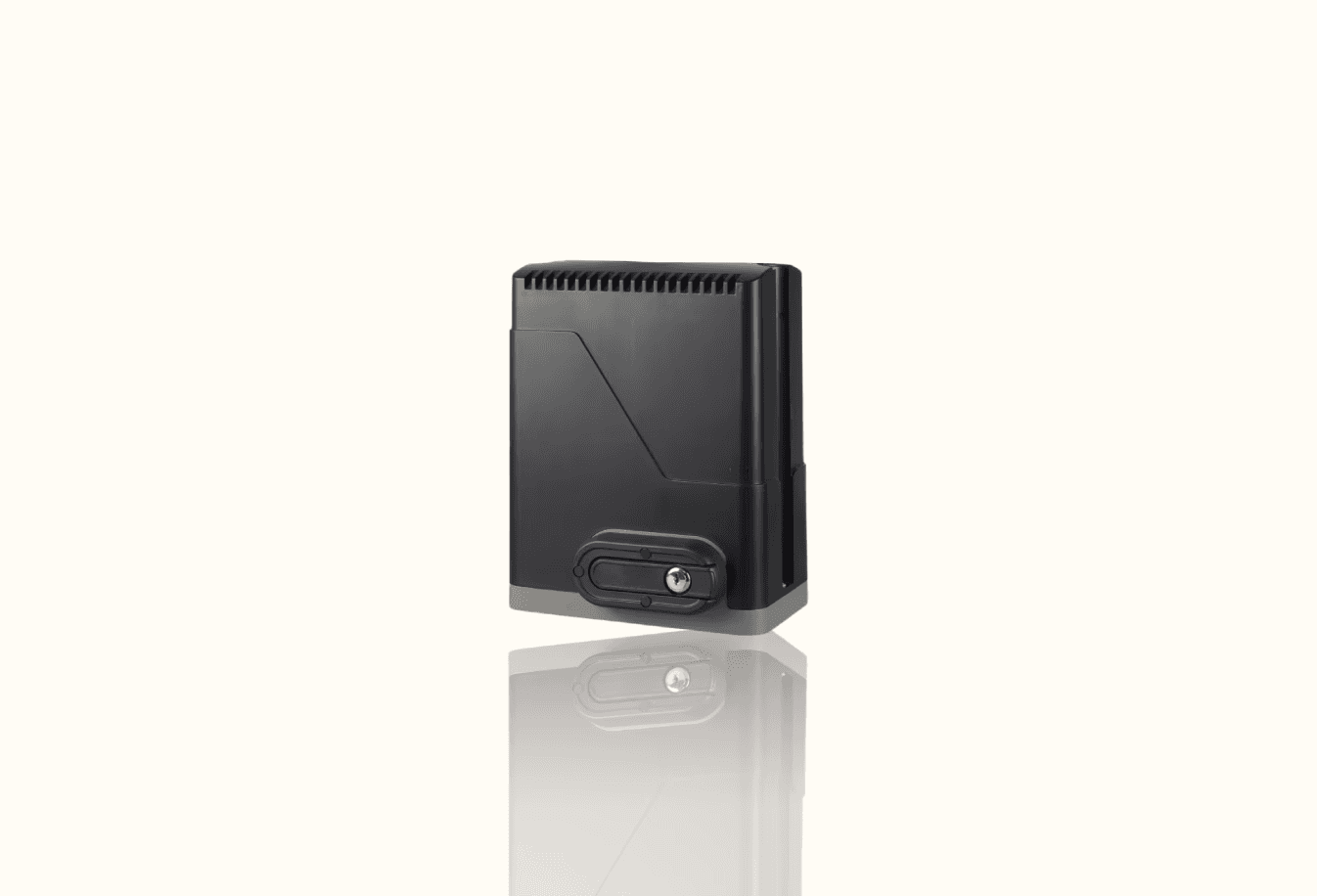
1200kg Sliding Gate Opener: When Is Heavy-Duty Capacity Needed?
A 1200 kg sliding gate opener is generally considered when moving beyond normal residential gates into heavier commercial applications.
Typical applications may include large commercial entrances, logistics sites, factories, warehouses, industrial compounds, apartment complexes, and high-security facilities.
However, even in this weight class, there is significant variation between products.
A 1200 kg gate may require a motor designed around strong torque but moderate cycle frequency, while another application may require high-speed operation and frequent cycles.
Current 1200 kg commercial products illustrate this difference. One market example is positioned specifically as a high-speed operator for gates up to 1200 kg and is intended for applications such as logistics facilities and multi-unit developments where rapid opening is important.
Therefore, when selecting a 1200 kg sliding gate motor, ask two questions:
Can the motor move the gate?
and:
Can it move the gate as frequently and as quickly as the project requires?
The second question is often overlooked.
1500kg Sliding Gate Opener: When Is It Required?
A 1500 kg sliding gate opener is typically selected for heavy commercial and industrial sliding gates.
Common applications include factories, logistics centers, warehouses, industrial compounds, commercial vehicle entrances, large apartment developments, and high-security access points.
At this level, the operator should no longer be evaluated like a simple residential appliance.
Maximum gate length becomes more important.
Duty cycle becomes critical.
Motor and gearbox construction matter more.
Opening speed can affect both security and traffic throughput.
Thermal behavior, limit systems, environmental protection, manual release, control-board capability, and spare-parts support also become significant.
Proteco currently lists a 1500 kg sliding operator with 600 W power, 1000 N maximum thrust, 8.5 m/min opening speed and 40% duty cycle. Meanwhile, other industrial 1500 kg operators are available with much higher cycle capabilities.
Again, both products may carry a “1500 kg” label while serving different applications.
CHINA-DEVELOP's WOLF Series currently covers 600 kg through 1500 kg configurations, with published motor power increasing from 370 W for the 600 kg version to 1000 W for the 1500 kg model.
This makes the 1500 kg class particularly relevant for distributors and installers serving heavier commercial gates.
500kg vs 800kg vs 1200kg vs 1500kg: Which Should You Choose?
A useful comparison is:
Factor | 500 kg | 800 kg | 1200 kg | 1500 kg |
|---|---|---|---|---|
Residential driveway | Excellent | Excellent | Usually unnecessary | Usually unnecessary |
Large residential gate | Possible | Excellent | Depends on design | Usually excessive |
Apartment entrance | Depends on traffic | Good | Very good | Application-specific |
Commercial entrance | Light duty | Good | Excellent | Excellent |
Warehouse / factory | Limited | Application-specific | Good | Excellent |
Heavy industrial gate | No | Usually insufficient | Possible | Preferred class |
Capacity margin | Low–Medium | Medium | High | Highest |
Duty-cycle importance | Important | Very important | Critical | Critical |
Gate-length check | Required | Required | Required | Required |
The correct answer is determined by actual project data rather than building category alone.
Does Gate Length Affect Sliding Gate Motor Size?
Yes.
Gate length should be checked separately from weight.
Consider two gates:
Gate A weighs 700 kg and is 4 meters long.
Gate B also weighs 700 kg but is 10 meters long.
They have the same total weight, but Gate B travels much farther during every opening and closing cycle.
This means the motor operates longer per cycle.
The longer gate may also be more sensitive to track alignment, wind, frame deflection, and rack accuracy.
Professional operator manufacturers therefore commonly publish both a maximum gate weight and maximum gate length.
Current sizing guidance explicitly warns against treating weight as the only capacity limit.
For example, one current range lists gate capacity combinations such as 500 kg with a maximum 6-meter length and 1200–1500 kg models with maximum lengths around 12 meters.
Always check both dimensions.
Why Gate Rolling Resistance Matters
A sliding gate motor does not lift the entire gate vertically.
It moves the gate horizontally along rollers or wheels.
Because of this, the condition of the mechanical system can dramatically change the force required from the motor.
A correctly installed 800 kg gate with high-quality wheels may move more easily than a poorly maintained 450 kg gate.
Common causes of excessive rolling resistance include damaged wheels, worn bearings, debris in the track, bent tracks, poor gate alignment, rack pressure against the pinion, guide roller problems, frame deformation, corrosion, and foundation movement.
Before selecting or upgrading a motor, the gate should be tested manually.
If it does not move smoothly without automation, the mechanical problem should be fixed first.
Oversizing the motor to overcome resistance may hide the problem temporarily while increasing stress on the gearbox, pinion, rack, and motor.
Does Gate Slope Affect Motor Selection?
Yes.
Most tracked sliding gates are designed to operate on a relatively level path.
If the gate travels uphill or downhill, gravity changes the force required during different parts of the operating cycle.
A motor moving a gate uphill must overcome both rolling resistance and part of the gate's gravitational load.
The same gate may then accelerate more strongly in the opposite direction.
Slope applications therefore require manufacturer-specific engineering review and should not be sized using only a standard weight-capacity chart.
If your project has a significant slope, provide the gradient to the gate operator supplier before selecting the motor.
Does Wind Affect Sliding Gate Opener Capacity?
It can, especially for large solid gates.
An open ornamental gate allows much of the wind to pass through.
A solid steel, aluminum, timber, or composite gate behaves more like a large panel.
Strong crosswinds can create significant additional resistance during movement.
Wind load becomes particularly important for long, tall gates installed in coastal regions, exposed industrial sites, high-wind areas, or large open properties.
A motor selected with almost no operating margin may perform normally in calm conditions but struggle during strong winds.
For these installations, gate surface area and local wind conditions should be considered alongside gate weight.
Why Duty Cycle Matters as Much as Gate Weight
Duty cycle describes how much operating time the motor can handle relative to rest or cooling time.
This specification is frequently ignored by buyers.
Imagine two identical 800 kg gates.
The first is installed at a private home and opens eight times per day.
The second is installed at a commercial parking entrance and operates 200 times per day.
The same motor may be mechanically capable of moving both gates, but its thermal and operational requirements are very different.
LiftMaster specifically identifies expected daily and hourly cycles as a key part of gate operator selection.
This is why commercial buyers should ask for the duty rating or cycle specification rather than simply requesting “an 800 kg gate opener.”
What Does S2 20 Minutes Mean?
Some AC sliding gate motors use an S2 short-time duty rating.
For example, CHINA-DEVELOP's DOG Series currently lists S2, 20 min working duty for the published configuration.
S2 refers to short-time duty operation, where the motor operates for a defined period from a cold condition and is then allowed sufficient rest to cool.
It should not be interpreted as unlimited continuous operation.
This becomes important when comparing residential/light-commercial operators with motors designed specifically for high-frequency or continuous-duty applications.
A motor may have an impressive gate-weight rating while still being unsuitable for a busy entrance if the expected cycle frequency exceeds its duty capability.
Is a 1500kg Motor Always Better Than an 800kg Motor?
No.
Bigger capacity does not automatically mean better performance for every project.
A 1500 kg operator may cost more, consume more power, use different installation hardware, and provide no practical advantage for a 300 kg residential gate.
A lighter operator may also offer faster movement, quieter operation, battery compatibility, or other features better suited to the project.
Correct sizing means selecting adequate capacity with appropriate operating margin.
It does not mean choosing the highest weight rating available.
Can I Use an 800kg Opener on a 500kg Gate?
Yes, provided the manufacturer approves the gate dimensions, application, speed, rack configuration, and installation.
Using an 800 kg opener on a 500 kg gate can provide useful capacity margin, particularly when the gate operates frequently or faces challenging environmental conditions.
However, additional capacity should not be used as a substitute for repairing poor wheels, track alignment, or other mechanical problems.
The correct question is not whether the opener can handle more weight than the gate.
The correct question is whether the complete operator specification fits the application.
What Happens If a Sliding Gate Opener Is Undersized?
An undersized opener may work initially, which is one reason sizing errors are sometimes difficult to identify.
Problems may appear gradually.
The gate may start moving more slowly.
The motor may become hotter.
Thermal protection may activate.
The gate may stop halfway.
The gearbox may experience accelerated wear.
Starting under load may become less reliable.
Component lifespan may decrease.
What appears later as an electrical or control-board problem may actually have started as a sizing problem.
Current gate-operator sizing guidance similarly warns that operators used beyond appropriate weight, length, or cycle requirements can develop premature motor and gear problems.
Does Motor Wattage Determine Gate Weight Capacity?
No.
Motor wattage and maximum gate weight are related, but wattage alone cannot determine operator capacity.
Consider current market specifications.
One 500 kg operator can use approximately 250 W while another uses a 120 W motor architecture. A 1500 kg operator may use approximately 600 W in one design and around 1000 W in another.
Different gearbox ratios, motor designs, output speeds, torque characteristics, controllers, and mechanical efficiencies can produce very different gate capacities from similar power ratings.
This is why professional buyers should not compare sliding gate motors only by watts.
Does Gate Speed Affect Motor Selection?
Yes.
Opening speed affects both user experience and motor loading.
Residential gates often prioritize smooth and reliable movement.
Commercial entrances may require faster opening to reduce vehicle waiting time.
High-security facilities may also prefer faster gate movement because shorter open times can reduce unauthorized entry opportunities.
However, moving a heavy gate rapidly places additional demands on acceleration, deceleration, braking, motor control, and mechanical stability.
Current products show significant variation. Some 500–800 kg operators operate around 8–13 m/min, while high-speed products in similar weight categories can exceed 20 or even 30 m/min.
Therefore, gate speed and weight capacity should always be considered together.
AC vs DC Sliding Gate Motors: Does It Affect Capacity?
Both AC and DC motors can be designed for heavy sliding gates.
The choice is not simply that AC is for heavy gates and DC is for light gates.
AC systems are widely used for robust residential and commercial automation.
DC systems can provide advantages such as battery backup, variable speed control, soft start and stop, and efficient integration with solar or low-voltage systems.
Professional buyers should compare the final operator specification rather than choosing solely based on AC or DC architecture.
The important factors remain rated gate capacity, torque, duty, speed, power supply, environmental protection, and application requirements.
Nylon vs Steel Gear Rack for Heavy Gates
The gear rack transfers motor force from the pinion to the sliding gate.
For lighter residential gates, nylon rack with an internal steel core is commonly used because it offers quiet operation and corrosion resistance.
Heavier commercial and industrial gates often use steel rack because of its greater mechanical strength.
However, installation quality is just as important as material.
Incorrect rack alignment can create alternating high and low loads on the pinion and gearbox.
The rack should follow the gate accurately while maintaining the clearance specified by the motor manufacturer.
A 1500 kg motor combined with poorly installed rack will not create a reliable gate system.
How Much Capacity Margin Should You Allow?
There is no universal percentage that should be applied to every gate installation.
The required margin depends on gate length, traffic frequency, wind exposure, mechanical resistance, temperature, slope, operator design, and manufacturer requirements.
The safest professional approach is to avoid treating the published maximum gate weight as the automatic target working load.
If a gate is close to the maximum weight rating and also long, frequently used, exposed to wind, or mechanically demanding, moving up to the next operator class should be considered.
If the gate is substantially below the maximum rating, moves freely, and operates only occasionally, the smaller operator may be fully appropriate.
Use the manufacturer's application limits rather than an arbitrary universal oversizing rule.
Residential vs Commercial Sliding Gate Opener Sizing
Residential and commercial gates should not be sized using exactly the same priorities.
A private driveway gate may operate only a handful of times each morning and evening.
For this application, reliable residential duty, quiet operation, remote control, battery backup, and cost may be the main considerations.
A commercial entrance may experience concentrated traffic at shift changes or during business hours.
Here, duty cycle, opening speed, control-board reliability, thermal performance, access-control integration, photocells, loop detectors, and spare-parts availability become more important.
Industrial gates add another level.
Large gate length, heavy steel construction, high wind exposure, frequent cycles, security requirements, and demanding environmental conditions may justify 1200 kg, 1500 kg, or even larger operator classes.
How to Choose the Right Sliding Gate Opener Step by Step
Professional selection should begin by measuring and evaluating the gate rather than selecting a motor from a catalogue first.
Determine the actual gate weight or obtain a reliable estimate from the gate manufacturer.
Measure the total moving gate length, not only the driveway opening.
Confirm that the gate travels freely from fully closed to fully open.
Estimate the expected daily cycles and, more importantly, peak-hour cycles.
Check whether the gate is solid or open and whether wind exposure is significant.
Confirm whether the track is level.
Determine the required opening speed.
Check the destination power supply, such as 110–120 V / 60 Hz or 220–230 V / 50 Hz.
Then compare the operator's published gate weight, gate length, duty rating, movement speed, environmental rating, and control capabilities.
Only after these conditions are understood should the final operator model be selected.
Information to Give Your Sliding Gate Opener Supplier
For accurate selection, professional buyers should provide a supplier with enough project information to evaluate the complete application.
The most useful information is the gate weight, total gate length, gate height, gate construction, daily and peak-hour cycles, track condition, slope, wind exposure, required opening speed, voltage and frequency, ambient temperature, and access-control requirements.
Providing only “I need an 800 kg sliding gate motor” forces the supplier to make assumptions.
Providing actual gate and application data allows the manufacturer to recommend a system more accurately.
What Should Distributors Check Besides Maximum Gate Weight?
Distributors and OEM buyers should compare far more than 500 kg versus 800 kg versus 1500 kg.
Motor construction affects long-term reliability.
Gearbox materials influence wear.
Duty cycle determines application suitability.
Opening speed affects the target market.
Soft start and stop can improve movement quality.
Mechanical or magnetic limit systems affect setup and maintenance.
IP rating influences outdoor reliability.
Working temperature matters in cold or extremely hot markets.
Control-board interfaces determine whether photocells, warning lights, access control, Wi-Fi modules, loop detectors, and other accessories can be connected.
Manual release is essential during power failure.
Remote-control frequency must suit the intended market.
Spare-parts availability is especially important for distributors because motors, control boards, capacitors, receivers, pinions, limit switches, photocells, and remotes may need replacement over the product's service life.
A professional product comparison should therefore evaluate the complete automation platform rather than simply asking which supplier offers the lowest price per kilogram of gate capacity.
CHINA-DEVELOP Sliding Gate Opener Capacity Options
CHINA-DEVELOP currently offers sliding gate motor ranges covering several capacity levels.
The DOG Series covers 500–800 kg applications and includes AC/DC configurations, while the WOLF Series extends from approximately 600 kg to 1500 kg for heavier gate applications.
This allows distributors and installers to select different motor platforms for residential, commercial, and heavier-duty projects instead of trying to use one operator for every gate.
When selecting a model, the published maximum gate weight should still be checked together with working duty, speed, motor power, voltage, temperature range, control features, and the actual gate installation.
Frequently Asked Questions About Sliding Gate Opener Weight Capacity
What size sliding gate opener do I need?
Start with the gate's actual weight and total moving length, then check operating frequency, track resistance, speed requirements, wind exposure, slope, and the manufacturer's published application limits. Maximum gate weight alone is not enough to select the correct opener.
Is a 500kg sliding gate opener enough for a 400kg gate?
It may be suitable if the gate moves smoothly, its length is within the operator's rating, usage is relatively moderate, and other installation conditions meet the manufacturer's requirements. If the gate is long, frequently operated, exposed to strong wind, or mechanically demanding, an 800 kg model may provide a more appropriate operating margin.
Can I use an 800kg sliding gate opener on a 500kg gate?
Yes, provided the operator is compatible with the gate length, installation and required operation. Additional capacity can provide useful headroom, but a larger motor should not be used to compensate for poor track or roller condition.
What motor do I need for a 700kg sliding gate?
An 800 kg operator may be a logical starting point, but the answer depends on gate length, cycles, speed, track condition, wind exposure and operator duty rating. If the gate is extremely long or operates frequently in a commercial environment, moving to a higher-duty or higher-capacity operator may be appropriate.
What size sliding gate opener do I need for a 1000kg gate?
A motor rated above 1000 kg should generally be evaluated rather than selecting an operator operating exactly at its limit. Depending on the project, a 1200 kg or 1500 kg operator may be appropriate, but gate length and duty requirements must also be checked.
Is a 1200kg sliding gate opener suitable for commercial use?
It can be, but a 1200 kg rating does not automatically mean the operator is designed for high-frequency commercial operation. Check duty cycle, maximum gate length, speed, thermal performance, control features and the manufacturer's application rating.
Is a 1500kg sliding gate opener an industrial motor?
Many 1500 kg operators are designed for heavy commercial or industrial applications, but weight capacity alone does not define industrial duty. Some 1500 kg motors have moderate duty ratings while others are specifically engineered for high-cycle operation.
Does a longer sliding gate need a stronger motor?
Not necessarily a stronger motor in every case, but gate length affects travel time, mechanical alignment and operator usage. Manufacturers commonly specify maximum gate length separately from maximum gate weight, so both limits must be checked.
Can a sliding gate motor be too powerful?
A motor can have substantially more capacity than an application requires. This does not necessarily damage the gate when correctly installed and configured, but it can add cost and provide little practical benefit. Correct sizing is better than simply choosing the largest motor.
What happens if my gate is heavier than the motor rating?
Operating beyond the manufacturer's published maximum capacity can increase motor and gearbox stress, cause overheating, reduce reliability and shorten service life. A correctly rated higher-capacity operator should be selected instead.
Is gate weight or motor wattage more important?
Gate weight is more directly useful for checking the manufacturer's application rating, but neither weight nor wattage should be used alone. Motor torque, gearbox design, speed, duty cycle, gate length and mechanical resistance all influence real-world performance.
How much bigger should my gate opener be than my actual gate weight?
There is no universal percentage that applies to every installation. The appropriate margin depends on gate length, usage frequency, resistance, slope, wind conditions, motor design and manufacturer recommendations. Avoid designing a demanding installation around an operator already operating near its published maximum.
Final Thoughts
Choosing between a 500 kg, 800 kg, 1200 kg and 1500 kg sliding gate opener requires more than comparing the gate's weight with a number printed on the motor.
Weight is the starting point.
Gate length determines how far and how long the operator must run.
Rolling resistance determines how much force is actually required.
Duty cycle determines whether the motor can repeat that work frequently.
Speed affects traffic flow and motor demand.
Wind, slope and environmental conditions can add additional load.
The most important rule is therefore simple:
Do not choose a sliding gate opener only by maximum gate weight.
For a light residential gate operating only a few times per day, a correctly selected 500 kg motor may provide excellent performance.
For larger residential and light-commercial gates, 800 kg is a common and practical class.
As gate size, weight and application demand increase, 1200 kg and 1500 kg operators become more appropriate.
But once a project moves into high-traffic commercial or industrial use, duty cycle and application rating become just as important as weight capacity.
Professional buyers should evaluate the complete system — gate weight, gate length, cycles, speed, motor, gearbox, rack, control board, environmental protection and safety devices — before choosing a model.
That approach produces a sliding gate automation system that is not only powerful enough to move the gate today, but reliable enough to continue moving it for years.
Looking for the Right Sliding Gate Opener for Your Project?
CHINA-DEVELOP provides sliding gate opener solutions covering residential, commercial and heavier gate automation applications, including 500–800 kg DOG Series operators and 600–1500 kg WOLF Series configurations.
For accurate motor selection, provide your gate weight, total length, height, construction, expected daily cycles, required opening speed, voltage, environmental conditions and access-control requirements.
Matching the opener to the complete application — rather than gate weight alone — helps reduce overheating, premature gearbox wear, service calls and long-term operating costs.
Other Blogs
