Blog
Automatic Sliding Door Opener Buying Guide: How to Choose the Right System
Author
Ray
Published
Category
Sliding Gate Motor
Learn how to choose the right automatic sliding door opener based on door weight, motor type, sensors, traffic, safety, installation, and OEM needs.


Author
Ray
An experienced automation specialist with a strong background in motor technology and industrial solutions. With years of expertise in central motors, tubular motors, and automation systems, the author is dedicated to sharing insights that connect engineering innovation with real-world applications. Passionate about advancing reliable, energy-efficient, and high-performance automation products for global markets.
What’s better than insider perks, pro tips, and surprises?
Sign up to get the most recent blog articles in your email every week.
Join now.
WHY I WRITE THIS
About my business
Our company’s main product lines include tubular motors, sliding gate motors, swing gate motors, roller shutter motors, and other door automation solutions, all manufactured by trusted partner factories we have worked with for many years.
Our Services
I help them with sales and export operations, while our company also provides sourcing and procurement services in China to help international clients solve supply-related challenges. If you need assistance with procurement, please feel free to contact us.
Choosing the right automatic sliding door opener is important for ensuring smooth operation, user safety, long-term reliability, and efficient access control.
Automatic sliding doors are widely used in shopping malls, hospitals, hotels, airports, office buildings, supermarkets, restaurants, and other commercial environments. However, different buildings have different requirements for door weight, opening width, traffic frequency, safety sensors, control systems, and motor performance.
A suitable automatic sliding door opener should be selected based on the complete door system rather than only the motor specification.
This guide explains how automatic sliding door openers work, the main components involved, important selection factors, common system types, safety considerations, and what buyers should check when evaluating a supplier or manufacturer.
What Is an Automatic Sliding Door Opener?
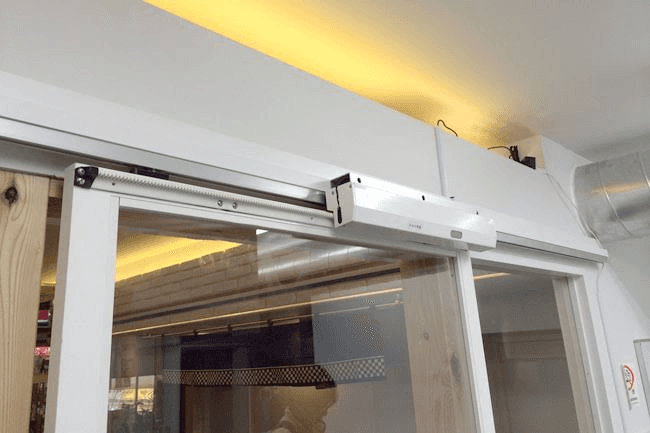
An automatic sliding door opener is a motorized operator that automatically opens and closes a sliding door when it receives a signal from a sensor, access control device, push button, remote control, or other activation system.
The opener normally includes a motor, controller, drive belt, track, hanger system, sensors, and other mechanical and electronic components.
When a person approaches the door, the activation sensor sends a signal to the controller. The controller then operates the motor, which moves the door panels along the track.
After the user passes through the doorway, the control system closes the door according to the programmed delay and safety settings.
Modern automatic sliding door systems can also integrate with access control, building management systems, fire alarm systems, security systems, and smart building platforms.
How Does an Automatic Sliding Door Opener Work?
The basic operating principle is relatively simple.
The system receives an opening command from an activation device.
The controller processes the signal and activates the motor.
The motor transfers movement through a belt or other drive mechanism.
The door hanger moves along the track and opens the sliding panel.
Safety sensors monitor the doorway while the door is moving.
After a programmed hold-open time, the controller closes the door.
If an obstruction or person is detected in the doorway, the safety system can delay closing, stop movement, or reopen the door depending on the system configuration.
Although the process appears simple, reliable operation depends on accurate coordination between the motor, controller, sensors, mechanical system, and door panels.
Main Components of an Automatic Sliding Door Opener
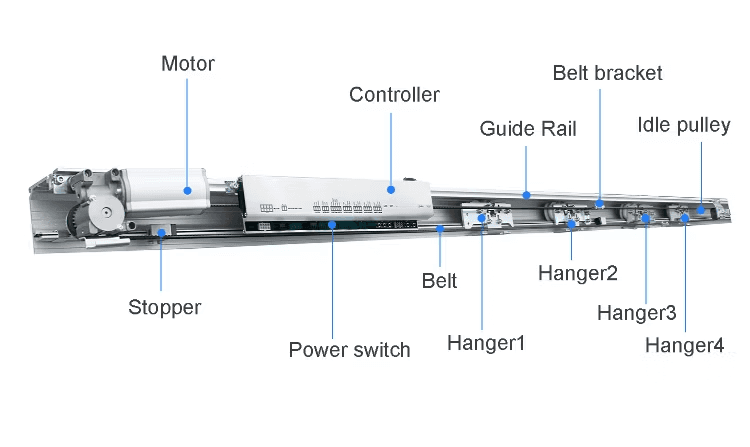
Understanding the main components makes it easier to compare automatic sliding door systems.
Motor
The motor provides the mechanical power required to move the door.
Motor quality affects operating noise, opening speed, acceleration, service life, and overall reliability.
Modern automatic sliding door systems commonly use DC motors, and many premium systems use brushless DC motors because they can provide quiet operation, efficient control, and reduced mechanical wear.
The motor should be selected according to the total door weight, required speed, operating frequency, and application environment.
Control Unit
The controller acts as the central control system of the automatic door.
It manages motor movement, opening speed, closing speed, acceleration, deceleration, hold-open time, safety response, and input signals from sensors or access control devices.
A reliable controller should provide stable operation and allow appropriate system adjustments for the installation environment.
Drive Belt
Many automatic sliding door systems use a toothed belt to transfer motor movement to the door hanger.
The belt should provide sufficient tensile strength while operating smoothly and quietly.
Poor belt quality can result in vibration, noise, stretching, inconsistent movement, or premature replacement.
Track
The track supports the door hangers and guides the sliding panels.
Track accuracy directly affects smooth movement.
A poorly manufactured or incorrectly installed track can create friction, vibration, noise, or uneven door movement.
Hanger and Roller System
The hanger connects the door panel to the track.
Rollers allow the door to move smoothly along the track.
Roller quality is especially important in commercial buildings where the door may operate hundreds or thousands of times over a long period.
Activation Sensors
Activation sensors detect an approaching user and send an opening command to the controller.
Common technologies may include microwave motion sensors, infrared sensors, push buttons, touchless switches, card readers, and access control systems.
The correct activation method depends on the building and application.
Safety Sensors
Safety sensors help prevent the door from closing while a person or object remains in the doorway.
Safety devices may include presence sensors, infrared curtains, photoelectric sensors, or other detection systems depending on the door design.
These components are critical for safe automatic door operation.
Types of Automatic Sliding Door Openers
Automatic sliding door systems can be configured in several ways depending on the building entrance and available space.
Single Sliding Door Opener
A single sliding door system uses one moving door panel.
The panel opens toward one side of the doorway.
This type of system is suitable where the opening width is limited or where there is sufficient wall space on one side for the door panel.
Single sliding systems are commonly used in smaller commercial entrances, offices, clinics, shops, and interior applications.
Bi-Parting Automatic Sliding Door
A bi-parting system uses two sliding panels that move in opposite directions.
Both panels open from the center.
This design provides a wider clear opening and is widely used in shopping centers, hotels, hospitals, airports, and high-traffic entrances.
Bi-parting systems require sufficient space on both sides of the opening for the door panels.
Telescopic Automatic Sliding Door
Telescopic sliding doors use multiple panels that slide together in a compact arrangement.
They are designed to maximize clear opening width where limited side space is available.
Telescopic systems are commonly used in hospitals, commercial buildings, premium retail environments, and architectural projects where a wider opening is required without increasing the overall wall space.
Because of the additional moving panels and mechanical complexity, telescopic systems require precise installation and higher-quality components.
Heavy-Duty Automatic Sliding Door
Heavy-duty systems are designed for larger or heavier door panels and applications with frequent operation.
These systems may use stronger motors, reinforced tracks, higher-capacity hangers, and more robust control components.
They are commonly used in transportation facilities, large commercial entrances, industrial buildings, hospitals, and other demanding environments.
How to Choose the Right Automatic Sliding Door Opener
Selecting the right automatic sliding door opener requires more than simply choosing a motor with the highest power rating.
Several factors should be evaluated together.
Door Weight
Door weight is one of the first specifications that should be checked.
The opener must be capable of moving the total door panel weight within the manufacturer's rated operating range.
Glass doors, framed doors, insulated doors, and large architectural panels can have very different weights even when their dimensions are similar.
Professional buyers should therefore calculate or confirm actual panel weight rather than selecting a system based only on door width.
Door Width
The total door width and clear opening width affect the required track length, door configuration, and motor setup.
A single sliding system and a bi-parting system may have very different hardware requirements even when the clear opening is similar.
The available side space must also be considered.
Door Height
Door height affects panel weight, wind load, structural requirements, and overall system stability.
Tall glass doors may require stronger framing, hangers, or track systems even if their width is not particularly large.
Traffic Frequency
A door used twenty times per day has very different operating requirements from a hospital entrance operating continuously throughout the day.
High-traffic applications require systems designed for frequent cycling.
In these environments, motor durability, controller reliability, roller quality, belt performance, and heat management become more important.
Hotels, supermarkets, hospitals, airports, and transportation facilities should typically prioritize system reliability over the lowest purchase price.
Opening and Closing Speed
Automatic sliding doors must provide a balance between efficient access and safe operation.
Fast opening can improve pedestrian flow, while controlled closing can reduce collision risks and energy loss.
Modern controllers often allow opening and closing speeds to be adjusted within defined operating parameters.
The ideal speed depends on doorway size, traffic volume, user type, and safety requirements.
Noise Level
Noise is especially important in hotels, hospitals, offices, luxury retail stores, residential buildings, and other quiet environments.
Motor design, belt quality, track accuracy, roller construction, and installation quality all affect operating noise.
A high-quality brushless motor system can help reduce noise, but the complete mechanical system must also be correctly designed and installed.
Installation Space
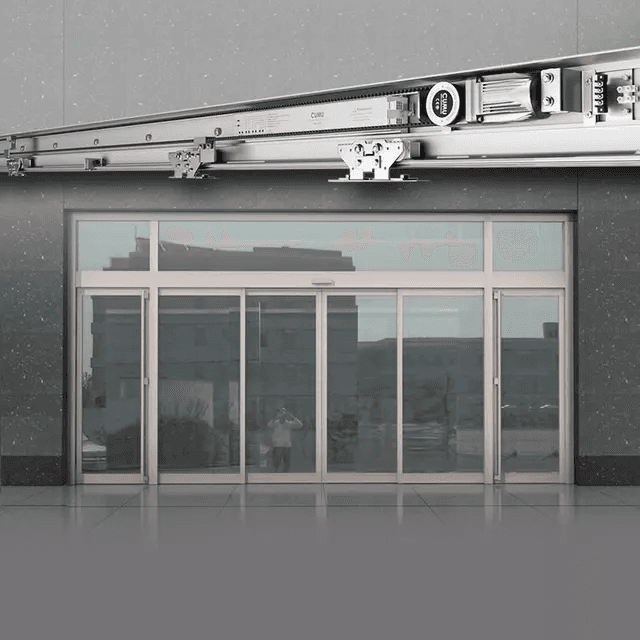
Automatic sliding door operators are usually installed above the doorway inside an operator cover.
The available header space must be sufficient for the track, motor, controller, belt, hangers, and other components.
Projects with limited installation space may require compact operator systems.
Ceiling height, structural support, wall condition, and access for future maintenance should also be evaluated before installation.
Brushless vs Brushed Motor for Automatic Sliding Doors
Motor type is an important factor when selecting an automatic sliding door opener.
Brushed Motor
A traditional brushed DC motor uses brushes to transfer electrical current to the rotating motor components.
Brushed motors are relatively simple and can provide reliable performance at a lower manufacturing cost.
However, the brushes are mechanical wear components.
Over long-term operation, they may require maintenance or replacement depending on usage conditions.
Brushless Motor
A brushless DC motor eliminates mechanical brushes and uses electronic control to manage motor operation.
This design can provide several advantages for automatic sliding door applications.
Brushless motors typically offer quieter operation, improved efficiency, more precise speed control, lower mechanical wear, and longer maintenance intervals.
These characteristics make brushless systems especially suitable for high-traffic commercial environments.
However, motor quality still depends on the complete design.
A poorly designed brushless motor system is not automatically better than a high-quality brushed motor system.
The controller, gearbox, bearings, mechanical alignment, and production quality all affect real-world performance.
Automatic Sliding Door Openers for High-Traffic Buildings
High-traffic buildings require more demanding automatic door systems.
Hospitals
Hospitals require reliable, smooth, and accessible entrances.
Automatic sliding doors are commonly used in emergency departments, main entrances, treatment areas, operating environments, and internal corridors.
The system should provide dependable operation, appropriate safety detection, and compatibility with access control or hygiene-related requirements where necessary.
Quiet operation is also valuable in healthcare environments.
Shopping Malls and Retail Stores
Retail entrances may operate continuously throughout business hours.
Automatic sliding doors help maintain pedestrian flow while creating convenient access for customers carrying bags, pushing carts, or using wheelchairs.
Durability and sensor performance are especially important because of the high operating frequency.
Hotels
Hotels often prioritize quiet operation, smooth movement, appearance, and guest experience.
Automatic sliding doors can also be integrated with building security or access control systems.
Airports and Transportation Facilities
Airports, train stations, and transportation terminals require heavy-duty automatic door systems capable of handling extremely high pedestrian traffic.
System reliability, maintainability, safety, and spare-part availability are critical in these applications.
Office Buildings
Automatic sliding doors can improve accessibility and provide a professional entrance for office buildings.
They can also integrate with card readers, security systems, and building access control.
What Sensors Does an Automatic Sliding Door Need?
The sensor system is one of the most important parts of an automatic sliding door.
An automatic door usually requires both activation and safety detection.
Activation sensors identify when someone intends to use the door.
Safety sensors monitor the doorway and surrounding movement to reduce the risk of contact during opening or closing.
A commercial entrance may use multiple sensors to create overlapping detection zones.
The exact sensor configuration should be selected according to the door design, local safety requirements, pedestrian flow, and installation environment.
Professional buyers should avoid evaluating an automatic sliding door opener based only on the motor.
A strong motor combined with poor sensor performance can still result in an unreliable or unsafe system.
Automatic Sliding Door Opener and Access Control Integration
Modern automatic sliding door systems can integrate with many different access control technologies.
Common options include card readers, keypads, biometric systems, facial recognition devices, push buttons, remote controls, intercom systems, building management systems, and fire alarm interfaces.
For example, an office entrance may remain locked until an authorized user presents an access card.
The access control system then sends a signal to the automatic door controller, allowing the door to open.
Different projects may require different operating modes.
Some buildings require automatic opening during business hours and access-controlled operation after hours.
Others may require doors to unlock, open, or change operating mode when a fire alarm signal is received.
These requirements should be considered during system design rather than added after installation.
Smart Features in Modern Automatic Sliding Door Systems
Automatic sliding door technology is increasingly integrated with intelligent building systems.
Depending on the product and project, smart functions may include remote monitoring, operating-status reporting, fault diagnostics, adjustable operating modes, access-control integration, scheduled operation, traffic monitoring, and building management system communication.
For facility managers, remote diagnostic capability can be especially useful.
Instead of waiting until the door completely stops operating, maintenance teams may be able to identify abnormal performance earlier.
For distributors and system integrators, smart functions can also differentiate premium automatic door products from basic entry-level systems.
Automatic Sliding Door Installation Requirements
Correct installation has a major impact on system performance.
Even a high-quality operator can perform poorly if the track is not level, the door panels are incorrectly aligned, the sensor positions are wrong, or the system parameters are not configured properly.
The supporting structure must be strong enough to support the operator and moving door panels.
The track must be accurately aligned.
Door hangers and rollers should move smoothly.
Electrical power and control wiring should be installed correctly.
Sensors should be positioned according to the system requirements.
After installation, opening speed, closing speed, hold-open time, safety response, and travel limits should be tested and adjusted.
Professional installation is particularly important for commercial entrances where the door operates frequently.
Automatic Sliding Door Maintenance
Regular maintenance helps improve reliability and extend the life of the system.
The track should be kept clean and free from debris.
Rollers and hangers should be inspected for wear.
The drive belt should be checked for tension and condition.
Sensors should be kept clean and properly aligned.
Electrical connections should be inspected.
Door movement should remain smooth and consistent.
Abnormal noise, vibration, slow movement, irregular opening, or repeated sensor faults should be investigated early.
Maintenance intervals depend on operating frequency and environment.
A hospital entrance operating continuously will require more frequent inspection than a low-traffic interior office door.
Common Mistakes When Choosing an Automatic Sliding Door Opener
Choosing Only Based on Motor Power
A powerful motor does not guarantee a reliable automatic door.
The controller, track, rollers, belt, sensors, and installation quality are equally important.
Ignoring Traffic Frequency
A system designed for light commercial use may not provide sufficient long-term durability for an airport or hospital entrance.
Always consider expected operating cycles.
Selecting Based Only on Price
Very low-cost systems may use lower-quality motors, belts, rollers, electronic components, or sensors.
For commercial buyers, the cost of failure can exceed the original equipment savings.
Ignoring Spare Parts
Automatic doors are long-term building systems.
Buyers should confirm whether replacement belts, rollers, sensors, controllers, remotes, and other components will remain available.
Ignoring Sensor Quality
A reliable motor combined with poor sensors can result in false activation, delayed closing, repeated errors, or user complaints.
Choosing the Wrong Door Configuration
Single sliding, bi-parting, and telescopic systems have different space and hardware requirements.
The correct configuration should be selected before specifying the operator.
What Should Buyers Check When Choosing an Automatic Sliding Door Opener Manufacturer?
For distributors, contractors, installers, and OEM buyers, choosing the right manufacturer requires more than comparing quotations.
Product Range
A capable supplier should be able to provide systems for different applications, such as single sliding doors, bi-parting doors, heavier doors, and different commercial environments.
Motor and Controller Quality
Buyers should understand the motor type, rated door capacity, control system, operating parameters, and expected application range.
Production Quality Control
A professional manufacturer should have defined procedures for incoming component inspection, assembly control, functional testing, motor testing, sensor verification, and final product inspection.
Testing Capability
Buyers should ask how the manufacturer tests opening and closing performance, load capacity, operating noise, control functions, durability, and safety response.
A sample that operates correctly for several minutes does not prove long-term production consistency.
OEM Capability
OEM automatic sliding door opener projects may include logo customization, operator cover design, packaging, manuals, sensor configurations, remote controls, access-control interfaces, motor specifications, and software settings.
Professional manufacturers should clearly explain which changes are standard customization and which require additional engineering.
Technical Support
Installation manuals, wiring diagrams, parameter instructions, troubleshooting support, spare parts, and after-sales communication are important for distributors and installers.
Automatic door systems are more technical than many simple building products, so supplier support can significantly affect customer satisfaction.
Certifications and Market Requirements
Automatic door requirements can vary by market and project.
Professional buyers should confirm which standards, electrical requirements, safety requirements, and certifications apply in the destination country before placing an order.
Do not assume that one product configuration is automatically suitable for every international market.
How to Compare Automatic Sliding Door Opener Suppliers
When comparing suppliers, avoid evaluating only the unit price.
A more complete supplier comparison should include product reliability, motor design, controller performance, sensor quality, track and roller quality, operating noise, production capacity, testing procedures, certifications, spare parts, warranty policy, customization support, lead time, and technical communication.
For distributors, failure rate can have a major impact on total cost.
A slightly cheaper operator may become more expensive if it produces repeated warranty claims, technician visits, replacement shipments, customer complaints, and lost future business.
For B2B buyers, total lifecycle cost is often more important than the initial factory quotation.
Frequently Asked Questions About Automatic Sliding Door Openers
What is an automatic sliding door opener?
An automatic sliding door opener is a motorized system that opens and closes sliding doors automatically. It typically includes a motor, controller, track, belt, hangers, activation sensors, safety sensors, and control accessories.
How do I choose the right automatic sliding door opener?
Start by considering door weight, door width, door height, traffic frequency, opening speed, installation space, sensor requirements, access control, and operating environment. The selected system should fall within the manufacturer's rated application range.
What motor is best for an automatic sliding door?
Both brushed and brushless DC motors can be used. Brushless motors are commonly preferred for premium or high-frequency commercial systems because they can provide quiet operation, precise control, high efficiency, and reduced mechanical wear.
What is the difference between a single sliding and bi-parting automatic door?
A single sliding door uses one moving panel that slides to one side. A bi-parting system uses two moving panels that open from the center in opposite directions. Bi-parting systems generally provide a wider and more symmetrical entrance.
Are automatic sliding doors suitable for hospitals?
Yes. Automatic sliding doors are widely used in hospitals because they provide hands-free access, support pedestrian flow, and can accommodate wheelchairs, stretchers, and medical equipment. The operator and sensor system should be selected for the required traffic level and application.
Can automatic sliding doors connect to access control systems?
Yes. Many systems can integrate with card readers, keypads, biometric devices, push buttons, intercom systems, security systems, and other access-control technologies.
How often should an automatic sliding door be maintained?
Maintenance frequency depends on usage and environment. High-traffic doors should be inspected more frequently than low-use doors. Tracks, rollers, belts, sensors, wiring, door alignment, and operating performance should be checked regularly.
What causes automatic sliding doors to stop working?
Common causes include power problems, sensor faults, belt issues, controller errors, motor problems, track obstruction, roller wear, wiring problems, or incorrect system settings.
How long does an automatic sliding door opener last?
Service life depends on operating cycles, motor quality, mechanical components, installation, environment, and maintenance. A properly selected and maintained commercial system can provide many years of service.
Can automatic sliding door openers be customized for OEM brands?
Yes. Many manufacturers provide OEM and private-label services. Customization may include branding, packaging, manuals, covers, control functions, remotes, sensors, access-control interfaces, and other product configurations depending on project requirements.
Final Thoughts
Choosing the right automatic sliding door opener requires evaluating the complete system rather than focusing on one specification.
Door weight, opening width, traffic frequency, motor design, controller quality, sensor performance, track construction, installation space, smart controls, and access-control requirements all affect the final choice.
For a low-traffic office entrance, a standard commercial opener may be sufficient.
For hospitals, shopping malls, hotels, airports, and other high-traffic environments, durability, sensor reliability, motor performance, and technical support become much more important.
For distributors, installers, contractors, and OEM buyers, supplier selection is equally important.
A reliable automatic sliding door manufacturer should provide stable product quality, clear technical specifications, appropriate testing, spare-part support, customization capability, and long-term supply reliability.
The best automatic sliding door opener is not simply the system with the strongest motor or the lowest price. It is the system that correctly matches the door, building environment, pedestrian traffic, safety requirements, and expected service life.
Looking for Automatic Sliding Door Opener Solutions?
CHINA-DEVELOP provides automatic sliding door opener and door automation solutions for commercial buildings, distributors, installers, contractors, and OEM partners.
Different motor capacities, control systems, sensors, door configurations, access-control options, and customization solutions can be selected according to project and target-market requirements.
For professional buyers, automatic sliding door sourcing should be evaluated based on compatibility, product reliability, safety performance, technical support, OEM capability, spare-part availability, and long-term supply stability.
Other Blogs