Blog
How a Sliding Gate Motor Works: A Simple Guide
Author
Ray
Published
Category
Sliding Gate Motor
Learn how a sliding gate motor works, which parts matter, and how to choose the right automatic sliding gate system for home or commercial use.

Author
Ray
An experienced automation specialist with a strong background in motor technology and industrial solutions. With years of expertise in central motors, tubular motors, and automation systems, the author is dedicated to sharing insights that connect engineering innovation with real-world applications. Passionate about advancing reliable, energy-efficient, and high-performance automation products for global markets.
What’s better than insider perks, pro tips, and surprises?
Sign up to get the most recent blog articles in your email every week.
Join now.
WHY I WRITE THIS
About my business
Our company’s main product lines include tubular motors, sliding gate motors, swing gate motors, roller shutter motors, and other door automation solutions, all manufactured by trusted partner factories we have worked with for many years.
Our Services
I help them with sales and export operations, while our company also provides sourcing and procurement services in China to help international clients solve supply-related challenges. If you need assistance with procurement, please feel free to contact us.
A sliding gate motor works by turning electrical energy into controlled horizontal movement. In a typical system, the motor drives a small gear that engages with a gear rack fixed to the gate. When the control board receives a command from a remote, keypad, sensor, or access control system, it powers the motor in the correct direction. The gate then slides open or closed along its track while built-in safety devices and limit controls help manage speed, stopping points, and obstacle detection.
Key Takeaways
A sliding gate motor moves a gate sideways by driving a gear against a rack attached to the gate.
The core system usually includes a motor, gearbox, control board, gear rack, limit switches, and safety devices.
A sliding gate opener does more than move the gate. It also controls timing, stopping points, and safety functions.
Residential and commercial systems work on the same principle, but they differ in power, duty cycle, and durability.
Choosing the right motor depends on gate weight, gate length, frequency of use, site conditions, and safety requirements.
Good installation and regular maintenance matter as much as motor power.
What Is a Sliding Gate Motor?
A sliding gate motor is the drive unit that automates a gate designed to move sideways rather than swing inward or outward. Instead of pushing the gate on hinges, the motor pulls or drives the gate along a track or cantilever system.
People often use several terms interchangeably, including automatic sliding gate motor, electric sliding gate motor, sliding gate opener, and sliding gate operator. In practice, they all refer to the automation system that opens and closes a sliding gate with minimal manual effort.
This type of automation is common in homes, factories, warehouses, logistics yards, apartment complexes, farms, and commercial entrances. It is especially useful where space is limited or where heavier gates require more consistent, controlled movement.
How Does a Sliding Gate Motor Work?
At a basic level, the sliding gate motor working principle is simple: the motor rotates, a gear transfers that motion to the gate, and the gate slides along its path.
Here is the short version:
A user sends a command through a remote, keypad, intercom, card reader, button, or sensor.
The control board processes that command.
The motor turns in the required direction.
A drive gear on the motor engages with a gear rack mounted on the gate.
The gate moves open or closed.
Limit switches or programmed travel settings tell the system when to stop.
Safety devices monitor for obstacles and can stop or reverse movement when needed.
That is the essential answer to how does a sliding gate motor work. The real sophistication lies in how the system manages force, speed, stopping precision, and safety.
Featured Snippet Answer
How does a sliding gate motor work?
A sliding gate motor works by using an electric motor to rotate a drive gear that meshes with a gear rack attached to the gate. When the system receives an open or close signal, the motor turns the gear, moving the gate horizontally along its track. A control board manages the motion, while limit switches and safety devices help stop the gate at the correct position and prevent accidents.
The Main Parts of a Sliding Gate Motor System
To understand parts of a sliding gate motor and how it works, it helps to break the system into its core components.
Motor and gearbox
The motor is the power source. In many systems, the motor works with a gearbox that reduces speed and increases torque. That matters because a gate usually needs strong, controlled pulling force rather than high rotational speed.
The gearbox allows the system to move a heavy gate steadily and with more precision.
Control board
The control board is the system’s decision center. It receives signals from user inputs and safety devices, then tells the motor when to start, stop, slow down, or reverse.
On more advanced systems, the control board may also manage:
soft start and soft stop
auto-close timing
partial opening for pedestrian access
obstacle sensitivity
integration with access control systems
Gear rack and drive gear
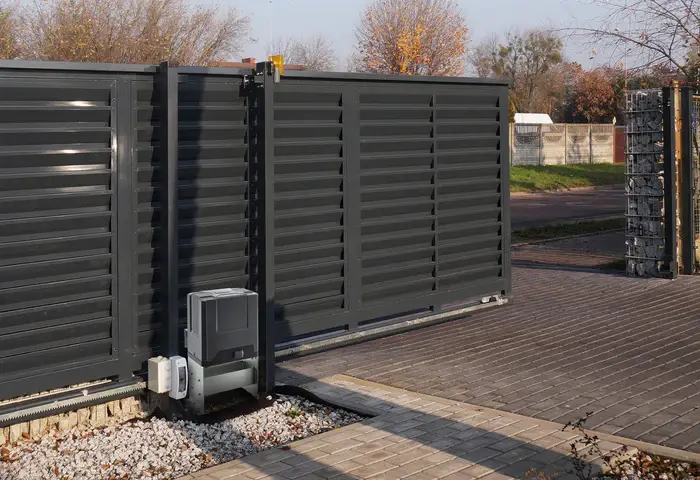
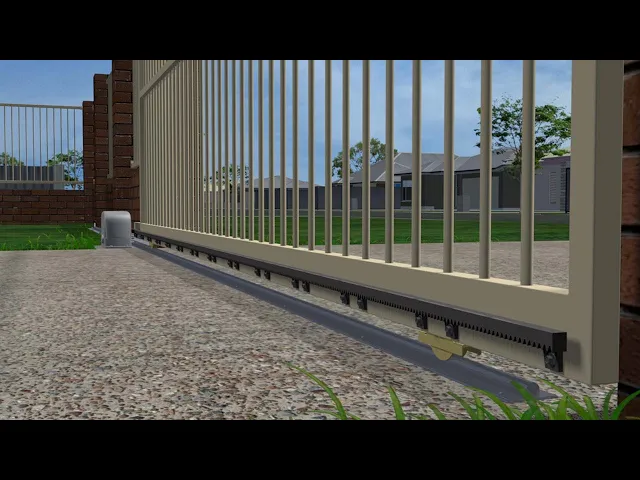
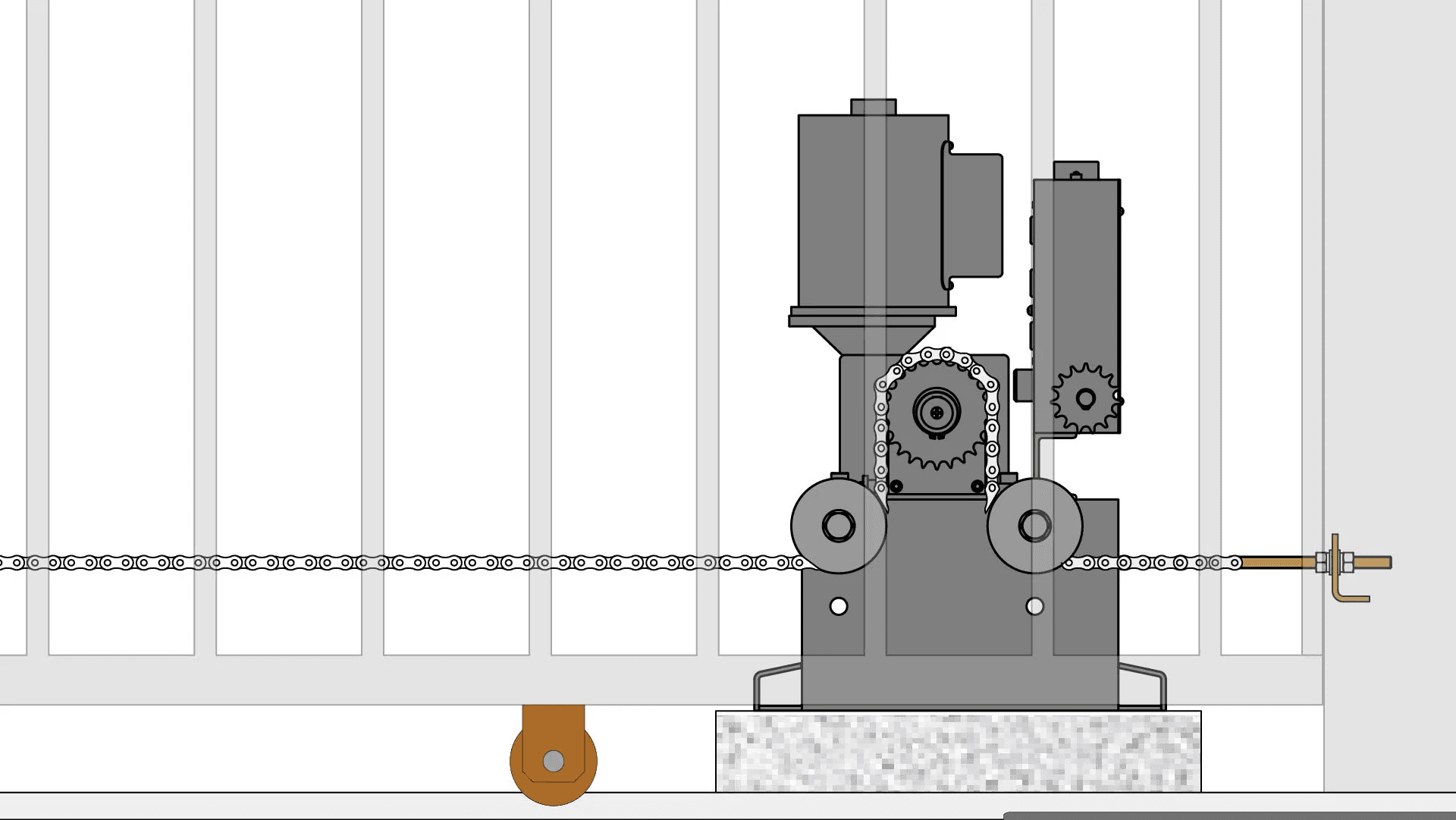
This is the mechanical link between the motor and the gate. The motor spins a pinion gear, and that gear engages with a rack mounted along the gate. As the gear rotates, the gate is pushed or pulled sideways.
This rack-and-pinion setup is central to the sliding gate motor mechanism.
Limit switches
Limit switches tell the system when the gate has reached its fully open or fully closed position. Some systems use physical limit stops, while others rely on magnetic or electronic sensing.
Without proper travel limits, the gate may overrun its intended position or place unnecessary stress on the operator.
Safety devices
Safety devices are a crucial part of any sliding gate automation system. These may include photocells, obstacle detection, edge sensors, or current-sensing protection.
Their job is to reduce the risk of injury, vehicle impact, or mechanical damage.
Manual release mechanism
If power fails or the system malfunctions, the manual release allows the gate to be operated by hand. This is especially important for emergency access and day-to-day practicality.
Step-by-Step: What Happens When the Gate Opens and Closes
For anyone asking how a sliding gate motor works step by step, here is the full sequence in plain language.
1. The system receives a command
The opening cycle begins when the system receives an instruction. That command might come from:
a handheld remote
a keypad
an intercom
a vehicle loop detector
a push button
a smart access system
2. The control board checks the conditions
Before moving the gate, the control logic may check whether the system is safe to operate. For example, it may verify that safety sensors are clear or that the gate is not already in motion.
3. The motor starts turning
The control board sends power to the motor. The motor spins in the required direction, and the gearbox helps convert that motion into usable torque.
4. The drive gear moves the gate
As the pinion gear rotates against the rack, the gate slides along its guide path. In a tracked system, the gate rolls along wheels on a ground track. In a cantilever system, the gate is supported without a ground track, but the motorized movement principle is similar.
5. The gate slows or stops at the set position
When the system reaches its programmed or sensed endpoint, it stops the motor. Better systems may slow down near the end of travel to reduce shock and wear.
6. The system waits, then closes if programmed
Some gates stay open until another command is given. Others have an automatic close timer. If auto-close is enabled, the gate will close after a delay, provided the safety zone remains clear.
7. Safety features interrupt movement if needed
If a sensor detects an obstacle, the system may stop or reverse. The exact behavior depends on how the control board is configured and what safety components are installed.
This is the practical answer to how do sliding gate motors open and close: a controlled sequence of signal input, motor drive, rack movement, position control, and safety monitoring.
Residential vs. Commercial Sliding Gate Motors
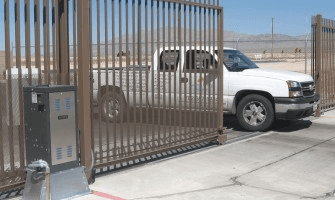
The working principle stays mostly the same, but the design requirements can be very different.
How does a residential sliding gate motor work?
A residential unit is usually built for lighter gates and lower daily traffic. It may prioritize quiet operation, compact design, and ease of use. Many residential systems support remotes, keypad access, and basic safety accessories.
For homes, the biggest considerations are usually:
gate weight
convenience
appearance
low noise
power backup during outages
How does a commercial sliding gate motor work?
A commercial operator is typically designed for heavier gates, more frequent cycles, and tougher site conditions. It may need to handle high traffic volume, longer gates, stricter security expectations, and more robust safety integration.
Commercial systems often require:
higher duty cycle
stronger housing and drivetrain
better thermal management
integration with access control and security systems
more durable racks, rollers, and hardware
So while the answer to how does a commercial sliding gate motor work is mechanically similar, the operating environment is usually more demanding.
What Powers a Motorized Sliding Gate System?
An electric sliding gate motor usually runs on mains power, though system design can vary by market and application. Some installations also include battery backup, solar support, or external backup power arrangements.
In practical terms, a motorized sliding gate system includes both the drive unit and the supporting electrical controls. The motor provides motion, but the full system depends on reliable power distribution, wiring, logic control, and safety device communication.
For buyers, this matters because the motor alone does not define performance. Power quality, controller setup, and accessory compatibility all affect how the gate behaves in daily use.
Common Problems With Sliding Gate Motors
When people search for common problems with sliding gate motors, they are often dealing with issues that are not purely electrical. Many faults come from installation errors, alignment problems, or neglected maintenance.
Here are some of the most common issues:
Gate does not open or close
Possible causes include:
power supply failure
blown fuse or tripped breaker
remote or receiver issue
faulty control board
engaged manual release
Gate moves unevenly or jams
Possible causes include:
damaged or dirty track
worn rollers
poor gate alignment
debris in the travel path
rack and gear misalignment
Gate stops before fully opening or closing
Possible causes include:
incorrectly set limit switches
obstacle detection set too sensitively
mechanical resistance in the gate
control board programming issue
Motor runs but gate does not move properly
Possible causes include:
loose or damaged gear rack
worn drive gear
slipping mechanical connection
disengaged motor after manual release
Noisy operation
Possible causes include:
lack of lubrication where appropriate
rack engagement issues
worn bearings or rollers
improper mounting or loose fasteners
A useful rule is this: if the motor seems weak, the root cause is not always the motor. Often the real problem is drag, misalignment, or incorrect installation.
How to Choose a Sliding Gate Motor
For buyers researching how to choose a sliding gate motor, the best starting point is not brand preference. It is the gate itself and the site conditions.
Gate weight and length
Motor selection should match the actual load. A longer or heavier gate needs more torque and more durable hardware. Buyers should avoid choosing only by appearance or by a vague “standard” category.
Duty cycle and frequency of use
How often will the gate open and close each day? A gate used a few times at a private home has very different requirements from one serving an apartment block or industrial yard.
Site conditions
Consider:
wind exposure
dust and dirt
rain and drainage
track quality
temperature extremes
available installation space
A good motor on a poor site plan will still perform badly.
Safety and access control compatibility
Modern buyers may need compatibility with:
photocells
safety edges
loop detectors
intercom systems
card readers
smart controllers
The right sliding gate operator should fit the wider access control setup, not just the gate leaf.
Power supply and backup needs
If the site experiences power interruptions, backup options matter. A system without a practical fallback can become an operational problem very quickly.
Sliding Gate Motor Installation Basics
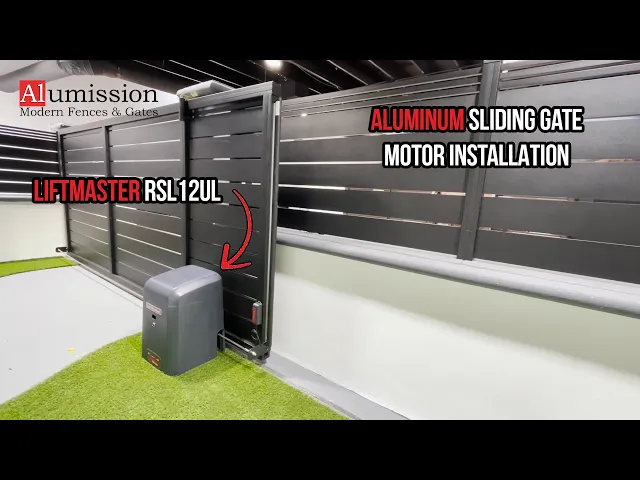
Anyone searching how to install a sliding gate motor should know that installation quality directly affects performance, lifespan, and safety.
A typical sliding gate motor installation includes these stages:
Confirm the gate structure moves smoothly by hand before adding automation.
Prepare a stable foundation for the motor base.
Position the motor correctly in relation to the gate path.
Mount the gear rack at the correct height and alignment.
Install limit devices and safety accessories.
Complete wiring and control board setup.
Test opening, closing, stopping, and obstacle response.
Fine-tune travel limits and force settings.
The important point is this: automation should not be used to compensate for a poorly built gate. If the gate does not roll smoothly on its own, the motor will be under constant strain.
Maintenance Tips for Long-Term Performance
A sliding gate system is only as reliable as its upkeep. Even a well-selected operator can fail early if basic maintenance is ignored.
Good maintenance typically includes:
keeping the track area clean
checking rack and gear alignment
inspecting rollers and support hardware
testing safety devices regularly
checking mounting bolts and fasteners
reviewing limit settings and travel behavior
operating the manual release occasionally to ensure it works
For commercial or high-cycle applications, maintenance intervals usually need to be more frequent. Heavier use means wear appears sooner, even when the system is well designed.
Why Understanding the Working Principle Matters
Understanding how sliding gate automation works helps buyers make better decisions. It clarifies why some systems fail early, why installation quality matters so much, and why the cheapest operator is not always the lowest-cost option over time.
It also helps specifiers ask better questions:
Is the motor sized for the real gate load?
Is the system built for the expected cycle count?
Are safety devices appropriate for the site?
Can the operator integrate with the access system?
Is there a practical backup plan for power loss?
Those questions matter more than generic feature lists.
Final Thoughts
A sliding gate motor works through a straightforward but carefully coordinated process: the control system receives a command, the motor and gearbox generate movement, the drive gear engages the rack, and the gate slides open or closed under controlled conditions. Around that core mechanism, limit controls, safety devices, and installation quality determine whether the system performs smoothly and reliably in the real world.
For homeowners, the goal is often convenience and quiet daily use. For commercial buyers, it is more likely durability, cycle capacity, and integration with broader site access control. In both cases, the same lesson applies: the best results come from matching the motor to the gate, the traffic level, and the environment.
A good sliding gate operator is not just a motor. It is a complete system that must be selected, installed, and maintained with care.
FAQ
1. How does a sliding gate opener work?
A sliding gate opener works by using an electric motor to drive a gear that meshes with a rack attached to the gate. When activated, the motor moves the gate sideways along its track or support system.
2. What is the difference between a sliding gate motor and a sliding gate operator?
In everyday use, the terms are often interchangeable. More precisely, the motor is the drive unit, while the operator can refer to the broader automation system, including controls and safety accessories.
3. Can a sliding gate motor work during a power outage?
Some systems can continue operating if they include a battery backup or other backup power arrangement. Otherwise, most rely on a manual release so the gate can be moved by hand.
4. What causes a sliding gate motor to stop working properly?
Common causes include power issues, damaged tracks, gate misalignment, rack problems, incorrect limit settings, faulty safety devices, and general wear.
5. How do I choose the right sliding gate motor?
Choose based on gate weight, gate length, usage frequency, site conditions, safety requirements, and compatibility with access control systems. The smoothness of the gate’s mechanical movement is also critical.
6. Is sliding gate motor installation difficult?
It can be. Proper installation requires accurate alignment, stable mounting, correct rack positioning, safe wiring, and setup of limits and safety devices. Poor installation can shorten system life and reduce safety.
Other Blogs