Blog
How to Choose an Automatic Gate Opener for Heavy Gates
Author
Ray
Published
Category
Design & Inspiration
Learn how to choose an automatic gate opener for heavy gates. Explore key factors including gate weight, motor capacity, operating frequency, and installation requirements.

Author
Ray
An experienced automation specialist with a strong background in motor technology and industrial solutions. With years of expertise in central motors, tubular motors, and automation systems, the author is dedicated to sharing insights that connect engineering innovation with real-world applications. Passionate about advancing reliable, energy-efficient, and high-performance automation products for global markets.
What’s better than insider perks, pro tips, and surprises?
Sign up to get the most recent blog articles in your email every week.
Join now.
WHY I WRITE THIS
About my business
Our company’s main product lines include tubular motors, sliding gate motors, swing gate motors, roller shutter motors, and other door automation solutions, all manufactured by trusted partner factories we have worked with for many years.
Our Services
I help them with sales and export operations, while our company also provides sourcing and procurement services in China to help international clients solve supply-related challenges. If you need assistance with procurement, please feel free to contact us.
Introduction
Choosing the right automatic gate opener for heavy gates requires more than simply selecting a motor with higher power.
Heavy gates create greater mechanical loads during opening and closing, which means the automation system needs to provide sufficient driving force while maintaining stable and reliable operation.
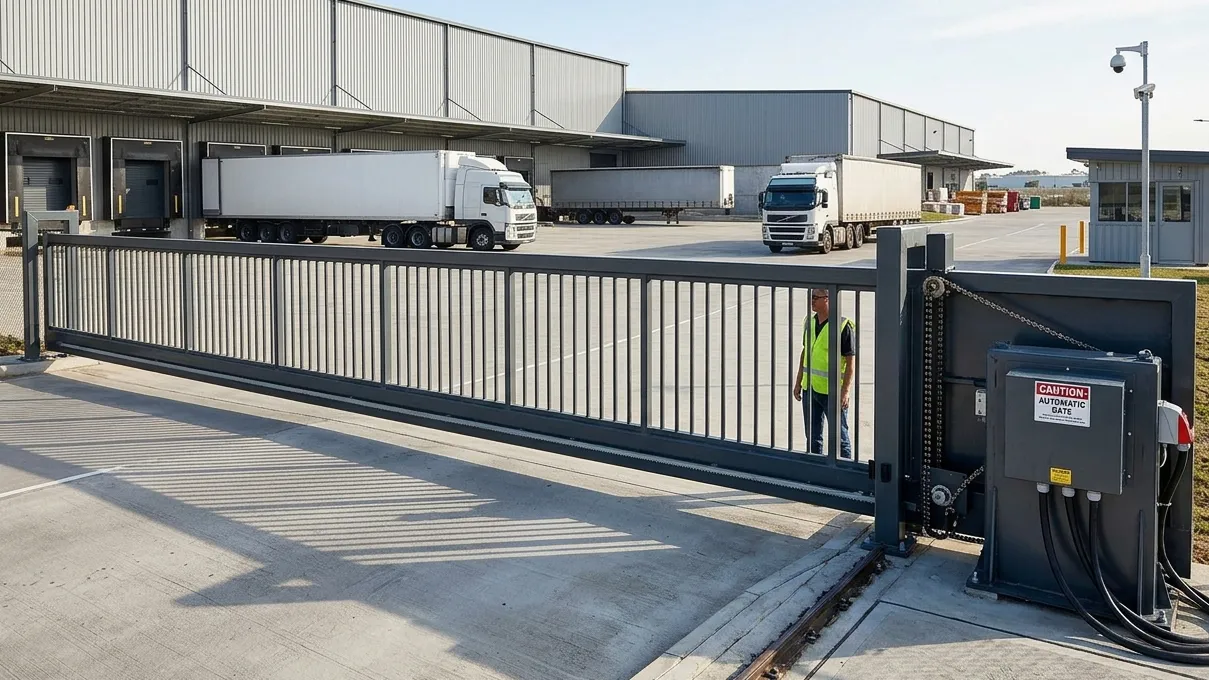
Compared with standard residential gates, heavy gates are often larger, heavier, and used in more demanding environments. These applications may include industrial facilities, warehouses, commercial entrances, and large private properties.
A suitable gate opener should be selected based on multiple factors, including gate weight, dimensions, operating frequency, installation conditions, and the complete gate structure.
For installers, distributors, and project suppliers, understanding these factors helps create more reliable automation solutions for high-load gate applications.
Why Heavy Gates Require Specialized Gate Openers
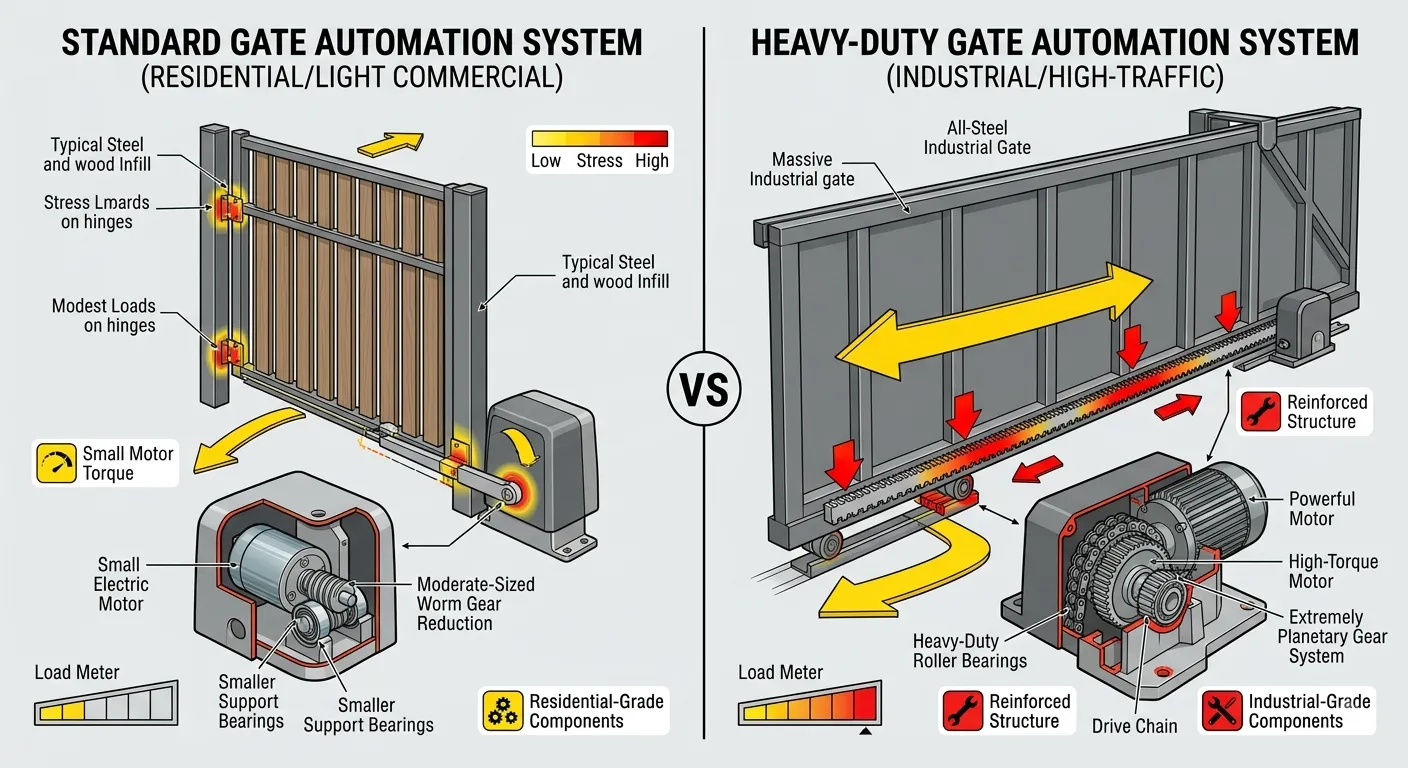
Heavy gates place higher demands on automation systems because of their increased size and mechanical load.
Although many gate openers can automate standard gates, heavier structures require stronger components to maintain smooth movement and long-term reliability.
Higher Load Requirements
The weight of a gate directly affects the amount of force required during operation.
A heavier gate requires a gate opener with sufficient driving capability to start movement, maintain stable operation, and complete opening and closing cycles smoothly.
However, the actual load requirement is not determined by weight alone. Factors such as gate balance, hinge condition, track quality, and installation accuracy can also influence the workload placed on the opener.
Selecting an opener with suitable capacity helps prevent excessive motor stress and improves overall system performance.
Greater Mechanical Stress
Heavy gates create greater mechanical stress on motors, gears, and supporting components.
During frequent operation, these components must repeatedly handle the force required to move the gate structure. If the opener is not properly matched with the application, it may lead to unstable movement, increased wear, or reduced service life.
For this reason, heavy gate automation systems should be evaluated as a complete solution rather than focusing only on the motor specification.
Key Factors When Choosing a Gate Opener for Heavy Gates
Selecting an opener for a heavy gate requires evaluating several important application factors.
The most suitable solution should match the physical characteristics of the gate and the expected operating conditions.
Gate Weight and Dimensions
Gate weight and size are among the first factors to consider.
A larger gate usually requires more powerful automation equipment because the opener needs to overcome greater resistance during movement.
However, gate dimensions are also important. A long gate panel may create additional mechanical pressure even if its overall weight is within a certain range.
Before selecting a gate opener, installers should evaluate the complete gate structure, including size, weight distribution, and movement condition.
Motor Capacity and Torque Requirements
Motor capacity plays an important role in heavy gate applications.
The opener must provide enough torque to move the gate smoothly without operating under excessive load.
A motor with insufficient torque may struggle during operation, while an oversized solution may increase costs without providing practical benefits.
The correct balance between motor capacity and actual gate requirements helps improve efficiency and reliability.
Operating Frequency
The expected operating frequency is another important factor when selecting a heavy gate opener.
A private gate may only open several times per day, while a commercial or industrial entrance may operate continuously throughout working hours.
Frequent operation creates higher requirements for motor durability, heat management, and component reliability.
For heavy gates used in high-traffic environments, the selected opener should be designed to handle repeated operating cycles while maintaining stable performance.
Key Factors When Choosing a Gate Opener for Heavy Gates
Installation Environment
The installation environment can significantly influence the performance of a heavy gate opener.
Outdoor gate systems may be exposed to rain, dust, temperature changes, and other environmental factors. These conditions can affect mechanical components and electrical systems over time.
For industrial and commercial applications, the opener should be selected according to the actual working environment and expected operating conditions.
Considering environmental factors during selection helps improve system reliability and reduce potential maintenance issues.
Choosing Between Sliding and Swing Gate Openers for Heavy Gates
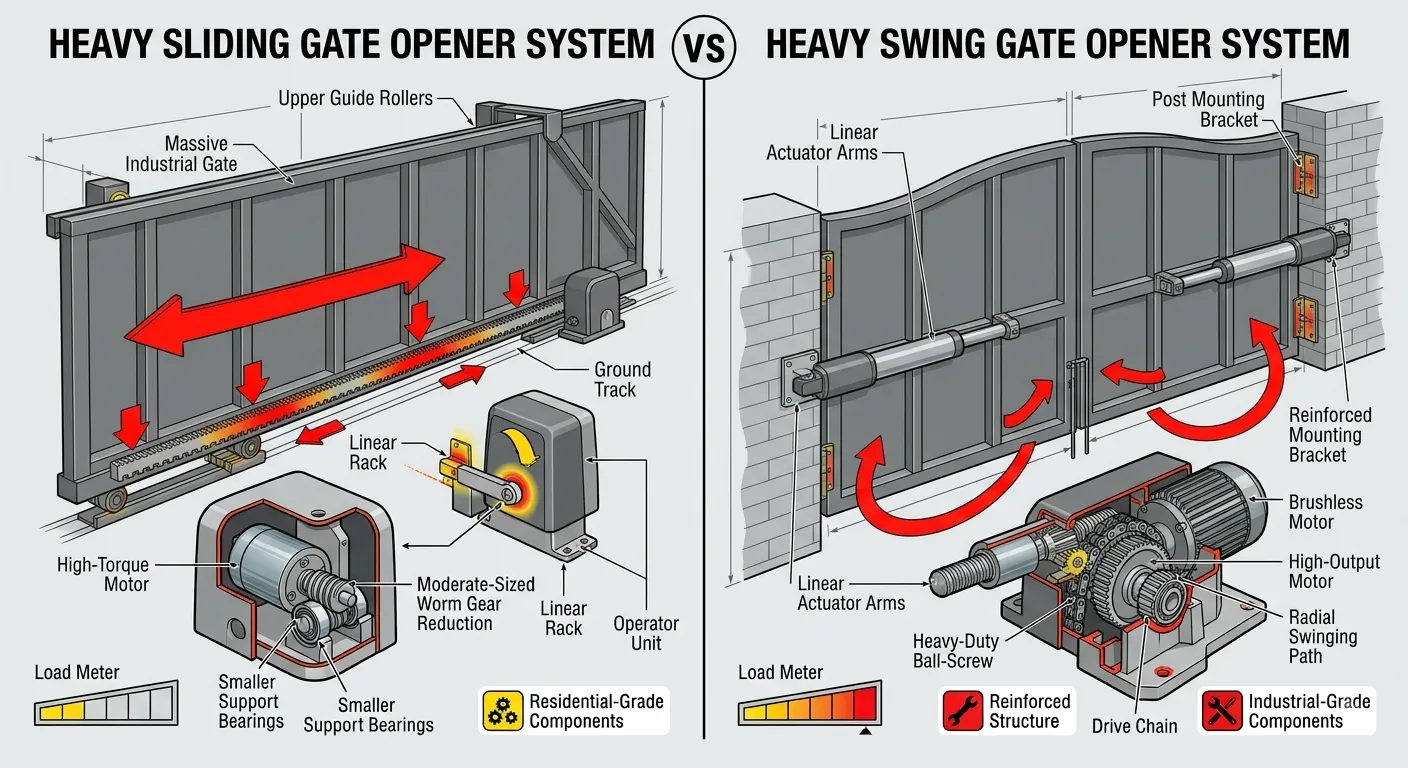
Heavy gates can use different automation solutions depending on their movement structure.
The choice between sliding and swing gate openers depends on available space, gate design, and project requirements.
Heavy Sliding Gate Applications
Heavy sliding gates are commonly used in industrial entrances, warehouses, and large commercial properties.
Because these gates move horizontally along a track, the opener needs to provide continuous driving force to move the gate smoothly.
For heavy sliding gates, factors such as gate weight, track condition, operating frequency, and motor capacity should be carefully evaluated.
A suitable sliding gate opener can support stable movement while reducing unnecessary stress on the mechanical system.
Heavy Swing Gate Applications
Heavy swing gates require openers that can control the rotating movement of large gate panels.
For these applications, actuator strength, hinge condition, and opening angle are important considerations.
A properly selected swing gate opener should provide enough force to move the gate while maintaining controlled operation throughout the opening and closing process.
Before installation, the gate structure should be checked to ensure that the hinges and supporting components can handle automated movement.
Common Mistakes When Selecting Heavy Gate Openers
Choosing a heavy gate opener based only on one specification can lead to performance problems.
Choosing Based Only on Weight Rating
Gate weight is an important factor, but it should not be the only selection criteria.
A gate opener may have a suitable weight rating but still perform poorly if the gate structure, installation conditions, or operating frequency are not considered.
A complete evaluation helps ensure that the opener matches the actual application requirements.
Ignoring Gate Structure and Installation Conditions
The condition of the gate itself can directly affect automation performance.
Problems such as uneven tracks, poor alignment, damaged hinges, or insufficient support can increase the workload on the opener.
Before selecting an automation solution, the existing gate structure should be inspected and prepared properly.
Overlooking Future Usage Requirements
Some projects only consider current operating conditions and ignore possible future changes.
For example, a gate that currently has low usage may require more frequent operation later due to increased traffic or expanded site requirements.
Choosing a suitable solution with enough flexibility can help avoid unnecessary replacement in the future.
Frequently Asked Questions
Q1: What type of gate opener is suitable for heavy gates?
A: The suitable opener depends on the gate structure, weight, dimensions, and operating requirements. Heavy sliding gates and heavy swing gates may require different automation solutions.
Q2: Do heavy gates need more powerful motors?
A: Yes. Heavy gates generally require higher driving capability to move smoothly and maintain reliable operation.
Q3: Can a standard gate opener be used for a heavy gate?
A: In most cases, standard openers are not recommended for heavy gates because they may experience excessive stress and reduced service life.
Q4: What factors affect heavy gate opener selection?
A: Important factors include gate weight, size, operating frequency, installation environment, movement type, and mechanical condition.
Q5: Are heavy gate openers suitable for industrial applications?
A: Yes. Heavy-duty gate openers are commonly used in industrial facilities, warehouses, logistics centers, and commercial entrances where reliable operation is required.
Conclusion
Selecting an automatic gate opener for heavy gates requires careful evaluation of the complete gate system.
Factors such as gate weight, dimensions, motor capacity, operating frequency, and installation environment all influence the final choice.
By selecting an opener that matches the actual application requirements, installers and project suppliers can improve system reliability, reduce maintenance needs, and create more durable automated access solutions for heavy gate applications.
Other Blogs


