Blog
What Is a High Lift Sectional Door? Standard vs High Lift vs Vertical Lift Explained
Author
Ray
Published
Category
Design & Inspiration
Learn what a high lift sectional door is, how it works, and how it compares with standard and vertical lift systems, including tracks, drums, springs, motors, headroom, and industrial applications.


Author
Ray
An experienced automation specialist with a strong background in motor technology and industrial solutions. With years of expertise in central motors, tubular motors, and automation systems, the author is dedicated to sharing insights that connect engineering innovation with real-world applications. Passionate about advancing reliable, energy-efficient, and high-performance automation products for global markets.
What’s better than insider perks, pro tips, and surprises?
Sign up to get the most recent blog articles in your email every week.
Join now.
WHY I WRITE THIS
About my business
Our company’s main product lines include tubular motors, sliding gate motors, swing gate motors, roller shutter motors, and other door automation solutions, all manufactured by trusted partner factories we have worked with for many years.
Our Services
I help them with sales and export operations, while our company also provides sourcing and procurement services in China to help international clients solve supply-related challenges. If you need assistance with procurement, please feel free to contact us.
A high lift sectional door is a sectional overhead door designed to travel vertically farther above the opening before the panels transition through the curved track and continue horizontally beneath the roof.
That additional vertical travel is what distinguishes a high lift system from a conventional standard-lift sectional door.
In industrial buildings, this is much more than a track-layout choice. Increasing the high-lift distance changes the track geometry, cable travel, cable-drum design, torsion-spring requirements, shaft position, operator arrangement and available installation space.
DASMA defines high-lift track as track and hardware that allows a sectional door to rise vertically for a distance above the opening before leveling into the horizontal position. It also defines a high-lift drum as a cable drum specifically contoured to balance a high-lift door.
This makes high-lift sectional doors particularly useful in warehouses, factories, logistics centers, vehicle workshops and other buildings where there is substantial space above the door opening and keeping the door close to the wall can free valuable overhead space.
What Is a High Lift Sectional Door?
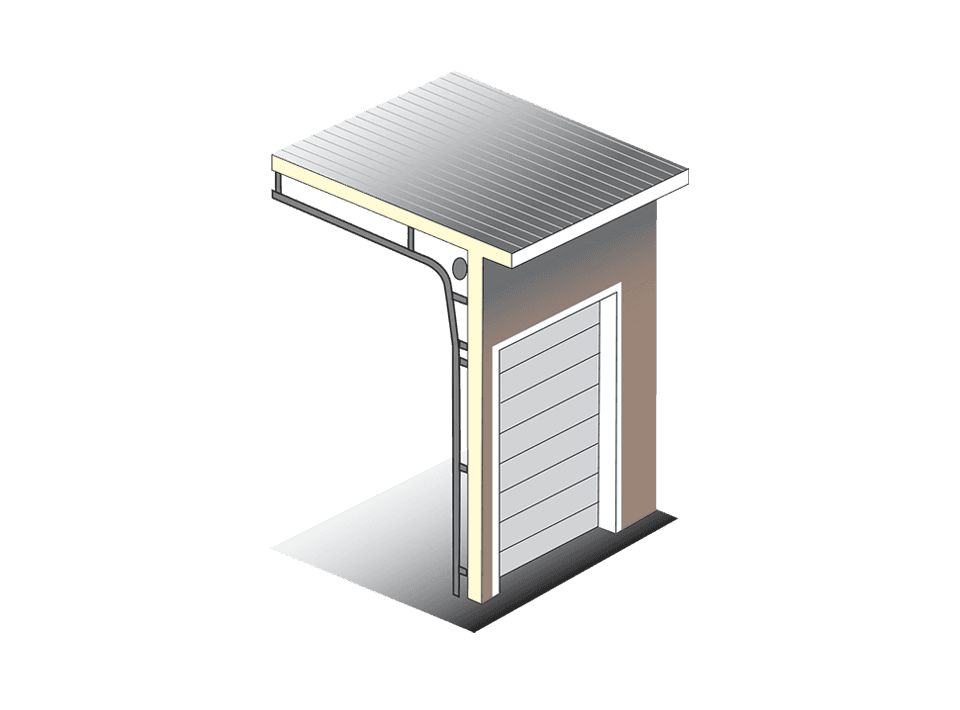
A sectional door is built from horizontal door sections connected by hinges. Rollers attached to the sections travel inside guide tracks as the door opens and closes.
With a standard-lift door, the vertical track normally transitions into the curved and horizontal track relatively close to the top of the opening.
A high-lift sectional door extends that vertical section upward.
The door therefore follows approximately this path:
Closed position → vertical travel → additional high-lift travel → curved transition → horizontal travel
The purpose is to move the horizontal track higher into the building.
This can provide more clear space immediately behind and above the opening for:
tall vehicles
vehicle lifts
storage racks
cranes
lighting systems
HVAC equipment
workshop equipment
production machinery
loading operations
Commercial door manufacturers therefore offer standard-lift, high-lift and vertical-lift track configurations as separate engineered systems rather than treating them as interchangeable versions of the same track. DOCO, for example, lists all three as distinct industrial sectional-door track systems.
How Does a High Lift Sectional Door Work?
The operating principle begins with the same basic components used in other sectional overhead doors:
sectional door panels
hinges
rollers
vertical and horizontal tracks
torsion shaft
torsion springs
lifting cables
cable drums
bottom brackets
bearings
operator or manual drive system
What changes is the geometry between these components.
The mechanical load path
The load path of a typical torsion-spring sectional door can be simplified as:
Door panels → bottom fixtures → lifting cables → cable drums → torsion shaft → torsion springs
When an automatic operator is installed, the operator also applies torque to the torsion shaft or associated drive system.
The motor should therefore not be considered a device that simply “lifts the entire door weight.”
A properly counterbalanced sectional door uses the spring system to offset a large part of the gravitational load.
The operator mainly has to overcome:
residual imbalance
rolling and bearing friction
seal friction
acceleration and deceleration forces
wind-related resistance where applicable
gearbox and transmission losses
This distinction becomes especially important when sizing motors for high-lift and vertical-lift sectional doors.
Why High Lift Changes the Counterbalance System
The torsion springs and cable drums work together to balance the door throughout its movement.
As the door opens, torsion springs unwind and their available torque changes.
At the same time, the relationship between the amount of door weight supported by the cables and the effective cable-drum radius also changes.
For a simplified shaft system:
Torque = Force × Effective Radius
or:
T = F × r
But on a sectional door, neither the effective force nor the effective drum radius should automatically be assumed constant throughout the entire travel.
That is one reason high-lift doors use specialized cable drums.
DASMA specifically describes a high-lift drum as being contoured to balance a high-lift door.
DOCO likewise offers cable drums specifically engineered for different high-lift distances, door weights, cable diameters and shaft sizes. For example, its current industrial high-lift drum range includes models with different maximum high-lift dimensions and load capacities rather than one universal drum for every high-lift door.
This is why converting a standard-lift door into a high-lift door is not simply a matter of extending the vertical track.
The counterbalance system has to be engineered for the new geometry.
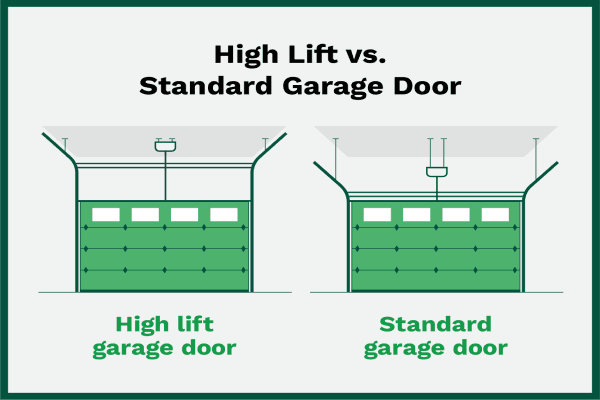
Standard Lift vs High Lift vs Vertical Lift
These three configurations solve different building-space problems.
Configuration | Door Movement | Overhead Space Requirement | Typical Application |
|---|---|---|---|
Standard Lift | Vertical, then quickly horizontal | Normal headroom | Standard commercial buildings and garages |
High Lift | Extended vertical travel, then horizontal | Greater headroom | Warehouses, workshops, industrial buildings |
Vertical Lift | Nearly or completely vertical travel | Very high wall space above opening | Loading docks, factories and large industrial facilities |
Standard Lift
A standard-lift sectional door moves vertically slightly above the opening and then turns through the curved track into a horizontal position.
It is normally appropriate where there is enough conventional headroom but no reason to raise the horizontal track significantly.
DOCO's current industrial range, for example, treats standard lift as a separate track system from high lift and vertical lift.
High Lift
A high-lift door continues vertically beyond the top of the opening before entering the curved section.
The amount of additional vertical travel can vary significantly depending on the building and system.
As one manufacturer-specific example, DOCO's current high-lift industrial system supports configurations with high lift up to 4100 mm. That number is a limit for that particular system and should not be interpreted as a universal maximum for all sectional doors.
Vertical Lift
A vertical-lift sectional door continues upward along the wall rather than transitioning into a conventional horizontal track beneath the roof.
It is generally used where substantial wall height is available above the opening.
This arrangement can be highly effective at loading docks and industrial facilities because it minimizes horizontal track intrusion into the building.
What Is High-Lift Height?
In practical door engineering, high-lift height describes the additional vertical travel provided above the opening before the door transitions toward the horizontal track.
DASMA defines high lift as the distance from the header to the underside of the horizontal track where high-lift track is required.
This dimension is one of the most important measurements when engineering a high-lift door.
Increasing it can affect:
vertical track length
cable length
drum selection
spring calculations
shaft position
horizontal track elevation
track radius
operator location
number of shaft revolutions
available side room
required structural support
For this reason, “make it high lift” is not sufficient information for manufacturing a door system.
The actual high-lift dimension must be specified.
How Much Headroom Does a High Lift Sectional Door Need?
There is no universal headroom number.
Required space depends on:
desired high-lift height
cable-drum design
track radius
shaft position
spring configuration
top fixture geometry
operator arrangement
door thickness
building structure
roof slope
For example, one DOCO industrial-door engineering guide lists a manufacturer-specific high-lift headroom relationship of approximately high-lift dimension + additional clearance, with the actual value dependent on the cable drum.
That formula applies to that system.
It should not be copied to another manufacturer without checking that manufacturer's drawings.
A professional quotation should therefore begin with actual building measurements instead of assuming that every high-lift door needs the same clearance.
What Measurements Are Needed for a High Lift Sectional Door?
At minimum, the supplier or door designer should know:
Opening width
Measure the finished structural opening from jamb to jamb.
Opening height
Measure from the finished floor to the header.
Headroom
Measure from the top of the opening to the lowest obstruction above it.
Possible obstructions include:
beams
ducts
sprinkler pipes
cable trays
lights
crane rails
structural bracing
Side room
Space beside the opening is required for:
vertical track
brackets
cable drums
bearings
torsion shaft
operator
spring-break devices
Backroom
The horizontal track and open door still require sufficient depth inside the building.
Required high-lift dimension
Determine how high the horizontal section must be positioned.
Roof pitch
High-lift track can also be engineered to follow a sloping roof.
DOCO currently offers pitched high-lift configurations, and Clopay publishes high-lift follow-the-roof track drawings for commercial systems.
Door weight
Actual moving door weight is required for correct spring, cable, drum and operator engineering.
Door construction
A steel insulated door, panoramic aluminum/glass door and lightweight panel door can have very different weights despite having identical opening dimensions.
Why the Cable Drum Matters So Much
The cable drum is one of the most important components in a high-lift sectional door.
As the torsion shaft rotates, the lifting cable winds onto or unwinds from the drum.
The drum determines the effective cable moment arm at different positions.
For a simplified cable load:
Tdrum = Fcable × reffective
where:
Tdrum = torque acting at the drum
Fcable = cable tension
reffective = effective drum radius at the point where the cable leaves the drum
Changing drum geometry therefore changes the shaft torque required for a given cable force.
High-lift cable drums are designed around this changing geometry.
Current industrial drum data demonstrates how specific this selection can become. Different high-lift drum models are rated for different:
door weights
high-lift heights
cable diameters
shaft diameters
wall offsets
safety windings
Some current DOCO models, for example, are rated for approximately 250 kg, 454 kg, 650 kg, 728 kg or even 1000 kg depending on the drum design and operating geometry.
The lesson is important:
A cable drum is an engineered part of the counterbalance system, not simply a pulley.
Cylindrical vs High-Lift Drum Geometry
Standard-lift sectional doors commonly use relatively conventional drum geometry.
High-lift doors often require a drum with a changing or combined profile because the mechanical relationship changes while the door travels through its vertical, high-lift and curved portions.
This is why high-lift systems may be described using cylindrical-conical or contoured cable drums.
China-Develop's current LION50 application data, for example, distinguishes standard sectional doors using cylindrical cable drums from high-lift door configurations using cylindrical-conical drum arrangements.
The exact drum profile must always be determined from the complete door design.
How Torsion Springs Balance a High Lift Door
A sectional door should be mechanically counterbalanced before the operator is expected to automate it.
Torsion springs store energy when the door is closed.
As the door opens, spring torque decreases.
The drum profile, spring torque curve and changing effective door load should work together so that the door remains reasonably balanced through its travel.
Perfect neutral balance at every millimeter is not always achievable.
DASMA notes that high-lift doors can present additional counterbalance challenges and that some high-lift doors may be slightly out of balance through a portion of their travel. It also emphasizes that the purpose of counterbalancing is to reduce the force required to operate the door and to help extend motor life on automated doors.
A door that is severely out of balance should therefore not be “fixed” by installing a larger motor.
The spring and counterbalance system should be corrected first.
Why Door Weight Alone Cannot Determine Motor Torque
A common mistake is:
The door weighs 300 kg, therefore it requires an X-Nm motor.
That calculation is incomplete.
The operator does not normally support the full gravitational load of a properly counterbalanced door.
A better simplified engineering relationship is:
Toperator ≥ |Tdoor − Tspring| + Tfriction + Tacceleration
with an appropriate design/service margin.
Where:
Tdoor = torque generated by the door/cable/drum system
Tspring = counterbalancing spring torque
Tfriction = track, roller, seal, bearing and mechanical losses
Tacceleration = additional torque required to accelerate the moving system
The operator therefore acts on the residual mechanical load of the complete door system.
That is why a well-balanced heavy sectional door can sometimes require less operator effort than a much lighter but poorly balanced door.
Does a High Lift Sectional Door Need a Special Motor?
Not necessarily a completely different motor technology, but the operator must be approved for the high-lift configuration.
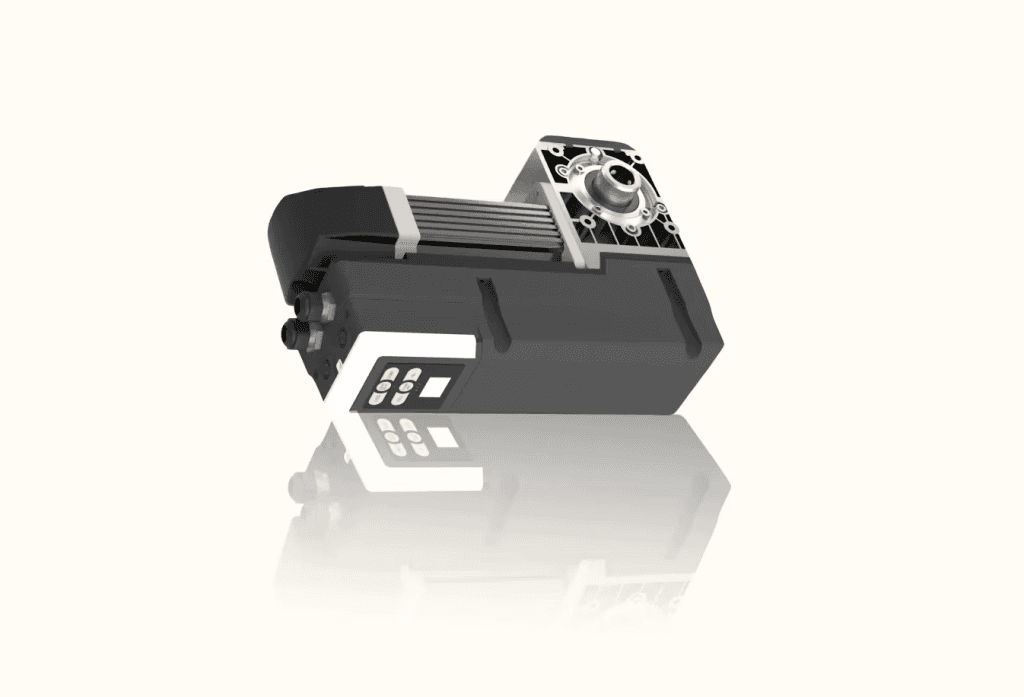
High-lift and vertical-lift sectional doors frequently use shaft-mounted or jackshaft-style operators because the operator can drive the torsion shaft from the side of the door rather than relying on a ceiling-mounted trolley system.
LiftMaster currently specifies several jackshaft operators specifically for high-lift or vertical-lift sectional doors. Its J and MJ operators, for example, are designed for side mounting on vertical or high-lift applications, with different duty-cycle ratings depending on the operator class.
This arrangement has several advantages:
does not occupy central ceiling space
works naturally with elevated horizontal track
connects directly or indirectly to the torsion shaft
supports industrial controls
can incorporate manual emergency operation
is easier to integrate with high-lift geometry
How to Select a Motor for a High Lift Sectional Door
A professional motor selection should evaluate the complete operating system.
1. Rated output torque
Rated torque is more meaningful for continuous normal operation than relying only on a peak or starting-torque number.
The motor must handle the residual shaft torque throughout the travel range.
2. Maximum or starting torque
Higher short-duration torque can help during starting and transient loading, but it should not be used as a substitute for adequate rated torque.
3. Output speed
Output shaft rpm affects door speed.
Very high door speeds can increase:
dynamic loads
braking requirements
control complexity
wear
safety requirements
4. Duty cycle
A warehouse door operating four times per hour and a logistics door operating twenty times per hour are fundamentally different applications.
LiftMaster illustrates this clearly in its current commercial operator range: some medium-duty high-lift-compatible operators are limited to about 12 cycles per hour and fewer than 50 per day, while heavier commercial operators are rated for higher cycle frequencies.
5. Maximum limit travel
Industrial operators normally have a specified maximum number of output-shaft revolutions.
This must be sufficient for the actual door travel.
High lift increases cable travel and may change the number of shaft revolutions required.
The final calculation should use the actual selected drum geometry rather than assuming:
travel ÷ one fixed drum circumference
because the effective radius of a high-lift drum may change during rotation.
6. Shaft diameter and keyway
The operator coupling must match the torsion shaft or adapter arrangement.
Common industrial dimensions vary by system, so the supplier should confirm:
shaft diameter
hollow-shaft diameter
key size
coupling type
7. Static holding capability
A closed or stationary industrial door creates holding requirements different from dynamic operating torque.
Brake and gearbox design therefore matter.
8. Emergency operation
Industrial high-lift doors should have a suitable strategy for manual or emergency operation.
Depending on the operator, this may involve:
emergency hand chain
manual release
floor-level disconnect
LiftMaster's commercial jackshaft systems and China-Develop's industrial sectional operators both include configurations intended to support emergency manual operation.
High Lift Door Motor Example: What Specifications Actually Matter?
Consider a current industrial sectional-door operator such as China-Develop's LION50.
Its published specifications include:
35 Nm rated output torque
50 Nm maximum output torque
24–32 rpm maximum output speed
15 output-shaft limit turns
25.4 mm standard sleeve shaft diameter
up to 20 cycles per hour
IP54 protection
thermal protection
emergency chain-hoist configuration
The important point is not that those values automatically make the motor suitable for any particular high-lift door.
The engineering question is whether the motor specification matches:
the actual door + drum + spring + shaft + travel + duty cycle.
For substantially larger industrial doors, higher-torque sectional-door operators are available. China-Develop's current IDS range, for example, includes 380 V industrial models across several higher torque/power classes, demonstrating how operator selection changes as door size and industrial demand increase.
High Lift vs Vertical Lift: Which Is Better?
Neither is universally better.
The correct choice depends on building geometry.
Choose high lift when:
substantial headroom exists above the opening
some horizontal door travel is acceptable
overhead workspace needs to remain clear near the opening
the building roof or internal layout suits elevated horizontal tracks
Choose vertical lift when:
very large wall height exists above the opening
there is sufficient vertical space for nearly the full door height
horizontal tracks would interfere with machinery or building services
loading-dock or industrial layout favors vertical movement
A vertical-lift system should not automatically be specified simply because the building has a high ceiling.
The complete wall height, structure, door size and counterbalance geometry must support it.
High Lift vs Low Headroom Sectional Doors
These configurations solve almost opposite problems.
High lift is intended to take advantage of extra space above the opening.
Low headroom is intended for buildings where very little space exists above the opening.
DOCO's current industrial range, for example, lists high lift and low headroom as separate engineered track systems, with its low-headroom system designed for installations with substantially reduced clearance.
Can High Lift Track Follow a Sloped Roof?
Yes, certain systems can.
Instead of making the horizontal track completely level, the track can continue along the roof pitch.
This is sometimes called:
follow-the-roof track
or:
pitched high-lift track
This can further reduce interference with the usable space below.
DOCO currently supports pitched high-lift configurations for selected industrial systems, and Clopay publishes dedicated high-lift follow-the-roof commercial track drawings.
The track angle must be designed as part of the entire door system.
It should not be changed on site without recalculating the track and counterbalance geometry.
Can a Standard Sectional Door Be Converted to High Lift?
Sometimes, but it should be treated as an engineered conversion.
Depending on the existing door, conversion may require changes to:
vertical tracks
horizontal tracks
curved track sections
high-lift drums
lifting cables
torsion springs
spring turns
shaft position
bearing plates
operator mounting
operator limits
top fixtures
structural supports
Clopay, for example, publishes dedicated supplemental instructions for high-lift track applications rather than treating the configuration as a simple field adjustment.
Most importantly, changing high-lift height alters the counterbalance geometry.
Drum and spring calculations should therefore be verified by the door-system manufacturer or a qualified door engineer.
Why Motor Limit Turns Matter on High Lift Doors
Industrial operators often include mechanical or electronic travel limits.
The operator must have sufficient available shaft revolutions to move the door from fully closed to fully open.
A standard-lift door may require fewer shaft rotations than a high-lift system using different cable travel and drum geometry.
If the required shaft travel exceeds the operator's limit range, the motor can reach its internal travel limit before the door reaches its intended end position.
When specifying an operator, always compare:
Required shaft revolutions < Operator available limit revolutions
with additional allowance according to the manufacturer's setup requirements.
How High Lift Affects Door Speed
For a simplified cable-drum section:
Linear cable speed ≈ Shaft angular speed × Effective drum radius
Therefore, both operator rpm and drum geometry affect linear movement.
Since a high-lift drum can have a changing effective radius, the mechanical relationship between shaft rotation and cable travel may vary through the operating cycle.
Modern industrial operators may also use electronic controls, soft start and soft stop, or variable-speed technology to manage movement more smoothly.
This is one reason selecting a door operator purely by motor wattage is inadequate.
Why Door Balance Should Be Checked Before Motor Installation
Before an automatic operator is commissioned, the sectional door should be correctly balanced and mechanically sound.
A properly counterbalanced door should not require the operator to compensate for:
incorrect spring selection
broken springs
excessive cable tension differences
damaged rollers
misaligned track
excessive seal friction
binding hinges
LiftMaster's commercial jackshaft documentation specifically describes balanced doors as an important condition for appropriate operation, while DASMA explains that correct counterbalancing reduces operating force and helps protect the motor system.
A larger motor is not a substitute for correct door mechanics.
Common High Lift Sectional Door Design Mistakes
Incorrect high-lift measurement
An error in the high-lift dimension can affect the entire track and counterbalance design.
Selecting the drum only by door weight
The selected drum must also match the required high lift, cable diameter, shaft and system geometry.
Reusing standard-lift spring calculations
High-lift geometry changes the load curve.
Spring and drum selection should be recalculated as a system.
Ignoring shaft offset
Larger or specialized cable drums may require additional distance between the torsion shaft and the wall.
Current high-lift drum specifications demonstrate different minimum wall offsets depending on drum geometry.
Selecting the operator by wattage alone
Rated torque, speed, duty cycle, shaft compatibility and travel limits are often more useful selection parameters.
Ignoring operator limit turns
A motor can have enough torque but insufficient available travel.
Ignoring peak operating frequency
A motor suitable for a workshop may not be suitable for a logistics center operating continuously during shift changes.
Installing a motor on an unbalanced door
This increases motor and gearbox loading and can hide a counterbalance problem until premature failure occurs.
Safety Requirements for Powered High Lift Sectional Doors
Industrial sectional doors combine substantial moving mass with springs, cables, tracks and powered operators.
Safety design therefore has to address more than motor performance.
Depending on the market and application, systems may require or incorporate:
photoelectric sensors
monitored safety edges
light curtains
spring-break protection
cable-break protection
emergency stop
emergency hand operation
obstacle detection
controlled closing logic
wicket-door interlocks
warning lights
For European power-operated industrial, commercial and garage doors, EN 12453:2017+A1:2021 addresses safety requirements and test methods for powered doors and gates and is referenced in the EU's current standards framework.
In North America, commercial door operators are commonly evaluated under UL 325. LiftMaster's high-lift-compatible commercial operators, for example, specify UL 325 safety compliance and monitored entrapment-protection provisions.
DASMA also recommends following the operator manufacturer's installation instructions and ensuring proper coordination between the door installer, operator installer and electrical contractor.
Local regulations and the requirements of the actual door/operator manufacturer always take precedence.
Where Are High Lift Sectional Doors Used?
High-lift sectional doors are particularly useful in buildings where standard horizontal tracks would interfere with operations.
Common applications include:
Warehouses
Raising the horizontal track creates more usable space around storage and material-handling areas.
Logistics centers
Sectional doors can be positioned around dock equipment while keeping overhead obstructions away from vehicle and warehouse operations.
Automotive workshops
High lift is especially useful where vehicle lifts are installed behind the door.
Car dealerships
High ceilings, lighting and architectural layouts can make elevated tracks preferable. Amarr has documented commercial installations using high-lift track in automotive dealership projects.
Factories
Higher tracks can avoid interference with production lines, cranes and building services.
Fire and emergency facilities
Large vehicle openings may require specialized sectional-door geometry depending on ceiling structure and operational clearance.
Loading bays
High-lift and vertical-lift configurations are widely used where dock layouts and building height permit them. DOCO currently offers dedicated dock-door high-lift systems.
Are High Lift Sectional Doors More Expensive?
Usually, a high-lift configuration can cost more than a basic standard-lift door of otherwise similar construction.
The additional cost may come from:
longer vertical tracks
custom track geometry
specialized cable drums
different cables
recalculated torsion springs
additional structural supports
more complex installation
jackshaft or industrial operator requirements
engineering and commissioning time
However, cost should be evaluated against the space gained.
In industrial buildings, preserving overhead working space can be considerably more valuable than minimizing the initial door cost.
What Information Should You Send a Manufacturer?
For accurate quotation and engineering, provide:
Parameter | Information Required |
|---|---|
Opening width | mm |
Opening height | mm |
Available headroom | mm |
Side room, left/right | mm |
Backroom | mm |
Required high lift | mm |
Door panel type | Steel / insulated / full vision |
Estimated or actual door weight | kg |
Roof slope | Degrees or drawing |
Shaft position | If predetermined |
Power supply | 110/120 V, 220/230 V, 380/400 V etc. |
Daily operating cycles | Cycles/day |
Peak operating frequency | Cycles/hour |
Required door speed | m/s or rpm data |
Environmental conditions | Indoor/outdoor, temperature, moisture |
Safety accessories | Photocell, safety edge, light curtain etc. |
Architectural drawings and photographs of the opening are also extremely useful.
How to Choose the Right High Lift Sectional Door Motor
For professional procurement, use the following sequence.
Step 1: Engineer the door first
Determine:
door dimensions
moving weight
high-lift height
track configuration
drum model
torsion springs
shaft arrangement
Step 2: Confirm that the door is correctly counterbalanced
The operator should automate a mechanically sound door rather than compensate for poor balance.
Step 3: Determine actual shaft requirements
Evaluate:
required torque
number of revolutions
output speed
shaft diameter
installation position
Step 4: Determine operational duty
Calculate:
cycles per hour
cycles per day
peak traffic periods
Step 5: Select operator and control system
Compare:
rated torque
maximum torque
rpm
limit travel
shaft compatibility
duty cycle
voltage
thermal protection
IP protection
brake/holding characteristics
emergency manual operation
Step 6: Design the safety system
Specify appropriate:
photocells
safety edges
light curtains
emergency stops
spring/cable protection
interlocks
warning devices
Step 7: Commission the complete door/operator system
Final commissioning should verify:
full-open position
full-close position
door balance
smooth track travel
safety-device operation
emergency operation
motor temperature
abnormal noise
braking
repeated-cycle performance
High Lift Sectional Door vs Rolling Shutter: Which Is Better for High-Ceiling Buildings?
A high-lift sectional door and a rolling shutter both open vertically, but the mechanisms are very different.
A rolling shutter curtain coils around a barrel above the opening.
A sectional door remains in articulated panels and follows a track system.
High-lift sectional doors may be preferred where buyers need:
thick insulated panels
full-view glazing
architectural appearance
strong thermal performance
sectional panel replacement
controlled overhead routing
Rolling shutters can offer advantages where compact coiling above the opening is more important.
The correct choice depends on the building, opening size, thermal requirements, duty cycle and available space.
Frequently Asked Questions
What is a high lift sectional door?
A high lift sectional door travels vertically farther above the door opening than a standard-lift door before transitioning through curved track into a horizontal position.
What is high lift on a sectional door?
High lift refers to the additional vertical distance between the door opening/header area and the elevated horizontal track. DASMA defines high lift as the distance from the header to the underside of the horizontal track when high-lift track is used.
What is the difference between standard lift and high lift?
Standard lift transitions into horizontal track relatively close to the opening. High lift continues vertically farther before the transition, positioning the horizontal track higher in the building.
What is the difference between high lift and vertical lift?
A high-lift door eventually transitions into horizontal track. A vertical-lift door continues substantially or completely upward along the wall.
Does a high lift door need special tracks?
Yes. The track geometry and related hardware are engineered specifically for the required high-lift dimension.
Does a high lift door need special cable drums?
Normally, yes. High-lift systems use cable drums designed for their specific counterbalance geometry. DASMA defines high-lift drums as contoured drums used to balance high-lift doors.
Does a high lift sectional door need different springs?
Changing from standard lift to high lift changes counterbalance geometry, so the spring and drum system must be recalculated. Whether the physical spring itself must change depends on the specific door design.
Can an existing sectional door be converted to high lift?
In some installations, yes. However, tracks, drums, cables, springs, shaft position, operator location and other components may need to be changed or recalculated.
What type of motor is best for a high lift sectional door?
Industrial high-lift doors commonly use side-mounted shaft or jackshaft operators. The correct motor depends on shaft torque, speed, limit travel, duty cycle, shaft dimensions and control requirements rather than door weight alone. LiftMaster, for example, specifies jackshaft commercial operators for high-lift and vertical-lift sectional doors.
Can I calculate the motor from door weight alone?
No. A sectional door is counterbalanced by springs. Motor sizing should consider residual shaft torque, drum geometry, spring balance, friction, acceleration, speed and duty cycle.
Are high lift doors suitable for warehouses?
Yes. High lift is particularly useful where a warehouse has significant space above the opening and the horizontal tracks need to remain clear of racks, vehicles, lighting or equipment.
Can high lift track follow the roof?
Some engineered systems can. Manufacturers including DOCO and Clopay offer pitched or follow-the-roof high-lift track solutions.
Is high lift the same as a high-speed sectional door?
No.
High lift describes the track geometry.
High speed describes the operating speed.
A high-lift sectional door can operate at normal or higher speeds depending on the door and operator design.
Final Thoughts
A high lift sectional door is not simply a standard sectional door with longer tracks.
It is an engineered system in which the track geometry, cable drum, torsion springs, cables, shaft and operator must work together throughout the entire door travel.
The fundamental difference is simple:
Standard lift turns toward the ceiling relatively soon.
High lift continues vertically before turning.
Vertical lift continues upward with little or no conventional horizontal travel.
But from an engineering perspective, that additional high-lift distance affects almost every important part of the system.
For installers, distributors and industrial-door buyers, the most important specifications are therefore not only door width and height.
The manufacturer should also know:
high-lift dimension, door weight, drum configuration, shaft dimensions, available headroom, required speed, cycles per hour, power supply and safety requirements.
The motor should then be selected around the mechanical characteristics of the correctly balanced door.
For high-lift industrial sectional doors, shaft-mounted industrial operators are particularly practical because they preserve overhead space while integrating directly with the door's torsion-shaft system.
China-Develop's current industrial sectional-door motor range includes shaft-driven operator solutions across multiple torque and power classes for commercial and industrial sectional-door applications.
Correct engineering at the track, counterbalance and operator stages is what ultimately determines whether a high-lift sectional door operates smoothly, safely and reliably over its service life.
Other Blogs


