Blog
Solar Gate Opener Guide: How It Works, Costs, Battery Size & Is It Worth It?
Author
Ray
Published
Category
Design & Inspiration
Learn how to size a solar gate opener, including panel watts, 12V/24V battery capacity, daily cycles, costs, cloudy-day backup and solar vs grid power.


Author
Ray
An experienced automation specialist with a strong background in motor technology and industrial solutions. With years of expertise in central motors, tubular motors, and automation systems, the author is dedicated to sharing insights that connect engineering innovation with real-world applications. Passionate about advancing reliable, energy-efficient, and high-performance automation products for global markets.
What’s better than insider perks, pro tips, and surprises?
Sign up to get the most recent blog articles in your email every week.
Join now.
WHY I WRITE THIS
About my business
Our company’s main product lines include tubular motors, sliding gate motors, swing gate motors, roller shutter motors, and other door automation solutions, all manufactured by trusted partner factories we have worked with for many years.
Our Services
I help them with sales and export operations, while our company also provides sourcing and procurement services in China to help international clients solve supply-related challenges. If you need assistance with procurement, please feel free to contact us.
Executive Summary
A solar gate opener is not normally powered directly by a solar panel. In a properly designed off-grid gate system, the energy path is:
Solar panel → charge controller → battery → DC gate operator → gate
The solar panel replenishes the battery; the battery supplies the instantaneous current required by the motor when the gate starts, accelerates, travels, and stops. This is why battery capacity and peak discharge capability matter just as much as panel wattage. Current solar-optimized gate products illustrate this architecture clearly: Nice's Juno is a 12 VDC battery-powered sliding operator that can charge from AC or solar and incorporates a battery charger and maximum-power-point-tracking technology; Nice's larger Smart 535 platform uses 24 V brushless DC motors, integrated solar charging and optional larger batteries for solar applications.
For a lightly used residential gate, 10–50 W of solar may be enough when the operator is specifically designed for low-power solar operation and the site has strong sunlight. Mighty Mule's official 10 W panel chart, for example, estimates 16–26 gate openings per day in its sunnier solar zones and 20–54 openings per day with 30 W, based on eight hours of sunlight and a fully charged battery. Those numbers are product- and location-specific, not universal rules.
For larger gates, more accessories, cloudy climates, or higher cycle counts, 50–200 W or more can be a much safer design range. Nice's commercial Smart 535 architecture supports a 200 W MPPT battery-charging system and battery upgrades for solar applications, demonstrating that commercially capable solar gate automation can require substantially more charging capacity than basic residential kits.
Battery sizing should be based on daily watt-hours and required days of autonomy, not merely on gate weight. Lead-acid batteries are commonly sized around no more than 50% routine depth of discharge to preserve life, while a current Renogy 12.8 V 20 Ah LiFePO4 battery is rated for 4,000 cycles at 80% depth of discharge and can supply 20 A continuously with a brief 75 A peak rating. Exact allowable depth of discharge, charging profile and discharge current must always follow the battery manufacturer's specifications.
For most purpose-designed off-grid installations, a native 12 VDC or 24 VDC solar-ready gate operator is preferable to powering an AC motor through an inverter. An inverter is a DC-to-AC conversion stage; PWM and MPPT are charge-controller technologies and solve a different problem. MPPT can harvest more available panel power than PWM under several difficult irradiance and temperature conditions, while PWM remains a cost-effective option for small, correctly voltage-matched systems. Victron reports MPPT advantages of roughly 10–40% under some low-irradiance or temperature conditions, although the actual gain is site dependent.
Economically, solar is usually most compelling where grid power is expensive to bring to the gate. Solar should not be sold primarily on the promise of dramatically reducing a gate's electricity bill: 2026 U.S. cost data puts automatic-gate electricity at only about $30–$100 per year in many residential applications. The larger financial advantage can be avoiding trenching, conduit, electrical upgrades and long cable runs. Where utility power already exists beside the gate, the financial payback of solar may be weak; where the gate is hundreds of feet from power, solar can be less expensive from day one.
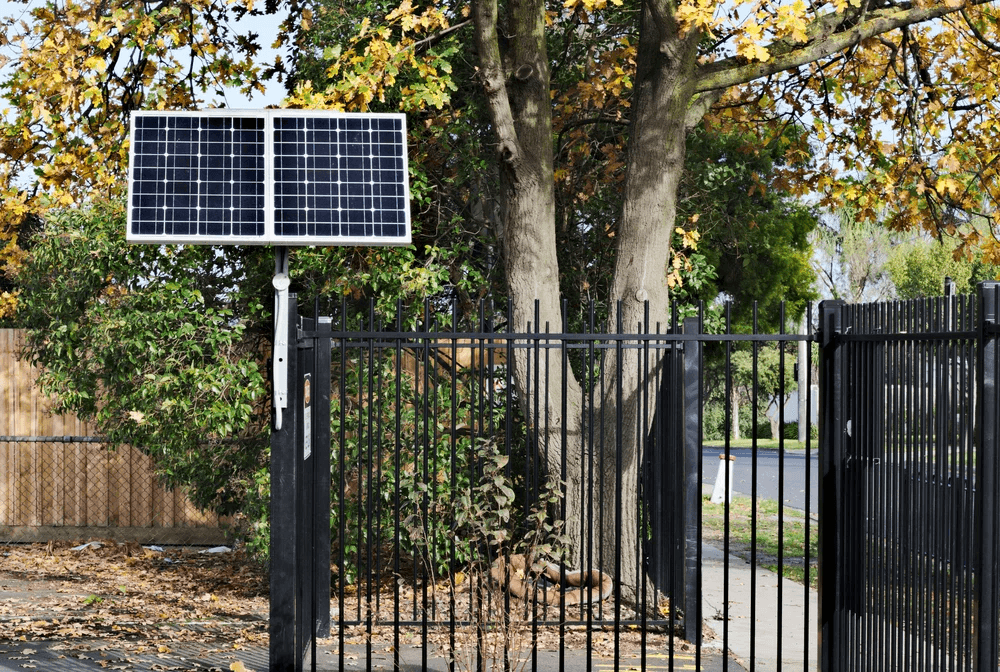
The practical recommendation is therefore:
Application | Solar recommendation |
Light residential swing/slide gate | Excellent candidate with a solar-ready DC operator |
Remote farm/ranch entrance | One of the strongest solar use cases |
500 kg sliding gate | Very practical if correctly sized |
800 kg sliding gate | Practical, but verify motor current, cycles and autonomy |
1200 kg sliding gate | Possible, preferably engineered as a 24 VDC system with larger PV/battery reserve |
1500 kg sliding gate | Project-specific; professional energy and duty-cycle calculation required |
High-cycle commercial/HOA entrance | Possible but not automatically economical; grid or hybrid power may be more robust |
Deeply shaded entrance | Usually poor solar candidate unless the array can be mounted remotely in good sun |
Those classifications are engineering recommendations rather than universal manufacturer ratings. Gate weight alone cannot determine solar-system size; daily cycles, travel time, motor current, accessories and solar resource are often more important.
How a Solar Gate Opener Actually Works
A common misconception is that the solar panel “runs the gate motor.”
That is usually not how a professionally designed solar automatic gate works.
During daylight, the photovoltaic panel converts solar radiation into DC electrical power. The charge controller regulates that power so that the battery receives the correct charging voltage and current. The battery stores the energy and supplies the gate operator whenever an opening or closing command is received—including at night. The U.S. Department of Energy describes exactly this fundamental relationship between PV generation and battery storage: storage allows solar energy to be used after the sun has set and during interruptions in solar production.
This architecture is visible in commercial products. Nice's Juno, for example, operates at 12 VDC, has a published idle current of only 10 mA and can operate from either AC charging or solar charging. Its Solar version includes two 7 Ah batteries, and Nice explicitly states that additional battery capacity may be needed depending on accessories, cycles per day and sunlight hours.
That last point is fundamental:
The gate's maximum weight rating tells you whether the mechanical operator can move the gate. It does not tell you how large the solar panel or battery should be.
Solar sizing is an energy-budget problem.
A 500 kg gate running 150 cycles per day can consume more daily energy than a 1200 kg gate that operates only ten times.
A long gate also keeps the motor energized longer per cycle than a short gate. Photocells, loop detectors, Wi-Fi modules, GSM devices, intercoms and access-control boards may consume power 24 hours a day, so their standby consumption can eventually exceed the energy used for actual gate movement.
Why a battery is essential. A gate motor can demand relatively high current for a brief period, particularly at start-up or when the mechanical load rises. A modest solar panel cannot necessarily provide that instantaneous power directly. The battery acts as both energy storage and a power buffer. That is why battery Ah/Wh capacity and maximum discharge current both matter. Renogy's current 12.8 V 20 Ah LiFePO4 battery, for example, stores 256 Wh and is rated at 20 A continuous discharge and 75 A for five seconds; those are separate specifications.
Can a solar gate work at night? Yes. Night operation is normal because the motor draws energy from the battery, not directly from instantaneous sunlight. The question is whether the battery has adequate state of charge and reserve capacity.
Can it work during cloudy weather? Yes, within the energy reserve for which it was designed. Cloud, haze, shadow, rain, snow, dust and dirt all reduce PV production, and the battery bridges periods when production is below consumption. A system designed for three days of autonomy therefore has a much larger resilience margin than one sized only to survive a normal sunny day.
Native DC versus an inverter. A solar panel and battery are DC sources. With a native 12 V or 24 V DC gate operator, the energy path can remain largely DC. With an AC-only motor, the stored DC energy normally has to pass through an appropriately sized inverter before reaching the motor. That introduces another conversion stage, adds standby demand and requires the inverter to tolerate the motor's starting current. This is why solar-ready gate platforms commonly use low-voltage DC or brushless-DC architectures. Nice's Juno uses 12 VDC, while the Smart 535 uses 24 V brushless DC motors.
That does not mean every 24 VDC motor is automatically solar-ready. The control board must also support the battery voltage, charging arrangement, low-voltage behavior and required safety accessories. A motor datasheet showing “24 VDC” is not sufficient proof of solar compatibility.
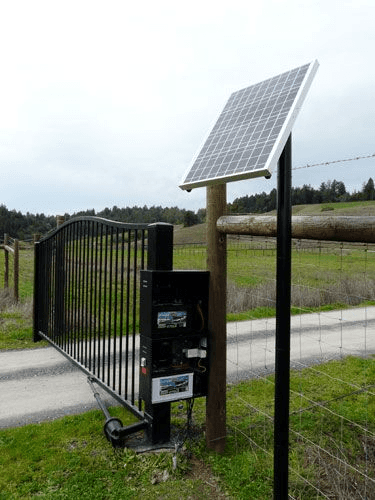
PWM or MPPT?
This distinction is often confused with the inverter question.
Technology | What it does | Best fit |
PWM charge controller | Couples PV array voltage relatively closely to battery charging voltage | Small, inexpensive, correctly matched PV systems |
MPPT charge controller | Tracks the PV array's maximum-power operating point and DC-converts that power to battery voltage | Larger panels, variable conditions, higher-voltage arrays, premium solar systems |
Inverter | Converts battery DC into AC | Only when an AC load/operator requires it |
Victron describes a PWM controller essentially as a switching connection that brings array voltage toward battery voltage, whereas an MPPT controller continuously adjusts PV input to harvest maximum available power and then converts it to the battery/load voltage. Victron reports that MPPT can provide a substantial advantage under low irradiance and certain high- or low-cell-temperature conditions and also enables higher PV-array voltage, which can reduce cable losses.
In current retail examples, the price difference may be surprisingly small. Renogy lists a waterproof 20 A PWM controller at $54.99 and a 20 A Rover MPPT controller at $87.99 at the time of research. Prices can change, but this illustrates why MPPT increasingly makes sense once reliability and solar harvest matter more than the lowest possible component cost.
For a 10 W trickle-charging residential gate, a manufacturer-approved PWM design can be perfectly reasonable.
For a 100–200 W commercial array, limited winter sunshine, a long panel-to-controller cable, or a site where every Wh matters, MPPT is usually the stronger engineering choice. Nice's current Juno and commercial Smart 535 architectures both incorporate maximum-power-point-tracking solar technology.
Typical components and current cost benchmarks
The following prices are U.S. retail/reference prices, not global quotations, and were current when researched in September 2026. They are useful for scale rather than budgeting a specific project.
Component | Representative specification | Current/reference cost | Practical note |
Gate-specific solar kit | Mighty Mule 10 W / 12 V | $149.99 | Includes gate-oriented mounting hardware; manufacturer cycle chart available. |
General rigid PV panel | Renogy 50 W | $55.99 | Panel only; 25.5 V Voc, 21.17 V Vmp. |
Waterproof PWM controller | Renogy Voyager 20 A, 12/24 V | $54.99 | IP67; max PV 260 W at 12 V or 520 W at 24 V. |
MPPT controller | Renogy Rover 20 A, 12/24 V | $87.99 | MPPT, battery-profile charging and monitoring interface. |
LiFePO4 battery | 12.8 V, 20 Ah / 256 Wh | $89.99 | 20 A continuous, 75 A/5 s peak; verify gate charger compatibility. |
Gate automation labor | Professional automatic-gate work | $50–$150/hr in 2026 U.S. Angi data | Geography and scope have a large effect. |
Automating existing gate | Opener + installation | $400–$5,500 broad U.S. range | Not solar-specific; varies strongly by operator and site. |
Full automatic gate installation | Gate + automation | $2,380–$8,000 common 2026 U.S. range | Average reported around $4,000; not a solar-only figure. |
Notice something important: a generic 50 W panel can cost less than a branded 10 W gate-specific kit. This is not contradictory. A kit price can include mounting hardware, connectors, cables, compatibility validation and the manufacturer's support ecosystem. B2B buyers should therefore compare the complete installed system, not $/W alone.
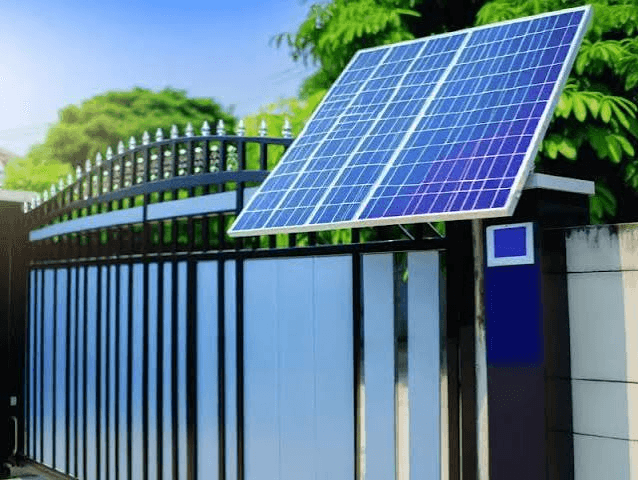
Worked Solar Gate Opener Sizing Calculator
The following examples are intentionally transparent so installers and buyers can substitute their own measurements.
They are illustrative engineering calculations, not model-specific approvals.
Common assumptions for all three examples:
· Native 24 VDC solar-ready gate operator
· One cycle = full open + full close
· 4 peak sun hours/day
· PV-to-stored-energy design factor = 75%
· 25% load/design margin
· Three days battery autonomy
· LiFePO4 usable DoD = 80%, battery efficiency assumption = 90%
· AGM usable DoD = 50%, battery efficiency assumption = 85%
· Gate rolls correctly and is not being forced through mechanical resistance
Manufacturer-specific limits always override these assumptions.
Worked example: 500 kg sliding gate
Assume:
· Gate weight: 500 kg
· System: 24 VDC
· Average motor current while travelling: 6 A
· Full open + close motor runtime: 60 seconds
· Usage: 20 cycles/day
· Average control/accessory standby load: 1.5 W
Now notice the counterintuitive result:
Example | Gate weight | Cycles/day | Design energy | Calculated PV | Practical baseline |
Residential/light duty | 500 kg | 20 | 105 Wh/day | 35 W | 50 W |
Higher-traffic | 800 kg | 30 | 217.5 Wh/day | 72.5 W | 100 W |
Heavy but lower-frequency | 1200 kg | 20 | 195 Wh/day | 65 W | 100 W |
The 800 kg example consumes more energy per day than the 1200 kg example.
That is not an error.
It demonstrates the most important sizing principle in this article:
Solar panel size is driven by energy consumption, not gate weight alone.
The 800 kg example performs more daily cycles and has a longer assumed travel time.
What happens with only 2.5 peak sun hours?
This is why installers should never size only for a sunny-season average.
Keeping the same energy loads but reducing the site to 2.5 peak sun hours:
· 500 kg example:
· 800 kg example:
· 1200 kg example:
The same gates now point toward roughly 80 W, 150 W and 150 W practical arrays, respectively.
DOE notes that solar production changes with season and weather, so annual-average sunlight is not sufficient when year-round reliability is required.
How many days of battery backup should you design for?
There is no universal number.
For a sunny residential site, two or three days can be a reasonable design target.
For a critical farm entrance, commercial property, cloud-prone climate or site with emergency-access requirements, additional autonomy may be justified.
So the battery bank could move from approximately 40–50 Ah to around 70 Ah nominal after practical rounding.
That is why “What size battery does a solar gate opener need?” cannot responsibly be answered with a universal “7 Ah” or “20 Ah.”
Nice's product range reinforces this point. Its residential Juno Solar ships with two 7 Ah batteries, while the commercial Smart 535 platform supports upgrading to 35 Ah batteries for solar applications and publishes substantially higher backup-cycle capability with larger battery configurations.
Solar Gate Opener Cost, ROI and Solar vs Grid Power
A solar gate opener can be cheaper than grid power, more expensive than grid power—or economically neutral.
The site decides.
The wrong way to calculate ROI is:
Solar panel costs $500 ÷ electricity savings = payback.
where total cost of ownership includes:
· operator
· solar panel or utility connection
· battery bank
· charge controller
· wiring
· mounting
· trenching
· conduit
· electrician
· permits
· battery replacement
· scheduled maintenance
· electricity
· failure/downtime risk
2026 Angi data puts a complete U.S. automatic-gate installation broadly at $2,380–$8,000, with professional labor commonly around $50–$150 per hour. HomeGuide's broader automatic-driveway-gate data puts automation of an existing gate at approximately $400–$5,500, while solar functionality or electrical power-source work can add hundreds to thousands depending on configuration and site. These figures are U.S.-specific and should not be treated as global pricing.
One recent 2026 Los Angeles installer guide quotes solar gate systems with battery backup around $2,200–$5,500 installed for residential applications and emphasizes that avoided trenching is a major driver of solar economics. Those figures are local-market examples rather than national benchmarks.
Illustrative ROI example: grid power already beside the gate.
Assume:
· grid-ready operator can use an existing nearby circuit
· incremental solar hardware/installation premium: $600
· electricity avoided: $60/year
· ignore battery replacement for the first simple calculation
Once periodic battery replacement is considered, solar may never provide an attractive purely energy-bill payback in this scenario. Angi estimates annual gate electricity at roughly $30–$100 for many automatic-gate installations, illustrating why energy savings alone are usually not the strongest financial case.
Here, choose solar for resilience, off-grid operation or sustainability goals, not because it will necessarily produce rapid utility-bill savings.
Illustrative ROI example: remote driveway entrance.
Assume, for illustration:
· solar-ready operator solar hardware/install premium: $1,500
· bringing utility power to the remote gate with trenching, conduit and electrical work: $3,500
· both figures are site quotations, not universal averages
There is no conventional payback period: solar is already financially ahead on day one.
This is the classic farm, ranch, estate and long-driveway solar use case. LiftMaster itself promotes solar-ready gate operators partly on the benefit of avoiding the need to trench a driveway for power.
Illustrative high-cycle commercial case.
Suppose a facility already has grid power within a few meters of a gate. A robust solar installation requires a 100–200 W array, larger battery bank, MPPT charging, monitored safety devices and perhaps redundant charging reserve.
In that environment, solar may cost more upfront than connecting the operator to existing mains. Even if the electricity bill falls by $100 per year, battery replacement and inspection obligations remain. The business case then depends less on utility savings and more on resilience, construction constraints or the cost of maintaining an underground power route. Angi's 2026 operating-cost data supports the broader conclusion that gate electricity consumption by itself is usually not large enough to justify a sophisticated solar system quickly.
Commercial solar is nonetheless technically viable. Nice's Smart 535 supports 24 V brushless DC motors, battery upgrades for solar use, integrated solar management and a 200 W MPPT charging architecture; its published backup capability reaches up to 450 cycles with battery upgrades.
Solar versus grid-powered gate openers
Factor | Solar gate opener | Grid-powered gate opener |
Remote locations | Excellent | Can require long electrical run |
Trenching | Often avoidable | Often required when power is remote |
Night operation | Yes, from battery | Yes |
Power outages | Continues while battery has reserve | Needs battery/generator backup |
Cloudy weather | Limited by PV production + battery autonomy | Largely unaffected |
High traffic | Possible with engineering | Usually easier |
Shaded site | Major disadvantage | Little impact |
Battery required | Normally yes | Optional on some operators |
Energy bill | Very low/no gate-grid consumption | Usually modest |
Maintenance | PV + battery + gate | Gate + electrical supply |
Design complexity | Solar resource must be calculated | Electrical installation must be engineered |
Best use | Remote/off-grid entrances | High-cycle sites with nearby utility power |
Solar is therefore not categorically “better.” It is better where its system architecture solves a real site problem.
Sliding vs Swing Gates, Weight Classes, Problems and Maintenance
Solar works with both sliding and swing gates.
What matters is whether the operator is designed for battery/solar operation and whether the solar generator can support the actual energy budget.
Swing gates. A single swing gate can be a particularly good solar candidate because many residential linear-arm operators are already based on low-voltage DC architecture. Dual swing gates require two actuators, so movement energy can increase materially. Swing gates also experience wind loading differently from sliding gates, especially when they use solid infill panels. LiftMaster currently offers solar-ready low-voltage residential/light-commercial swing operators, demonstrating that solar is a mainstream power option rather than a niche retrofit.
Sliding gates. Solar is also highly practical for sliding gates when the track, rollers or cantilever system move freely. Sliding gates are especially attractive at long rural driveways because the operator and solar array can be installed near the gate without trenching all the way back to the building's electrical service. Nice's 12 VDC Juno is a current solar-optimized residential slide operator; its official specifications explicitly connect required battery capacity with cycles, connected accessories and sunlight hours.
For a 500 kg gate: Solar is generally technically straightforward when a suitable DC operator exists, traffic is residential or moderate and the gate rolls smoothly. A 50–100 W array with an appropriately sized battery can be a reasonable starting engineering range, but the worked calculation—not the gate weight alone—must determine the actual size.
For an 800 kg gate: Solar remains practical. Expect to pay closer attention to 24 V architecture, peak current, gate travel time and reserve capacity. High daily traffic can push the array toward 100–200 W even though the motor's mechanical capacity is only 800 kg.
For a 1200 kg gate: Solar is possible but should be engineered rather than assembled from a generic “solar gate kit.” Current commercial 24 V operators exist at this mechanical load level; CAME's 2026 BKX12AGM, for example, is a 24 V brushless sliding-gate operator rated up to 1,200 kg. Solar compatibility of a specific controller still must be confirmed independently—the fact that the motor itself is 24 V does not automatically make the complete operator solar-ready.
For a 1500 kg gate: Treat the project as commercial/industrial. A 1500 kg rating does not automatically mean the gate consumes huge daily energy, but the consequences of undersizing become more serious: motor starting current, control electronics, battery peak discharge, recovery after cloudy periods, gate duty cycle and safety-device consumption all require verification. The current Nice Smart 535 platform demonstrates commercial solar architecture up to 1,500 lb/680 kg, while LiftMaster offers much heavier 24 VDC commercial slide operators; this shows that high-capacity battery-based gate automation is technically established, but 1,500 kg solar should be specified from an operator manufacturer's approved engineering data rather than extrapolated from a residential kit.
Common solar gate opener problems
Symptom | Most likely areas to check |
Works in daytime, fails overnight | Weak/undersized battery, battery not reaching full charge |
Works after sunny days, stops after cloudy period | Too little autonomy or undersized PV array |
Battery never fully charges | Shading, dirty panel, poor orientation, controller/wiring fault, insufficient PV |
Gate gets slower before failure | Low battery voltage, mechanical resistance, aging battery |
Battery repeatedly fails early | Chronic undercharge, excessive DoD, wrong charging profile, heat |
Solar output suddenly drops | Dirt, shade, damaged wiring/connectors, panel/controller problem |
Gate works until Wi-Fi/intercom added | Accessory standby load exceeded design budget |
Controller shows battery/solar errors | Wrong battery type/settings, voltage mismatch, wiring fault |
Large AC opener drains battery quickly | Inverter losses/standby plus operator consumption may be too high |
System fails only in winter | PV system was sized from summer sunlight rather than worst-season resource |
The U.S. Department of Energy confirms that shade, clouds, dust, dirt and weather reduce PV production, while battery manufacturers warn that repeated undercharging or excessively deep discharge can shorten lead-acid battery life.
A surprisingly common failure is adding accessories after commissioning without recalculating the solar budget. Nice explicitly warns on the Juno Solar specification that connected accessories, cycles per day and sunlight hours can require additional battery capacity.
Another is an undersized panel combined with an oversized battery. A huge battery provides more autonomy, but if the panel cannot replace average daily consumption and restore the battery after cloudy days, the system slowly walks toward a low state of charge.
The reverse can also happen: a large panel and small battery may generate enough daily Wh while providing insufficient overnight autonomy or peak-current capability.
Maintenance that actually matters
A solar automatic gate still needs gate maintenance.
The solar components do not fix poor mechanical installation.
Keep the sliding track, rollers, hinges, guides, rack and pinion mechanically sound so that resistance does not rise over time. Increasing mechanical resistance increases motor current and therefore changes the energy budget.
The PV surface should remain free from significant dust, pollen, leaves and other contamination. Mighty Mule specifically instructs owners to clean its solar panel with mild soap and water and notes that dust, dirt and pollen can reduce output; it also cautions against wetting electrical junctions and wiring unnecessarily.
Battery terminals, cables and controller connections should be inspected for corrosion, looseness and heat damage. Renogy similarly recommends inspecting controller wiring and terminals for loose, broken or burnt connections.
For lead-acid systems, verify that charging regularly reaches the manufacturer's required full-charge state; repeated partial-state operation can shorten life. Trojan identifies undercharging, prolonged discharged storage and overcharging as common causes of premature lead-acid battery problems.
For lithium batteries, confirm low-temperature charging behavior. The current Renogy 20 Ah LiFePO4 example permits discharge below freezing but specifies charging from 0°C/32°F upward and includes low-temperature protection. Battery temperature limits are product-specific.
For U.S./North American vehicular gates, solar power does not change the underlying automated-gate safety requirements. UL 325 addresses automatic gate-operator safety and entrapment protection, while gate construction requirements are covered separately by ASTM F2200. Safety devices should never be removed simply to reduce solar accessory load.
FAQ, SEO Package, Internal Links and Authoritative Sources
How many times can a solar gate opener open per day?
There is no universal number. It depends on solar-panel watts, sunlight, battery size, operator efficiency, gate travel time and accessories. As a real manufacturer example, Mighty Mule's current chart estimates 16–26 single-gate openings/day from a 10 W panel in its Zones 2–3 and 20–54 openings/day from 30 W depending on solar zone, assuming eight hours of sunlight and a fully charged battery. Larger professionally designed systems can support far more traffic.
Does a solar gate opener work on cloudy days?
Yes, primarily because the gate operates from stored battery energy. Cloud cover reduces PV generation, so reliability depends on the battery's autonomy and whether the panel is large enough to recover afterward. DOE confirms that clouds and other environmental factors reduce solar production and that storage allows energy to be used when solar production is low.
Does a solar gate opener work at night?
Yes. A properly designed system uses its battery after sunset. The panel replenishes that battery when adequate sunlight returns.
Is a 10 W solar panel enough for a gate opener?
Sometimes. Mighty Mule publishes a gate-opening chart for its 10 W system, proving that this size can work on compatible low-energy residential products in adequate sunlight. It should not be generalized to an 800 kg or 1200 kg commercial sliding gate.
Is a 20 W solar panel enough?
Potentially for a low-cycle, low-standby residential system. Calculate daily Wh and use local peak sun hours. Do not select 20 W simply because another gate of similar weight uses it.
Is a 50 W solar panel enough for a sliding gate?
For the 500 kg illustrative example in this guide, 50 W was a reasonable baseline at four peak sun hours. For the 800 kg example, it was undersized. The correct answer depends on energy consumption, not whether the gate is sliding.
What size solar panel do I need for an 800 kg gate?
There is no fixed 800 kg-to-watt conversion. In our stated example—24 V, 9 A average motor current, 70 seconds per cycle, 30 cycles/day, 2 W standby and four peak sun hours—the calculated requirement was 72.5 W, making 100 W a practical baseline. Change the traffic or sunlight and the answer changes.
Can solar power a 1200 kg sliding gate?
Yes in principle, provided a suitable battery/DC operator architecture is available and the complete load is engineered. Current 24 V commercial gate operators exist in the 1200 kg class, but the operator manufacturer must confirm solar charging and battery compatibility.
Can solar power a 1500 kg sliding gate?
Potentially, but this should be treated as a commercial engineering project rather than a generic DIY solar kit. Gate weight, length, motor current, cycles/hour, accessories, worst-season solar resource, autonomy and charging-recovery time must all be calculated.
Which is better for a gate opener, MPPT or PWM?
PWM is attractive for very small, low-cost, voltage-matched systems. MPPT is generally preferable as array size grows, sunlight becomes more variable, panel voltage differs significantly from battery voltage, or maximum energy harvest matters. Victron documents the technical differences and reports significant MPPT gains under certain low-irradiance and temperature conditions.
Do I need an inverter for a solar gate opener?
Not when a compatible native DC operator and control system can run directly from the battery architecture. An inverter is normally relevant when the load requires AC. MPPT or PWM does not replace the inverter; those technologies regulate PV-to-battery charging.
Can I convert an AC gate motor to solar?
Technically, an off-grid battery system can power some AC loads through a correctly sized inverter, but this is not equivalent to converting the motor into a solar-ready DC operator. The inverter must tolerate motor starting current and adds another power-conversion stage. For a new off-grid installation, a manufacturer-approved DC solar-ready operator is generally the cleaner architecture.
Which battery is better: AGM or LiFePO4?
AGM is established, relatively simple and widely used in gate automation, but routinely using only around half its nominal capacity helps preserve life. LiFePO4 can provide more usable energy per nominal Ah and potentially much higher cycle life, but charger/BMS compatibility and low-temperature charging requirements must be verified.
Is a solar gate opener worth it?
It is often highly worthwhile when the gate is remote from utility power. It is less financially compelling when a reliable electrical supply already exists beside the gate. Because typical gate electricity consumption is comparatively modest, the strongest ROI usually comes from avoided trenching and electrical infrastructure, not electricity-bill savings.
Are solar sliding gates better than solar swing gates?
Neither is automatically better. Sliding gates need healthy rollers/track or cantilever hardware; swing gates must deal with hinge condition and wind loading. The decisive variables for solar are motor energy, cycle count, standby load and the availability of a compatible DC operator.
How often should I clean a solar gate panel?
There is no universal schedule because dust, pollen, rainfall, bird contamination and site conditions vary. Inspect the panel periodically and clean it when contamination is reducing exposure. Mighty Mule recommends mild soap and water and warns that dust, dirt and pollen can reduce panel voltage/output.
What is the biggest solar gate sizing mistake?
Choosing a panel from gate weight alone. The correct design starts with daily Wh, peak solar resource, battery autonomy and accessory consumption.
Mighty Mule 10-Watt Solar Panel Kit for Gate Openers | FM123
Which solar charge controller: PWM or MPPT? - Victron Energy
Other Blogs


