Blog
Industrial Sectional Door Motor vs Rolling Shutter Motor: Key Differences, Sizing & Selection Guide
Author
Ray
Published
Category
Roller Shutter Motor
Compare industrial sectional door motors vs rolling shutter motors: drive types, torque needs, duty cycle, safety options, and a practical selection checklist.

Author
Ray
An experienced automation specialist with a strong background in motor technology and industrial solutions. With years of expertise in central motors, tubular motors, and automation systems, the author is dedicated to sharing insights that connect engineering innovation with real-world applications. Passionate about advancing reliable, energy-efficient, and high-performance automation products for global markets.
What’s better than insider perks, pro tips, and surprises?
Sign up to get the most recent blog articles in your email every week.
Join now.
WHY I WRITE THIS
About my business
Our company’s main product lines include tubular motors, sliding gate motors, swing gate motors, roller shutter motors, and other door automation solutions, all manufactured by trusted partner factories we have worked with for many years.
Our Services
I help them with sales and export operations, while our company also provides sourcing and procurement services in China to help international clients solve supply-related challenges. If you need assistance with procurement, please feel free to contact us.
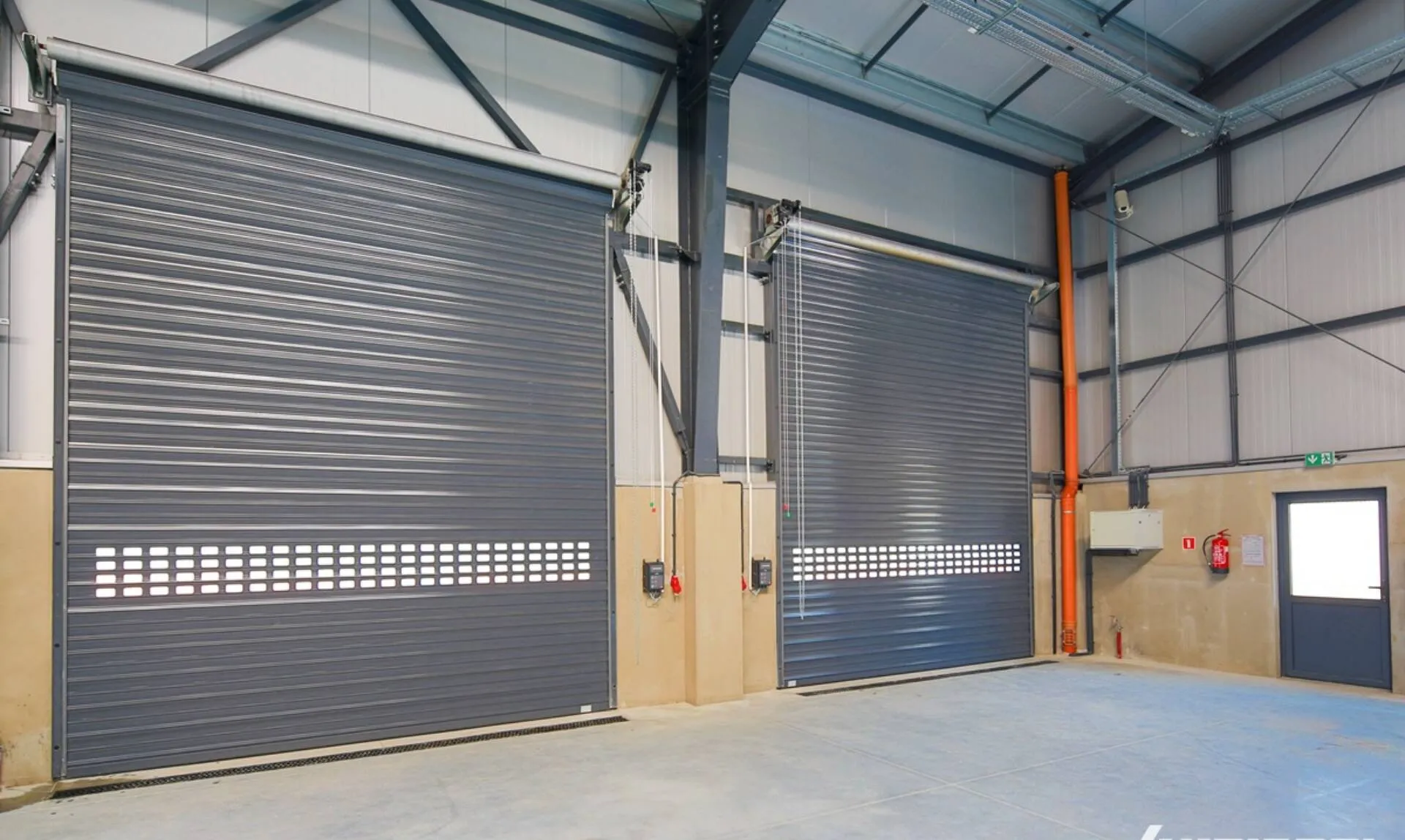
Choosing the right motor for an industrial door is not a “bigger motor = better” decision. Industrial sectional door motors and rolling shutter motors are designed for fundamentally different door mechanics and load profiles. A sectional door is typically spring-balanced and guided on tracks; a rolling shutter is a curtain that wraps around a barrel and loads the drive system differently through the travel. That difference affects everything—required torque, duty cycle, braking, limits, controls, safety integration, and long-term reliability.
Bottom line:
Choose a sectional door motor when you need smooth control, frequent cycles, and robust safety/automation integration—especially for logistics bays and insulated doors.
Choose a rolling shutter motor when you need a compact, rugged solution for security and access—often with simpler mechanics and easier installation in tight headroom.
Key Takeaways
Door type determines motor type. Sectional doors (tracks + spring balance) and rolling shutters (barrel roll-up) have different torque curves and control needs.
Sectional door motors rely on a properly balanced door. If springs are misadjusted, any motor will suffer from overload, rough stopping, and premature wear.
Rolling shutter motors are torque-driven. Correct torque, braking/holding capability, and barrel/curtain compatibility are critical.
High-cycle openings typically favor sectional systems; rolling shutters can be high-cycle too, but only with motors rated for the duty cycle and thermal management.
Don’t size by horsepower alone—size by door weight, balance condition, barrel diameter (rolling), duty cycle, safety devices, and control requirements.
1) How the door mechanics change the motor’s job
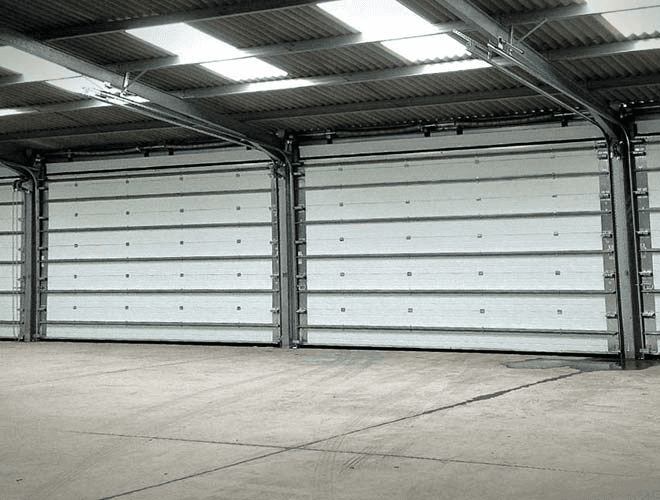
Industrial sectional doors: spring-balanced, track-guided
A sectional door is made of panels that travel up vertical tracks and then horizontal tracks under the ceiling. Most industrial sectional doors use torsion springs (or counterbalance systems) to offset door weight.
What the motor actually does (in a healthy system):
Overcomes friction in tracks and rollers
Handles inertia during start/stop
Manages sealing resistance (especially insulated/high-seal doors)
Provides controlled motion and safe stopping
Implication: The motor is part of a controlled motion system more than a pure lifting machine—assuming the door is correctly balanced.
Rolling shutters: curtain roll-up with changing effective radius
A rolling shutter is a curtain (slats) that wraps onto a barrel. Load characteristics can vary through the travel because the curtain builds up on the barrel, changing the effective radius.
What the motor must do:
Provide sufficient torque to lift the curtain on the barrel
Hold the load safely at stop (brake/gearbox integrity)
Tolerate harsher environments (dust, moisture, temperature swings) common at exterior openings
Implication: Rolling shutter motors are often selected first by torque and robustness, then by control features.
2) Motor architecture & drive method: what you’ll actually see on-site
Typical sectional door motor types (industrial)
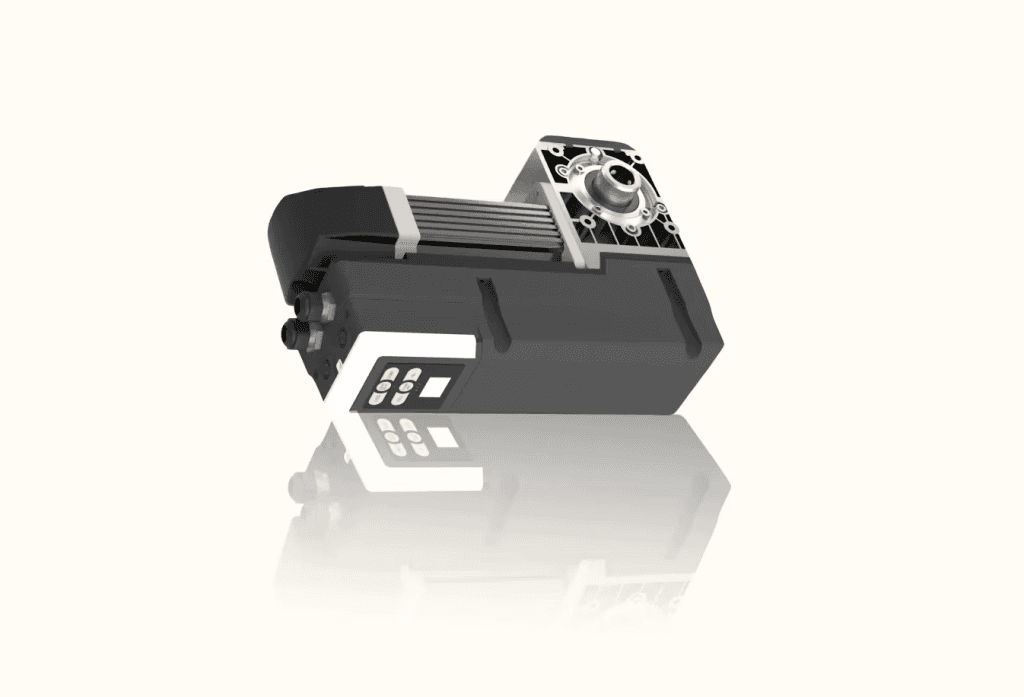
Jackshaft / side-mounted operator: Mounted at the torsion shaft; drives the shaft directly via coupling or chain. This is the most common industrial approach.
Trolley/rail operator: More common in lighter-duty applications; less common for heavy industrial, high-cycle use.
Why jackshaft is common: It’s compact, powerful, and integrates well with industrial control/safety systems.
Typical rolling shutter motor types
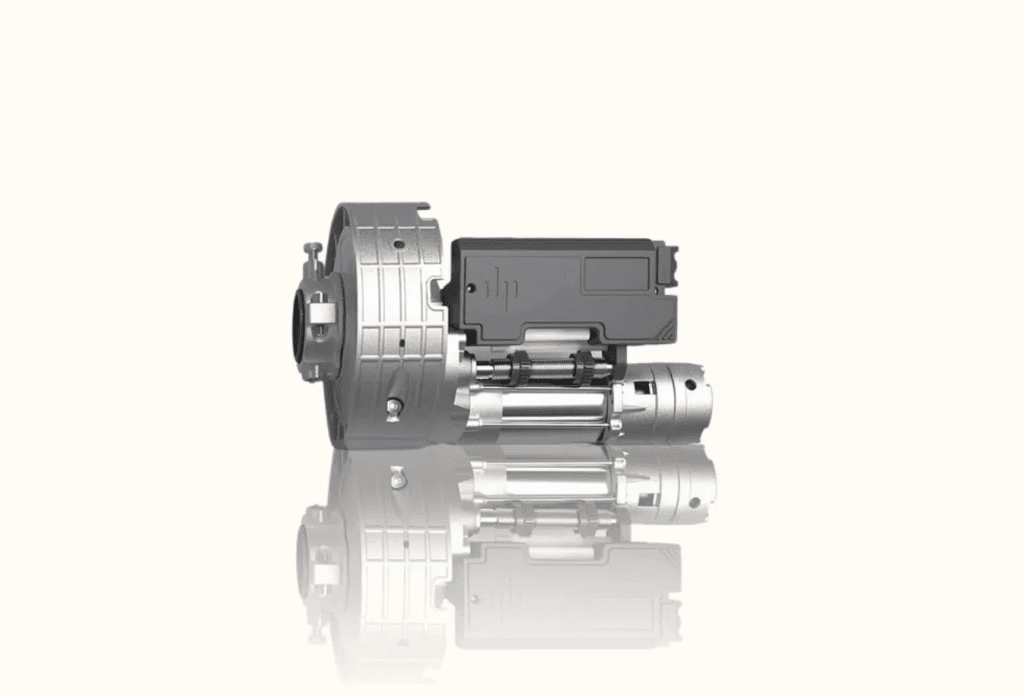
Side-mounted rolling shutter motor: Chain-driven or direct-coupled to the barrel shaft; common for larger and heavier shutters.
Tubular motor: Often used for smaller rolling shutters; not always suitable for large industrial curtains.
Common accessory: Manual override (hand chain/crank) for power failure scenarios.
3) Sectional vs rolling shutter: practical comparison table
Factor | Sectional Door Motor | Rolling Shutter Motor |
|---|---|---|
Door mechanics | Track-guided panels, spring-balanced | Curtain wraps on barrel |
Primary sizing focus | Balance + control + duty cycle | Torque + holding/braking + barrel fit |
Motion quality | Smooth start/stop and precise limits are critical | Robust lifting/holding is critical |
Safety integration | Often extensive (photo eyes, safety edge, interlocks) | Also important; often simpler but depends on application |
Best fit | Logistics bays, insulated doors, frequent cycles | Security openings, compact headroom, rugged environments |
Common failure driver | Poor door balance, mis-set limits, impact damage | Under-torqued motor, brake wear, curtain/barrel mismatch |
4) Sizing and selection: a field-proven workflow
Step 1: Confirm door fundamentals
Collect or verify:
Door type: sectional vs rolling
Clear opening size (W × H)
Door weight (manufacturer spec preferred)
Environment: indoor/outdoor, dust, humidity, temperature
Usage frequency: cycles/day and peak-hour demand
Speed requirements (standard vs high-speed needs)
Step 2: Define the “duty cycle reality”
Ask operational questions:
Is this a dock door running every few minutes?
Does it open/close in bursts (shift changes) or evenly throughout the day?
Is it part of an interlock system (airlock, cleanroom, security gating)?
Why it matters: Duty cycle drives motor thermal sizing, gearbox selection, brake wear expectations, and control strategy.
Step 3: Decide on safety & control requirements early
Common industrial requirements include:
Photo eyes
Safety edge (bottom edge)
Emergency stop
Audible/visual warning (where required)
Access control integration (RFID, keypad, PLC, fire system)
Compliance requirements vary by country/region and application. Validate with local codes and standards: [source placeholder: applicable industrial door safety standards].
Step 4: Do the “system-specific” checks
For sectional doors (critical check): balance condition
Before final motor selection, confirm the door is correctly balanced:
With the door disconnected from the operator (performed by qualified personnel), it should move smoothly and not free-fall or rocket upward.
Poor balance causes high load, harsh stopping, and frequent faults regardless of motor size.
Rule of thumb (engineering mindset): Fix balance first, then size the operator.
For rolling shutters (critical check): torque and barrel geometry
Rolling shutters demand correct:
Curtain weight
Barrel diameter and build-up
Gearbox/brake capability
End-locking/anti-drop considerations (application-specific)
If the barrel geometry or curtain configuration changes, torque requirements can change meaningfully.
Step 5: Confirm limits, braking, and control box features
At industrial scale, these features matter more than raw wattage:
Reliable limit setting (mechanical/electronic depending on model)
Brake/holding reliability under load
Soft start/soft stop (often reduces shock and wear)
Overload/overcurrent protection and fault reporting
Manual release/override method and safety interlocks
Step 6: Plan maintenance and spare parts from day one
Downtime is expensive. Decide:
What wear parts should be stocked (limit parts, brake components, chains, sprockets, control relays, etc.)
Service access requirements (is the motor reachable without a lift?)
Documentation and wiring diagrams availability
5) When a sectional door motor is the better choice
Choose an industrial sectional door operator when you have:
High cycle frequency (logistics, warehouses, distribution centers)
Insulated or high-seal doors (higher resistance, more need for controlled motion)
Requirements for robust automation and safety integration
A need for smoother, quieter, more controlled operation
What to specify clearly:
Required cycles/day and peak throughput
Control interfaces (push buttons, radar, PLC, interlocks)
Safety device compatibility (photo eyes, safety edge)
Power supply availability (single/three-phase, voltage stability)
6) When a rolling shutter motor is the better choice
Choose a rolling shutter motor when you have:
Tight headroom and a preference for simple mechanics
Security-focused openings (warehouses, back-of-house, industrial partitions)
Harsher environments (dust, moisture) where rugged construction and sealing matter
A cost-sensitive project where the structure and controls are simpler
What to specify clearly:
Curtain weight and barrel dimensions
Required torque and braking/holding performance
IP rating/environmental protection needs
Manual override requirements for power outages
7) Common selection mistakes (and how to avoid them)
Mistake 1: Sizing by horsepower only
Horsepower can be misleading without torque, gearbox ratio, duty cycle, and system design context. Use performance and duty cycle specs—not marketing shorthand.
Mistake 2: Oversizing the motor to “solve” a bad sectional door balance
A poorly balanced sectional door will destroy a motor faster. Balance and hardware condition must be corrected first.
Mistake 3: Underestimating rolling shutter torque due to barrel build-up
Curtain build-up changes effective lifting radius. Ensure the motor selection accounts for real curtain/barrel geometry.
Mistake 4: Ignoring braking and stopping behavior
Industrial doors are safety-critical. Specify braking/holding performance and limit reliability, especially for heavier shutters and high-traffic openings.
Mistake 5: Designing controls last
Safety devices, interlocks, and automation can dictate the operator/controller choice. Define control requirements before purchasing.
8) A simple decision guide
Choose a sectional door motor if you need:
frequent daily cycles
smooth motion and precise stopping
strong safety integration and automation
better sealing/insulation performance in a logistics environment
Choose a rolling shutter motor if you need:
compact, rugged operation
security-first design
straightforward installation in limited headroom
reliable torque and load holding for a roll-up curtain
Conclusion
“Industrial sectional door motor vs rolling shutter motor” isn’t just a product comparison—it’s a system decision. Sectional doors reward good balance, controlled motion, and robust safety integration. Rolling shutters reward correct torque matching, strong braking, and durable construction for real-world environments.
If you want fewer breakdowns and less downtime, build your selection around:
door mechanics and load profile
duty cycle and environment
safety + control integration
maintainability and spares
If you share your door type, opening size, approximate weight, cycles/day, and power supply, we can translate that into a practical motor/control configuration checklist suitable for procurement and installation planning.
FAQ
1) Can I use a rolling shutter motor on a sectional door (or vice versa)?
Generally, no. The door mechanics, load curve, mounting method, and control requirements differ. Use the operator designed for the door system.
2) Why does sectional door balance matter so much?
Because springs should counterbalance most of the door’s weight. If the door isn’t balanced, the operator is forced to “lift the weight,” causing overload, rough operation, and early failure.
3) What matters most when choosing a rolling shutter motor?
Correct torque, braking/holding reliability, compatibility with the barrel/curtain geometry, and environmental protection (IP rating) for the installation site.
4) Which motor is better for high-cycle logistics doors?
Sectional door operators are commonly preferred for high-cycle dock doors due to smooth control, safety integration, and suitability for insulated doors—assuming the door is properly balanced.
5) Do I need soft start/soft stop?
It’s not always mandatory, but it often reduces shock loads, noise, and wear—especially for large doors and frequent operation.
Other Blogs