Blog
How To Choose The Right Shutter Motor: A Complete Torque And Weight Calculation Guide
Author
Ray
Published
Category
Roller Shutter Motor
Learn how to size a shutter motor using door weight, drum size, efficiency, and safety factor—plus examples for garage & industrial shutters.


Author
Ray
An experienced automation specialist with a strong background in motor technology and industrial solutions. With years of expertise in central motors, tubular motors, and automation systems, the author is dedicated to sharing insights that connect engineering innovation with real-world applications. Passionate about advancing reliable, energy-efficient, and high-performance automation products for global markets.
What’s better than insider perks, pro tips, and surprises?
Sign up to get the most recent blog articles in your email every week.
Join now.
WHY I WRITE THIS
About my business
Our company’s main product lines include tubular motors, sliding gate motors, swing gate motors, roller shutter motors, and other door automation solutions, all manufactured by trusted partner factories we have worked with for many years.
Our Services
I help them with sales and export operations, while our company also provides sourcing and procurement services in China to help international clients solve supply-related challenges. If you need assistance with procurement, please feel free to contact us.
Selecting an electric shutter motor is mostly a torque sizing problem, not a brand problem. In practical terms: you estimate the real door weight, identify the drum radius the curtain wraps around, then adjust for friction, efficiency, and a safety margin. The result tells you the minimum shutter door motor torque (in Nm) you should buy—so the door lifts smoothly without overheating, stalling, or wearing out early.
The short answer: what to calculate (and what to ignore)
If you only remember one thing from this guide, make it this:
Torque requirement is driven by: door weight, drum radius, friction, and efficiency.
Motor “power” (kW) matters, but torque is the first gate. A motor can have decent power on paper and still struggle if the output torque at the shaft is insufficient.
Ignoring friction and safety margin is the most common reason doors feel “fine” during install but fail months later.
This article focuses on roller shutter door motor torque calculation in a field-friendly way—with clear steps and examples—so you can size confidently for garage, commercial, and industrial shutter door motor applications.
Key takeaways (read this first)
Start with door weight. Use the manufacturer’s curtain weight if available; otherwise estimate using curtain area and slat type, plus bottom bar and accessories.
Measure drum radius (not just shaft diameter). Torque increases as the wrap radius increases.
Add real-world losses. Guides, misalignment, chain/gear losses, and poor maintenance all raise torque demand.
Use a safety factor. Doors don’t get lighter over time; they get dirtier and less aligned.
Choose motor type to match the job. A central roller shutter motor can be ideal for many shutters; some doors need side-mounted operators, higher duty ratings, or stronger braking.
Validate with a site test when possible. If the door is already installed, measuring actual lifting effort is the fastest way to avoid under-sizing.
Torque, weight, and drum radius—explained without the engineering headache
What “Nm torque” means for shutter doors
Torque (Nm) is simply turning force. For a roller shutter door, the motor is trying to rotate the barrel so the curtain wraps up. The heavier the door and the larger the wrap radius, the more torque you need.
A simple way to think about it:
Heavier door → more turning force needed
Bigger drum/wrap radius → more turning force needed
More friction/poor alignment → more turning force needed
This is why two doors with the same opening size can need very different motors.
Why drum radius and shaft diameter change motor sizing
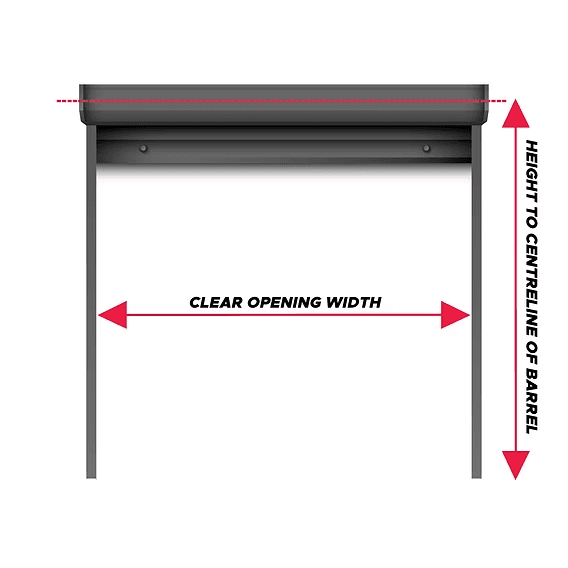
Many people measure the shaft diameter and stop there. But what matters to torque is the effective radius where the curtain load acts—often close to the drum/wrap radius once the curtain starts rolling up.
As the door opens, the wrap builds up slightly, and the working radius can increase. That means your motor must handle the worst-case condition, not just the “empty barrel” condition.
Step 1: Calculate (or estimate) the real door weight
Your door weight calculation is the foundation. If the weight is wrong, everything downstream is wrong.
When you can use the nameplate or supplier spec
Best case: you have one of these:
Curtain/slat weight from the door manufacturer
As-built drawing with curtain weight and bottom bar weight
Existing motor documentation specifying door mass and balance method
If you trust the source and the door hasn’t been modified, this is the fastest path.
How to estimate weight from curtain size and slat type
When you don’t have the spec, estimate using:
Door clear opening width × height (curtain area)
Slat profile and thickness (steel vs aluminum, insulated vs non-insulated)
End locks, wind locks, reinforcement (common on wider industrial openings)
Practically, installers often get the slat weight per square meter from a supplier datasheet, then multiply by door area and add extras. (You don’t need to write the math as a formula—just keep a clear worksheet.)
Don’t forget bottom bar, guides, and accessories
Add the weight of:
Bottom bar (often heavier than people expect)
Safety edge / sensor strip
Vision panels (if present)
Grilles (different mass distribution)
Any special locking or anti-lift devices that add drag
Also note: guide rails don’t “weigh” on the motor the same way, but guide friction absolutely increases torque demand, especially if rails are tight, dented, dirty, or misaligned.
Step 2: Convert door weight into lifting demand (the practical way)
The motor isn’t lifting kilograms; it’s lifting force. For quick estimation, it’s enough to remember:
1 kg of mass creates about 9.8 N of downward force (near Earth gravity)
So if your curtain assembly is roughly 100 kg, the lifting force is roughly “100 × 9.8” in Newtons. You can keep it as a practical approximation without overthinking it.
Counterbalance vs non-counterbalance shutters
Not all roller shutters behave the same:
Spring-balanced shutters (common in smaller doors): springs carry some of the door weight. The motor may only “see” a portion of the load, but it still must overcome friction, inertia, and imbalance over travel.
Direct drive / gear-operated industrial shutters: the motor typically carries most of the lifting load, plus friction and system losses.
If the door is properly balanced, required torque can drop significantly. If it’s poorly balanced, torque can spike and cause stalling, overheating, or gearbox damage.
Friction and misalignment: the hidden load
Real doors rarely run perfectly:
Guides may pinch the curtain
The barrel may not be level
Bearings may be worn
Curtains may be damaged or dirty
Wind locks may add drag (sometimes intentionally)
Treat friction as a real design input, not an afterthought. This is where a safety margin becomes essential.
Step 3: Determine drum radius (and why it’s not “one size fits all”)
Torque demand scales with how far from the center the load is applied.
In shutter terms: the larger the drum radius, the more torque is required to lift the same door.
Common drum sizes for garage vs industrial shutters
While exact sizing varies by manufacturer and curtain type:
Garage/retail shutters often use smaller barrels and lighter curtains.
Industrial roller shutter doors (wider, thicker slats, wind-rated designs) often use larger barrels to manage curtain roll-up diameter and stress.
The point isn’t a universal number—it’s that you must measure or confirm the barrel/drum dimensions for your exact door.
How larger drums increase torque requirement
If you swap to a larger barrel (or the effective wrap radius grows significantly with thicker slats), the motor has to provide more turning force to produce the same lift.
This is one reason retrofits go wrong: a new curtain or slat profile changes the wrap behavior, but the old motor remains.
Step 4: Apply efficiency and a safety factor (so it works in real life)
A perfect, frictionless drive system doesn’t exist. Your motor torque at the output must cover:
lifting demand
plus losses in the drive system
plus a reserve for aging, temperature, and imperfect installation
Drive system efficiency (gearbox, chain, sprockets)
Depending on design, you may have:
Direct drive tubular/central arrangements
Gearbox with output shaft
Chain-driven reduction
Sprockets and couplings
Each interface introduces losses. A conservative approach is to assume meaningful efficiency loss unless you have verified manufacturer efficiency data.
Duty cycle and starts/stops (industrial vs residential)
A motor that works for a residential shutter may fail quickly on an industrial bay door simply because of usage.
Consider:
cycles per day (10 vs 100+)
long open/close runs (tall doors)
frequent starts/stops (traffic control)
heat buildup in motor and brake
For high-cycle sites, prioritize motors rated for higher duty and better thermal performance—not just higher nominal torque.
Wind load and large openings
If the door is exposed to wind or is part of a loading dock environment:
wind pressure can push the curtain into guides, increasing friction
wider doors are more likely to rack/misalign under load
wind locks can add drag
If wind load is a real factor, treat it as a reason to increase torque margin and improve guide alignment—not as an afterthought.
Step 5: Select the motor type and rating (central motor, side motor, etc.)
Once you’ve determined the torque requirement for the door motor, choose a motor architecture that matches installation constraints and performance needs.
Central roller shutter motor vs side-mounted operator
Central roller shutter motor (often mounted within/at the barrel line) is common when you want a compact, integrated drive arrangement. It can be a strong choice for many shutters where space and alignment are well controlled.
A side-mounted operator may be preferable when:
the barrel assembly design requires it
you need easier access for service
torque requirements are very high
the door uses chain reduction or special brackets
Your selection is not only about torque; it’s also about serviceability, mounting geometry, and safety features.
Brake, manual override, and limits: “must-have” features
For most commercial and industrial shutters, look for:
Fail-safe braking to hold the curtain when stopped
Manual override (crank/chain) for power outages, where required
Reliable limit switches (mechanical or electronic) to prevent over-travel
Thermal protection to reduce burnouts during jam conditions
Optional: encoder/position feedback for frequent cycling and control integration
These are critical to both performance and safety. Local regulations may also apply. (Consult applicable standards for your country/region.) [source needed]
Matching speed and power (kW) to the application
People often search roller door motor power calculation, but in practice:
Torque ensures the door can lift.
Speed determines how fast it lifts.
Power relates to both torque and speed together.
If you want a faster opening door, you typically need a motor/gearbox combination designed for higher speed without sacrificing torque and without overheating under your duty cycle. When in doubt, use manufacturer selection tables or request a sizing confirmation based on weight, drum size, and cycles.
Worked examples (garage, commercial, industrial)
Below are simplified examples that demonstrate the sizing logic. Use them as a template for your own worksheet.
Example 1: Light garage shutter (basic torque logic)
Curtain + bottom bar estimated mass: ~80 kg
Door is reasonably aligned, low cycle
Effective drum radius: ~70–80 mm
Drive is relatively efficient (simple setup), but we still add margin
Process (in plain steps):
Convert 80 kg to lifting force using the “× 9.8” approximation.
Apply that load at the drum radius (bigger radius means bigger torque).
Add allowance for friction and efficiency losses.
Add a safety reserve so the motor isn’t operating at its limit.
Outcome: You pick a motor with an output torque rating comfortably above the calculated minimum—especially if the door may get tighter over time.
Example 2: Retail/commercial rolling door (more friction, more cycles)
Estimated mass: ~180–250 kg
Moderate daily cycling
Guides show higher friction (brush seals, tighter rails)
Medium drum radius
Key adjustments versus a garage door:
Increase margin for friction (retail shutters are often adjusted tight for security/noise).
Consider a motor with better thermal rating if there are many cycles per day.
Ensure brake holding capacity matches the curtain weight.
Example 3: Industrial shutter door motor (wide opening, wind exposure)
Estimated mass: ~400–800 kg (varies widely)
Large barrel due to thick slats and wind-rated design
Wind exposure and potential racking
High cycles possible (logistics/warehouse)
Key adjustments:
Choose torque with a stronger safety factor (wind + misalignment risk).
Prioritize robust gearbox, brake, and service access.
Confirm mounting rigidity and bearing condition—mechanical issues can mimic “not enough torque.”
Motor sizing checklist (installer-friendly)
Use this as your door motor sizing calculation worksheet:
Door type: roller shutter / rolling door / garage / industrial
Dimensions: width, height, and curtain type (slat profile, thickness)
Confirmed door mass: from spec OR estimated from curtain area + extras
Accessories added: bottom bar, locks, safety edge, wind locks
Drum / barrel details: shaft diameter and effective wrap radius
Balance method: spring-balanced, counterweight, or direct load
Condition: guide alignment, bearing condition, cleanliness
Usage: cycles per day + expected runtime per cycle
Environment: temperature, dust, wind exposure, corrosion risk
Safety margin: select motor torque above minimum requirement
Control needs: limits, brake, manual override, automation integration
Commissioning plan: set limits, test full travel, check current draw, verify smooth operation
If you’re procuring motors for multiple doors, standardize this checklist to reduce mis-sizing and site callbacks.
Common mistakes that cause motor failure or unsafe doors
Using opening size instead of door weight. Size tells you little without slat type, barrel, and accessories.
Ignoring drum radius. A larger barrel can push a previously “OK” motor into overload.
No allowance for friction and aging. Doors get tighter with dust, dents, and guide wear.
Underestimating duty cycle. A motor that survives 10 cycles/day may fail quickly at 100 cycles/day.
Skipping brake/holding requirements. Torque to lift is not the same as holding capability when stopped.
Assuming “more power” solves everything. If output torque at the door shaft is insufficient, higher kW alone won’t fix the mismatch.
Conclusion: choose torque first, then refine the system
The most reliable way to choose the right shutter motor is to size from the real mechanical demand: door weight → drum radius → losses → safety margin. Do that well, and your motor selection becomes straightforward—whether you’re specifying a central roller shutter motor, a side-mounted operator, or a heavy-duty industrial shutter door motor.
If you’re sourcing motors at scale or dealing with wind-rated industrial openings, it’s worth standardizing a sizing worksheet and validating assumptions with on-site measurements. That approach prevents under-sizing, reduces downtime, and improves safety and service life.
FAQ
1) How to calculate torque for roller shutter door motor without complex formulas?
Start with the door’s total mass (curtain + bottom bar + accessories), convert that to lifting force using the “1 kg ≈ 9.8 N” rule, then account for the effective drum radius. Finally, increase the result to cover friction, drive losses, and a safety margin. This gives a practical torque target in Nm.
2) What torque is needed for a roller shutter door?
There isn’t a universal number because torque depends on door weight, drum radius, balance method, and friction. Two same-size doors can need very different torque ratings if one has thicker slats, a larger barrel, tighter guides, or wind locks.
3) Roller shutter door motor torque vs weight: what matters most?
Weight is the starting point, but torque is driven by weight plus geometry and losses. A heavier door usually needs more torque, but a lighter door with a much larger wrap radius or high friction can also demand a larger motor than expected.
4) How do I size a motor for a rolling door in an industrial site?
For industrial sites, include factors that smaller-door guides often ignore: higher duty cycle, wind effects pushing the curtain into guides, larger barrels, and greater friction from heavier hardware. Choose a motor with robust braking, thermal protection, and torque headroom.
5) What’s the difference between rolling door motor torque and motor power (kW)?
Torque is the turning force available at the output shaft; power is related to both torque and speed. For selection, confirm torque first (so it can lift), then confirm speed and duty cycle (so it operates at the required pace without overheating).
6) Can I oversize a shutter motor “just to be safe”?
Some headroom is good; extreme oversizing can create other issues (harsher starts/stops, increased stress on components, more dangerous forces if something jams). The goal is correct sizing with a sensible safety margin, plus proper limits and safety controls.
Other Blogs