Blog
Automatic Door Sensors Explained: Types, Functions, and Applications
Author
Ray
Published
Category
Design & Inspiration
An overview of automatic door sensors, introducing types, selection guidance and system matching advice for commercial and industrial automatic door projects.


Author
Ray
An experienced automation specialist with a strong background in motor technology and industrial solutions. With years of expertise in central motors, tubular motors, and automation systems, the author is dedicated to sharing insights that connect engineering innovation with real-world applications. Passionate about advancing reliable, energy-efficient, and high-performance automation products for global markets.
What’s better than insider perks, pro tips, and surprises?
Sign up to get the most recent blog articles in your email every week.
Join now.
WHY I WRITE THIS
About my business
Our company’s main product lines include tubular motors, sliding gate motors, swing gate motors, roller shutter motors, and other door automation solutions, all manufactured by trusted partner factories we have worked with for many years.
Our Services
I help them with sales and export operations, while our company also provides sourcing and procurement services in China to help international clients solve supply-related challenges. If you need assistance with procurement, please feel free to contact us.
Introduction
Automatic doors rely on a combination of mechanical and electronic components to operate smoothly. While motors provide the movement required to open and close the door, sensors play an equally important role by detecting users, monitoring surroundings, and helping the system respond correctly.
Without reliable detection, even a high-performance automatic door motor cannot provide a safe and efficient user experience. Sensors act as the connection between people, the environment, and the automation system, allowing doors to open when access is needed and remain closed when operation is unnecessary.
For commercial buildings, public facilities, and industrial environments, selecting the right automatic door sensor is an important part of creating a reliable automation solution. Different applications require different detection methods depending on traffic flow, safety requirements, and operating conditions.
Understanding how automatic door sensors work and where different sensor types are used can help businesses and installers choose more suitable automation solutions.
What Is an Automatic Door Sensor?
An automatic door sensor is a detection device that identifies movement, presence, or access signals and sends information to the door control system.
When a sensor detects a person approaching or identifies a required access condition, it communicates with the controller, which then activates the door motor. This process allows the door to respond automatically without requiring manual operation.
Although sensors are often associated with opening commands, their functions can extend beyond simple detection. In many automatic door systems, sensors also contribute to safety by helping prevent unexpected closing or monitoring areas around the doorway.
The performance of an automatic door sensor depends on factors such as detection range, response speed, installation position, and environmental conditions. A suitable sensor needs to match both the door design and the application requirements.
How Do Automatic Door Sensors Work?
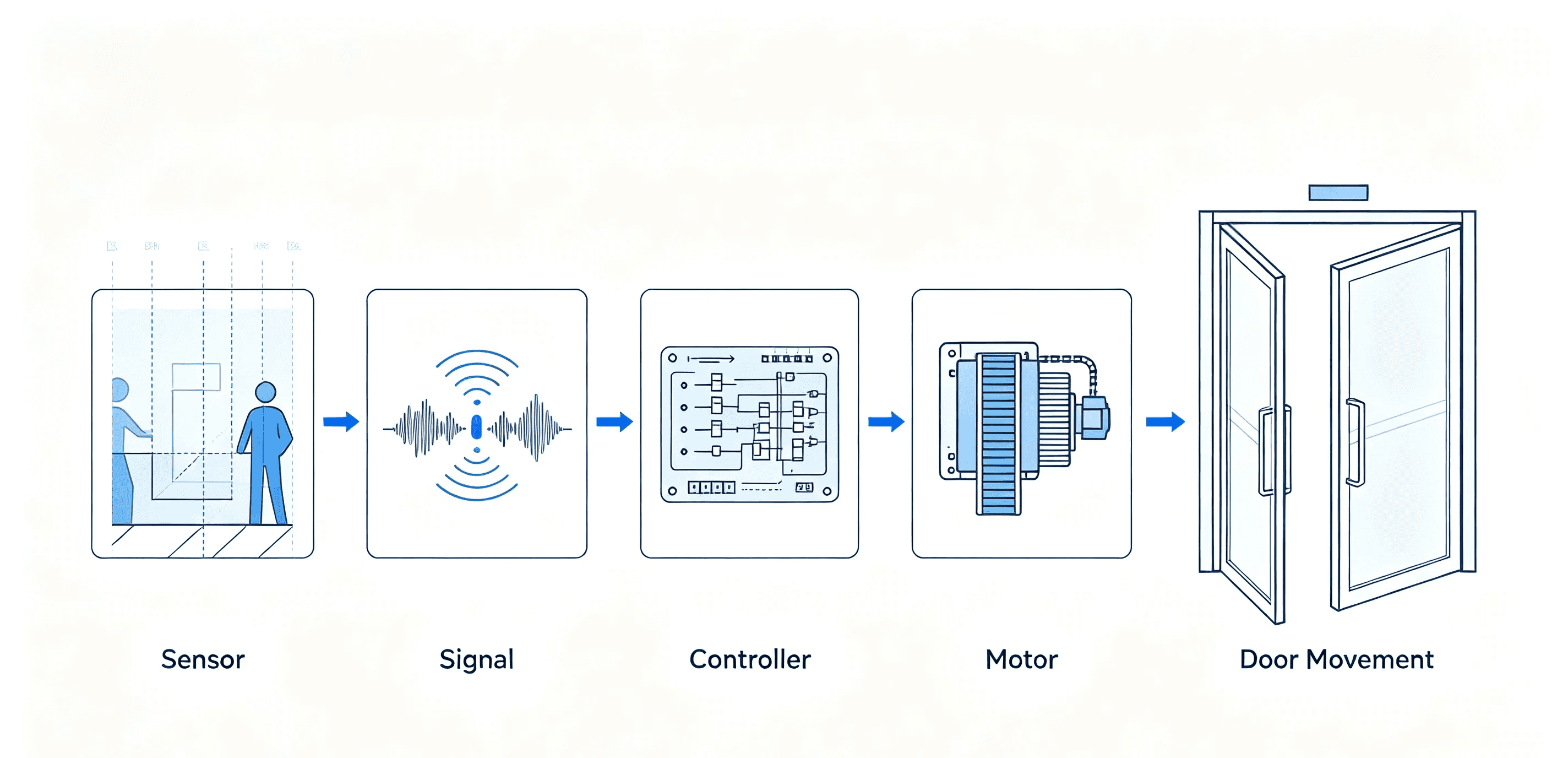
Automatic door sensors work by detecting changes within their monitoring area and sending signals to the control system.
When a sensor identifies movement or presence, it generates an electrical signal that is processed by the controller. The controller then determines whether the door should open, remain open, or perform another action based on the programmed settings.
Different sensor technologies use different detection methods. Some sensors focus on movement detection, while others are designed to detect objects, presence, or potential obstacles near the door area.
The sensor does not operate independently. It works together with the controller and motor to create a complete automatic door solution. Reliable communication between these components helps ensure smooth operation and improves both convenience and safety.
Main Types of Automatic Door Sensors
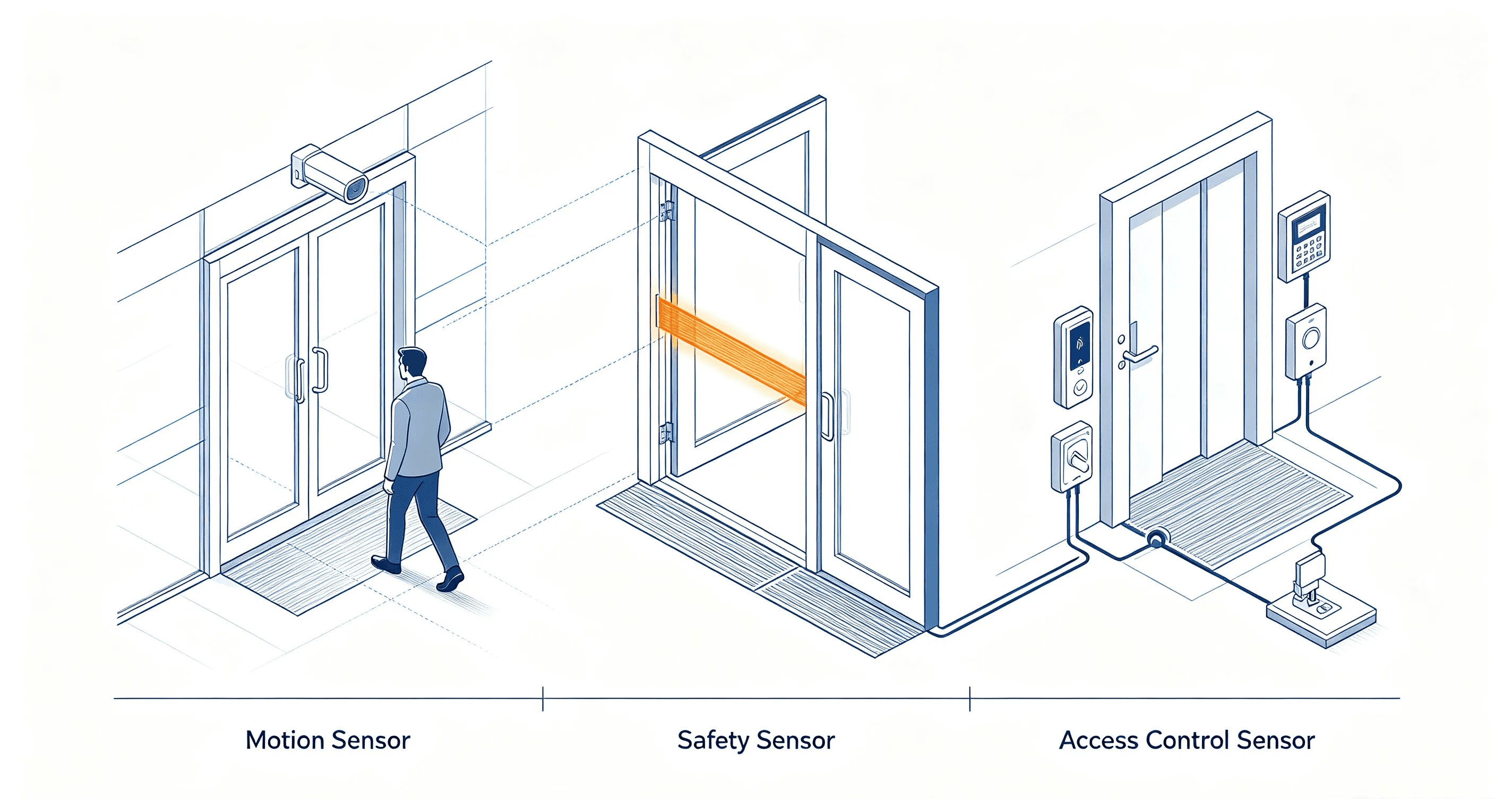
Different automatic door applications require different detection methods. The choice of sensor depends on the door type, installation environment, and required level of safety.
Motion Sensors
Motion sensors are commonly used to detect approaching users and trigger automatic door opening.
They are often installed at entrances with regular pedestrian traffic, such as shopping centers, office buildings, and public facilities. By detecting movement within a specific area, these sensors allow doors to open before users manually interact with them.
For high-traffic locations, motion sensors need to provide reliable detection while avoiding unnecessary activation caused by unrelated movement.
Safety Sensors
Safety sensors are designed to help prevent accidents during door operation.
Unlike sensors that mainly focus on detecting approaching users, safety sensors monitor areas where people or objects may be affected by door movement. They help reduce the risk of the door closing when someone is still passing through.
In commercial environments where accessibility and user safety are important, safety sensors are an essential part of a complete automatic door system.
Access Control Sensors
Some automatic doors are connected with access control systems to manage who can enter specific areas.
These solutions are commonly used in offices, healthcare facilities, industrial buildings, and other locations requiring controlled access. Instead of opening based only on movement detection, the system responds to authorized signals from access devices.
This integration allows automatic doors to become part of a broader building security and management system.
How to Choose the Right Automatic Door Sensor
Selecting an automatic door sensor requires understanding how the door system will be used and what conditions it needs to handle. A suitable sensor should not only detect users effectively but also work reliably with the motor, controller, and other automation components.
For installers and project suppliers, several factors should be considered before choosing a sensor solution.
Detection Requirements
The first consideration is what the sensor needs to detect.
Different applications may require detection of approaching users, people passing through the doorway, or specific access requests. A sensor used for a busy commercial entrance may need a wider detection area, while a sensor installed in a controlled environment may require more precise detection.
Understanding the purpose of detection helps avoid selecting a sensor that does not match the actual application.
Traffic Flow and Usage Frequency
The amount of daily traffic can influence sensor selection.
Automatic doors installed in locations with high pedestrian flow need sensors that can respond consistently throughout frequent operation. Shopping centers, airports, hospitals, and office buildings often require reliable detection because delays or incorrect triggering can affect user experience.
For lower-traffic environments, the sensor requirements may be different. The focus may shift toward reducing unnecessary activation and improving overall system efficiency.
Installation Environment
Environmental conditions can affect automatic door sensor performance.
Factors such as temperature changes, lighting conditions, dust, moisture, and surrounding movement may influence how effectively a sensor operates. A sensor suitable for an indoor commercial entrance may not perform the same way in a more demanding industrial environment.
Therefore, sensor selection should consider where the system will be installed and what external conditions it needs to handle.
Applications of Automatic Door Sensors
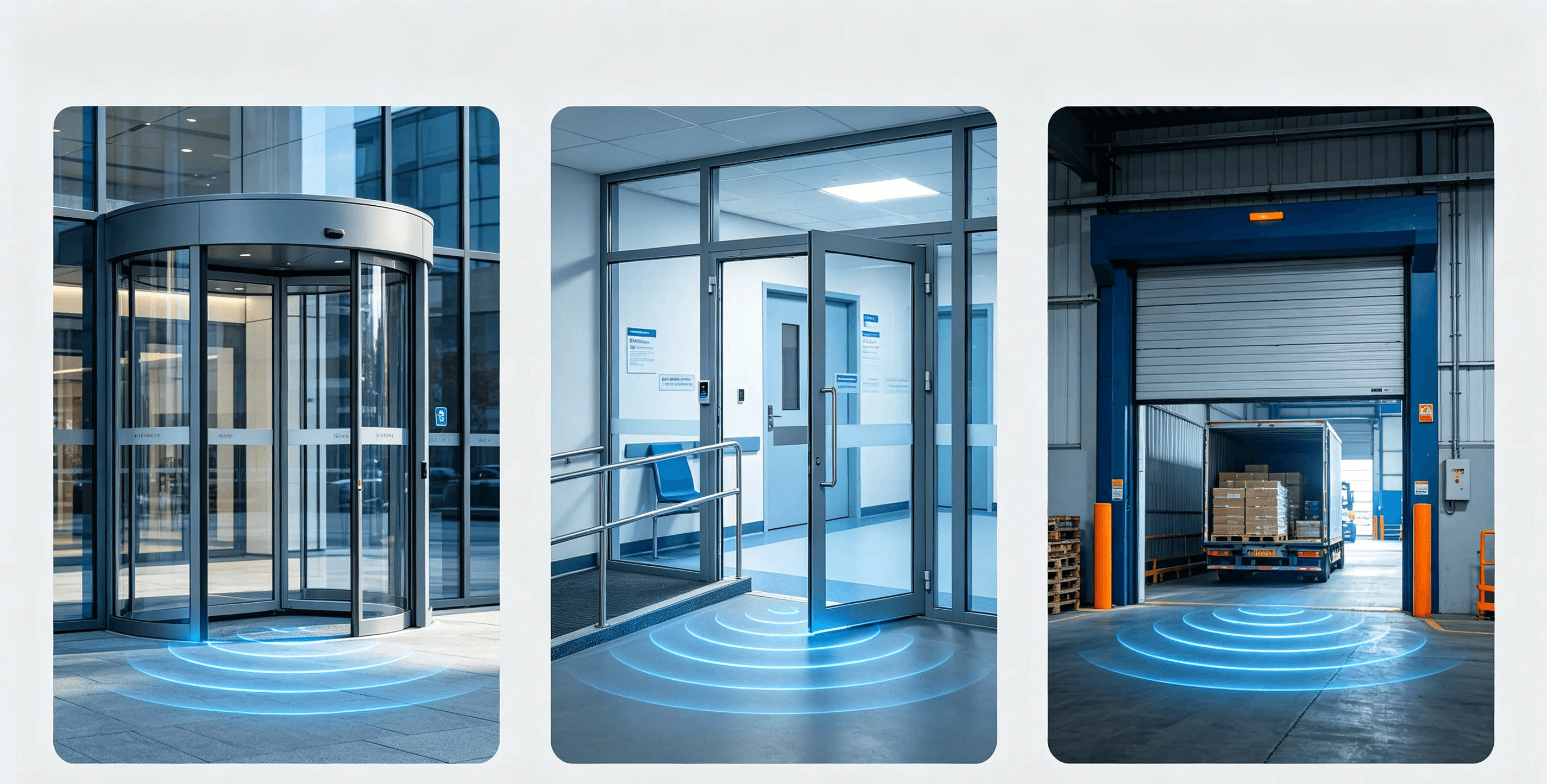
Automatic door sensors are used across many different environments, but their requirements vary depending on the purpose of the entrance.
Commercial Buildings
In commercial buildings, automatic door sensors help improve accessibility and create a more convenient entrance experience.
Office buildings, retail stores, and public facilities often require doors that can handle frequent daily operation while maintaining smooth and safe movement. Sensors play an important role by ensuring that doors respond quickly when users approach.
For these applications, the sensor needs to balance convenience, reliability, and safety.
Healthcare Facilities
Healthcare environments have specific requirements for automatic door operation.
Hospitals, clinics, and medical facilities often need entrances that support accessibility while reducing unnecessary contact with door surfaces. Reliable sensors help create smoother movement for patients, visitors, and staff.
In these environments, safety and consistent operation are especially important because automatic doors may be used continuously throughout the day.
Industrial and Commercial Facilities
Industrial environments may require automatic door sensors that can operate under more demanding conditions.
Warehouses, factories, and logistics facilities often have larger entrances and higher operational requirements. Sensors used in these locations need to work effectively with the complete automation system while considering factors such as traffic patterns and environmental conditions.
Proper sensor selection helps maintain efficient movement while supporting the overall reliability of the automated entrance.
The Relationship Between Sensors and Complete Automatic Door Systems
An automatic door sensor is only one part of the complete automation solution.
The sensor, controller, and motor must work together to achieve reliable performance. The sensor provides detection information, the controller processes the signal, and the motor performs the physical movement required to open or close the door.
If any part of this system is not properly matched, overall performance may be affected. For example, an advanced sensor cannot deliver the expected results if it is not compatible with the controller or door mechanism.
For this reason, automatic door projects should be evaluated as complete systems rather than selecting individual components separately.
Maintenance and Reliability Considerations for Automatic Door Sensors
Like other components in an automatic door system, sensors require proper installation and regular maintenance to maintain reliable performance.
A sensor that is incorrectly positioned, affected by environmental conditions, or not properly maintained may cause inaccurate detection or inconsistent door operation. This can reduce user experience and place additional stress on other system components.
Regular inspection helps ensure that sensors continue to detect accurately and communicate effectively with the controller. For commercial and industrial applications where doors operate frequently, maintaining sensor performance is an important part of reducing unexpected interruptions.
When evaluating an automatic door solution, sensor reliability should be considered together with the durability of the motor, controller, and mechanical structure. A well-matched system can provide more stable operation throughout its service life.
Frequently Asked Questions About Automatic Door Sensors
Q: What role does a sensor play in an automatic door system?
A: An automatic door sensor detects users, movement, or access signals and sends information to the control system. The controller then processes these signals and activates the motor to operate the door.
The sensor is an important part of the automation process because it allows the door to respond automatically without manual operation.
Q: Can automatic door sensors work with different types of doors?
A: Automatic door sensors can be used with different door systems, but compatibility depends on the complete automation setup.
Factors such as door structure, controller type, operating environment, and required detection method should be considered before selecting a sensor solution.
Q: Why does an automatic door sometimes open when nobody is approaching?
A: Unexpected activation can occur when a sensor detects movement or signals that are not related to a user approaching the door.
Possible factors include incorrect installation, unsuitable detection settings, environmental interference, or surrounding movement within the detection area. Proper sensor selection and adjustment can help reduce unnecessary activation.
Q: How often should automatic door sensors be checked?
A: The required inspection frequency depends on the operating environment and how often the door is used.
Doors installed in high-traffic commercial or industrial locations may require more frequent checks because sensors experience more continuous operation. Regular inspection helps maintain accurate detection and reliable system performance.
Q: Are sensors enough to ensure automatic door safety?
A: Sensors are an important safety component, but they are only one part of a complete automatic door safety system.
Reliable operation also depends on proper coordination between sensors, controllers, motors, and mechanical components. A complete system approach is necessary to achieve safe and consistent performance.
Conclusion
Automatic door sensors are essential components that allow automated entrances to respond efficiently to users and surrounding conditions. While motors provide the movement required to operate the door, sensors provide the information needed for the system to make accurate decisions.
Selecting the right sensor requires consideration of detection requirements, traffic flow, installation environment, and compatibility with other automation components. A suitable sensor solution helps improve convenience, safety, and long-term system reliability.
For businesses, installers, and project suppliers, understanding how sensors work within a complete automatic door system can help create more effective automation solutions.
DP Group provides automation components and solutions designed for different door applications, supporting reliable performance through suitable system integration and component selection.
Other Blogs


