Blog
Roller Shutter Motor Torque vs Power: What’s the Difference Between Nm and Watts?
Author
Ray
Published
Category
Tips
Understand the difference between roller shutter motor torque and power. Learn how Nm, watts, speed, and door weight affect motor selection.

Author
Ray
An experienced automation specialist with a strong background in motor technology and industrial solutions. With years of expertise in central motors, tubular motors, and automation systems, the author is dedicated to sharing insights that connect engineering innovation with real-world applications. Passionate about advancing reliable, energy-efficient, and high-performance automation products for global markets.
What’s better than insider perks, pro tips, and surprises?
Sign up to get the most recent blog articles in your email every week.
Join now.
WHY I WRITE THIS
About my business
Our company’s main product lines include tubular motors, sliding gate motors, swing gate motors, roller shutter motors, and other door automation solutions, all manufactured by trusted partner factories we have worked with for many years.
Our Services
I help them with sales and export operations, while our company also provides sourcing and procurement services in China to help international clients solve supply-related challenges. If you need assistance with procurement, please feel free to contact us.
When selecting a roller shutter motor, many buyers compare specifications such as watts, torque, speed, and voltage. However, one of the most common mistakes is assuming that a motor with higher wattage is always stronger or better.
For roller shutter systems, torque (Nm) and power (W) describe different performance characteristics.
Torque determines the rotational force available to move the shutter curtain, while power represents the rate at which the motor can perform work.
Understanding the difference between torque and power helps distributors, installers, contractors, and OEM buyers choose the correct roller shutter motor for different door sizes, curtain materials, and operating conditions.
A motor with high power but insufficient torque may not be suitable for lifting a heavy roller shutter. Likewise, a motor with sufficient torque but unsuitable speed or duty cycle may not provide the expected performance.
This guide explains the difference between roller shutter motor torque and power, why Nm is critical for shutter applications, and how buyers should evaluate motor specifications before making a purchase.
What Is Torque in a Roller Shutter Motor?
Torque is the rotational force produced by a motor.
It is measured in Newton-meters (Nm).
In a roller shutter system, torque is the force that rotates the shaft or drum to lift and lower the shutter curtain.
The higher the required load, the higher the torque requirement.
A roller shutter motor needs sufficient torque to overcome:
Curtain weight
Bottom bar weight
Drum resistance
Guide rail friction
Mechanical losses
Starting resistance
For example, a heavy steel roller shutter requires significantly more torque than a lightweight aluminum shutter of the same size.
This is why professional motor selection usually starts with calculating the required torque rather than simply choosing a motor based on wattage.
What Does Nm Mean on a Roller Shutter Motor?
The unit Nm represents the amount of rotational force generated by the motor.
A simple example:
A 180 Nm motor produces 180 Newton-meters of rated torque.
A 260 Nm motor produces 260 Newton-meters of rated torque.
The 260 Nm motor therefore provides approximately 44% more rated torque than the 180 Nm model.
However, this does not mean that a 260 Nm motor can always lift exactly 44% more door weight.
The actual lifting capability depends on other mechanical factors, including:
Drum diameter
Pulley size
Shaft configuration
Curtain material
Friction
Safety margin
Installation quality
For this reason, professional suppliers normally evaluate torque together with the complete shutter system.
What Is Power (Watts) in a Roller Shutter Motor?
Power is the rate at which a motor performs work.
It is measured in watts (W).
Motor power is related to both torque and speed.
The basic relationship is:
Power = Torque × Speed
This means a motor's power depends not only on how much rotational force it produces, but also how quickly it produces that movement.
A higher wattage motor may have:
Higher torque
Higher speed
Better performance under continuous load
However, wattage alone does not tell you whether a motor is suitable for a specific roller shutter.
Torque vs Power: What Is More Important for Roller Shutter Motors?
For roller shutter applications, torque is usually the first specification to evaluate.
The reason is simple:
The motor must first have enough rotational force to move the shutter.
A motor with insufficient torque may experience:
Slow opening
Difficulty starting
Stalling
Motor overheating
Frequent thermal protection activation
Reduced service life
Power is still important because it affects how efficiently the motor performs work and maintains operation under load.
The best roller shutter motor is not the one with the highest wattage.
It is the one with the correct combination of:
Torque
Speed
Power
Duty cycle
Mechanical compatibility
Torque vs Power Comparison Table
Parameter | Torque (Nm) | Power (W) |
|---|---|---|
Definition | Rotational force | Rate of performing work |
Unit | Newton-meter | Watt |
Main function | Moves the shutter load | Determines overall motor output capability |
Directly affects | Lifting ability | Energy consumption and performance |
Important for | Heavy curtains and starting force | Operating efficiency |
Higher value means | More turning force | More power output |
Both specifications are important, but they answer different questions.
Torque answers:
"Can this motor move my shutter?"
Power answers:
"How effectively can this motor perform the work?"
Why Higher Wattage Does Not Always Mean a Stronger Roller Shutter Motor
A common purchasing mistake is selecting a motor only because it has a higher wattage rating.
For example:
Motor A:
800 W
100 Nm torque
Motor B:
590 W
180 Nm torque
Although Motor A has higher electrical power, Motor B may be more suitable for a heavy roller shutter because it provides greater rotational force.
Roller shutter systems depend heavily on torque because the motor must rotate a shaft and overcome mechanical resistance.
Therefore, comparing wattage alone can lead to incorrect motor selection.
How Torque Determines Roller Shutter Door Weight
The required torque depends on the mechanical load created by the shutter system.
A simplified calculation is:
Required Torque = Load Force × Effective Radius
The main factors include:
Curtain Weight
The heavier the shutter curtain, the more torque is required.
Steel shutters generally require more torque than lightweight aluminum shutters because of their higher material density.
Drum Diameter
A larger winding diameter increases the torque requirement.
As the curtain rolls around the drum, the effective radius changes.
A larger radius requires more rotational force.
Friction
Guide rail resistance, roller condition, alignment, and installation quality can significantly affect torque requirements.
A poorly installed shutter may require much more torque than a correctly installed system.
Safety Margin
Professional installations normally include a safety margin to prevent the motor from operating continuously near its maximum capacity.
For more details about torque calculation and door weight selection, buyers can also refer to:
180 Nm vs 260 Nm Roller Shutter Central Motor: Which One Should You Choose?
Example: 180 Nm vs 260 Nm Roller Shutter Motor
Consider two central motors:
180 Nm Motor
Typical characteristics:
Medium torque capacity
Lower power consumption
Suitable for moderate shutter loads
260 Nm Motor
Typical characteristics:
Higher torque capacity
Greater load margin
Suitable for heavier shutters or demanding applications
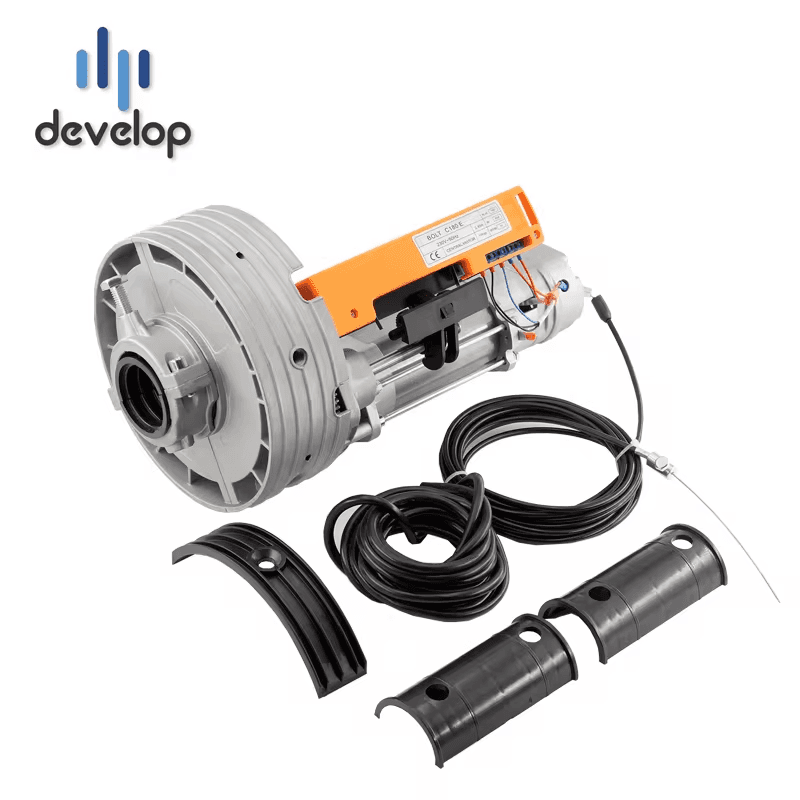
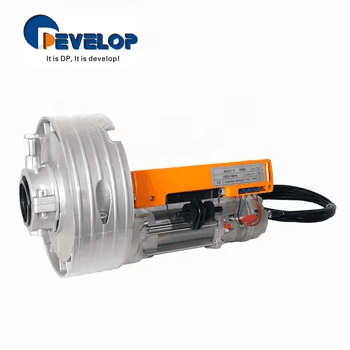
For example, CHINA-DEVELOP's current central motor series includes:
180 Nm model:
Approx. 590 W
Approx. 2.56 A
260 Nm model:
Approx. 800 W
Approx. 3.48 A
Both models are designed around similar mechanical configurations, including Ø60 mm shaft compatibility and Ø200 mm pulley specifications.
The main difference is the available torque capacity.
Does Higher Torque Require Higher Power?
Generally, yes.
Producing more torque usually requires a motor capable of handling higher mechanical and electrical loads.
However, the relationship is not simply:
More watts = more torque.
Motor design, gearbox efficiency, speed, winding design, and control system all influence the final performance.
A well-designed motor can provide efficient torque output without unnecessary energy consumption.
Why Output Speed Also Matters
Torque and power should always be considered together with motor speed.
A motor with high torque but very low speed may not provide the opening speed required for some applications.
A faster motor with insufficient torque may struggle under load.
For roller shutter applications, buyers should evaluate:
Torque
Speed (rpm)
Power
Door size
Operating frequency
The correct balance depends on the application.
For example:
A warehouse shutter may prioritize torque and durability.
A retail entrance may require a balance between speed, noise, and reliability.
How Duty Cycle Affects Motor Selection
Duty cycle describes how frequently and how long a motor can operate.
A residential shutter opened several times per day has different requirements from a commercial shutter used hundreds of times daily.
A motor with sufficient torque may still be unsuitable for a high-frequency application if its operating time and thermal performance are insufficient.
Professional buyers should always check:
Running time
Cooling capability
Thermal protection
Recommended cycles
Torque, Power and Voltage: How Are They Related?
Voltage affects how the motor receives electrical energy.
Common market requirements include:
110V / 60Hz
220V / 50Hz
230V / 50Hz
Voltage does not directly indicate lifting ability.
A 230V motor is not automatically stronger than a 110V motor.
The actual performance depends on:
Motor design
Torque output
Power rating
Gearbox efficiency
Controller design
For international buyers, voltage compatibility is essential because an incorrectly specified motor cannot operate correctly even if its torque rating is suitable.
What Specifications Should Buyers Compare Besides Torque and Power?
Professional buyers should not select roller shutter motors based only on Nm and watts.
Important specifications include:
Output Torque
Determines rotational force.
Rated Power
Shows motor energy output capability.
Output Speed
Determines opening and closing speed.
Shaft Diameter
Ensures mechanical compatibility.
Pulley Diameter
Affects transmission and torque requirements.
Door Weight Capacity
Helps match the motor to the shutter system.
Duty Cycle
Shows suitability for frequent operation.
Brake System
Important for safety and position holding.
Limit System
Controls opening and closing positions.
IP Rating
Important for environmental protection.
Voltage and Frequency
Required for international compatibility.
Common Mistakes When Comparing Roller Shutter Motors
Choosing by Wattage Only
A high-wattage motor may not provide enough torque for a heavy shutter.
Choosing Maximum Torque Without Calculation
Oversizing can increase cost and may not improve performance.
Ignoring Speed
A motor with sufficient torque may still be unsuitable if the operating speed does not meet project requirements.
Ignoring Door Mechanics
A motor cannot compensate for:
Poor alignment
Damaged guides
Excessive friction
Incorrect installation
Ignoring Duty Cycle
A motor suitable for residential use may not be suitable for commercial high-cycle operation.
How Manufacturers Select the Right Roller Shutter Motor
Professional manufacturers normally evaluate multiple project parameters before recommending a motor.
The selection process usually considers:
Door width
Door height
Curtain material
Curtain weight
Shaft diameter
Drum size
Operating frequency
Voltage requirement
Installation environment
Control requirements
Safety requirements
This approach prevents incorrect motor selection and reduces premature failures.
Why Torque and Power Matter for Overseas Buyers
For distributors and importers, understanding torque and power helps avoid incorrect product selection.
A common purchasing mistake is comparing motors only by:
Price
Wattage
Appearance
However, a reliable roller shutter motor requires balanced engineering.
A lower-priced motor with insufficient torque may result in:
Customer complaints
Warranty claims
Replacement costs
Installation problems
A properly selected motor provides:
Stable operation
Longer service life
Lower maintenance requirements
Better customer satisfaction
How OEM Buyers Should Evaluate Roller Shutter Motor Specifications
OEM buyers should request complete technical specifications rather than only a product quotation.
Important information includes:
Rated torque
Power rating
Motor speed
Voltage options
Shaft compatibility
Pulley size
Limit system
Brake system
Remote control options
Certifications
Testing procedures
For private-label and OEM projects, consistency between production batches is also critical.
A reliable supplier should provide stable performance, technical documentation, quality inspection, and after-sales support.
Frequently Asked Questions About Roller Shutter Motor Torque and Power
Is torque or wattage more important for a roller shutter motor?
Torque is usually the first specification to evaluate because it determines whether the motor can generate enough rotational force to move the shutter. Power is also important because it affects overall performance and efficiency.
Does a higher wattage roller shutter motor lift more weight?
Not necessarily. Lifting ability depends mainly on torque, speed, mechanical design, and the shutter system. A higher-wattage motor may not provide higher lifting capacity if its torque output is lower.
What does Nm mean on a shutter motor?
Nm means Newton-meter and measures rotational torque. It indicates how much turning force the motor can generate.
Is a 260 Nm motor always better than a 180 Nm motor?
No. A 260 Nm motor provides more torque, but the correct choice depends on the actual shutter requirements. A 180 Nm motor may be more efficient and suitable for lighter applications.
How do I calculate the torque needed for a roller shutter motor?
Torque calculation requires information such as shutter weight, drum radius, friction, mechanical efficiency, and safety margin. Door weight alone is not enough.
Can a powerful motor damage a roller shutter?
If incorrectly matched or improperly adjusted, excessive force can increase stress on the shutter curtain, shaft, brackets, and mechanical components.
Why does my roller shutter motor overheat?
Common causes include insufficient torque, excessive door resistance, frequent operation, poor installation, mechanical friction, or operating beyond the recommended duty cycle.
Should I choose a higher torque motor for commercial shutters?
Commercial shutters often require additional torque margin because of larger size, heavier materials, and higher operating frequency. However, the correct motor should still be selected based on actual calculations.
What parameters should I provide when ordering a roller shutter motor?
Provide door width, height, curtain material, estimated weight, shaft size, drum diameter, voltage, frequency, operating cycles, and control requirements.
Final Thoughts
When comparing roller shutter motors, torque and power should not be treated as the same specification.
Torque determines the rotational force available to move the shutter.
Power determines how effectively the motor performs work.
For roller shutter applications, torque is usually the starting point because the motor must first overcome the mechanical load of the curtain, shaft, and drum system.
However, the best motor selection requires evaluating the complete specification:
Torque
Power
Speed
Door weight
Shaft compatibility
Duty cycle
Voltage
Brake system
Limit system
Installation conditions
For homeowners, installers, distributors, and OEM buyers, understanding the difference between Nm and watts helps prevent incorrect selections and improves long-term system reliability.
Looking for Reliable Roller Shutter Motor Solutions?
CHINA-DEVELOP provides roller shutter motor solutions for distributors, installers, contractors, and OEM partners.
Our product range includes central motors with different torque options, electrical configurations, control solutions, and customization possibilities for different roller shutter applications.
For professional sourcing, selecting the correct motor is not only about higher wattage or higher torque. It is about matching the motor specification with the actual shutter system, operating environment, and long-term reliability requirements.
Other Blogs