Blog
What Is a Synchronous Motor? A Complete Guide for Roller Shutter and Blind Systems
Author
Ray
Published
Category
Guide

Author
Ray
An experienced automation specialist with a strong background in motor technology and industrial solutions. With years of expertise in central motors, tubular motors, and automation systems, the author is dedicated to sharing insights that connect engineering innovation with real-world applications. Passionate about advancing reliable, energy-efficient, and high-performance automation products for global markets.
What’s better than insider perks, pro tips, and surprises?
Sign up to get the most recent blog articles in your email every week.
Join now.
WHY I WRITE THIS
About my business
Our company’s main product lines include tubular motors, sliding gate motors, swing gate motors, roller shutter motors, and other door automation solutions, all manufactured by trusted partner factories we have worked with for many years.
Our Services
I help them with sales and export operations, while our company also provides sourcing and procurement services in China to help international clients solve supply-related challenges. If you need assistance with procurement, please feel free to contact us.
If you have ever asked yourself what makes a motorized blind move so smoothly and consistently, the answer often begins with the motor type driving the system. Among the various drive technologies used in window covering automation, the synchronous motor occupies a specific and technically interesting position — one that is frequently misunderstood, frequently misapplied, and occasionally the perfect tool for the job.
Whether you are a homeowner researching motorized roller shutter options, a contractor specifying drive systems for a commercial blind installation, or a product designer evaluating motor technologies for a new window covering product, understanding what a synchronous motor is — and what it is not — is essential knowledge.
This guide covers everything: the fundamental physics of synchronous motor operation, how synchronous motors are constructed, how they perform in roller shutter and blind applications, where they excel, where they fall short, and how to decide whether a synchronous motor or an alternative drive technology is the right choice for your specific project.
What Is a Synchronous Motor? Definition and Core Operating Principle
The Fundamental Definition
A synchronous motor is an alternating current (AC) electric motor in which the rotor rotates at a speed that is precisely synchronized with the frequency of the AC power supply driving it. Unlike induction motors — where the rotor always lags slightly behind the rotating magnetic field — a synchronous motor's rotor locks in step with the stator's magnetic field and maintains that exact rotational relationship under all load conditions up to its torque limit.
In plain terms: a synchronous motor always spins at the same speed, regardless of how much load it is carrying — as long as that load remains within the motor's rated capacity.
This constant-speed characteristic is not a side effect of the design. It is the defining engineering purpose of the synchronous motor, and it is why synchronous motors are chosen for applications where predictable, unwavering rotational velocity is a fundamental requirement.
The Physics Behind Synchronous Operation
To understand why synchronous motors behave the way they do, it helps to understand the electromagnetic relationship between the stator and rotor.
When AC current flows through the stator windings of a synchronous motor, it creates a rotating magnetic field that sweeps around the stator bore at a speed determined by two fixed variables:
The supply frequency (Hz): In most of Europe, Asia, and Africa, this is 50 Hz. In North America and parts of South America, it is 60 Hz.
The number of magnetic poles in the stator winding: More poles mean a slower rotating field.
The relationship is expressed by a simple formula:
Synchronous Speed (RPM) = (120 × Frequency) ÷ Number of Poles
For example:
A 4-pole motor on a 50 Hz supply: (120 × 50) ÷ 4 = 1,500 RPM
A 4-pole motor on a 60 Hz supply: (120 × 60) ÷ 4 = 1,800 RPM
An 8-pole motor on a 50 Hz supply: (120 × 50) ÷ 8 = 750 RPM
The rotor — whether it carries permanent magnets, wound field coils, or reluctance geometry — is designed to lock onto this rotating magnetic field and spin with it in perfect synchronization. Once locked, the rotor cannot deviate from synchronous speed without losing synchronism entirely (a condition called pull-out or loss of synchronism).
What Happens When Load Increases?
This is a critical concept for anyone applying synchronous motors in mechanical systems.
As the load on a synchronous motor increases, the rotor does not slow down — instead, the torque angle (the angular displacement between the rotor's magnetic axis and the stator's rotating field axis) increases. The motor draws more current to maintain synchronism and deliver the additional torque demanded.
If the load exceeds the motor's pull-out torque — the maximum torque it can deliver while maintaining synchronism — the rotor suddenly loses lock with the stator field, speed collapses, the motor stalls, and current spikes dramatically. This is why correct torque sizing is not just a performance consideration for synchronous motors — it is a protection requirement.
How Is a Synchronous Motor Constructed? Key Components Explained
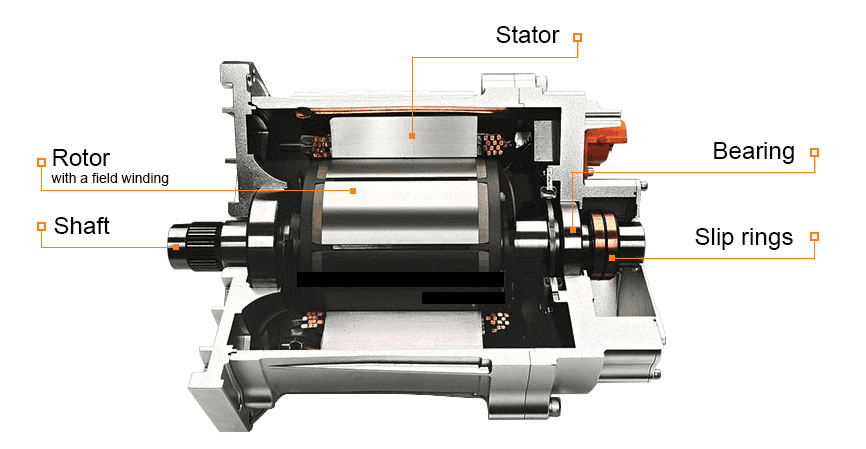
Stator Assembly
The stator is the stationary outer part of the motor. It contains:
Laminated silicon steel core: Reduces eddy current losses at operating frequency
Stator windings: Copper wire coils wound into slots in the core, connected in a pattern that creates the rotating magnetic field when energized
Insulation system: Typically Class B (130°C) or Class F (155°C) rated insulation, determining the motor's thermal tolerance
In small synchronous motors used for blind and shutter applications, the stator is typically a simple single-phase design with a shaded pole or capacitor-start configuration to create the rotating field from a single-phase supply.
Rotor Types Used in Small Synchronous Motors
The rotor design determines how the motor achieves and maintains synchronism. In the compact synchronous motors used for window covering applications, three rotor types are most common:
Permanent Magnet Rotor
The rotor carries embedded or surface-mounted permanent magnets. The rotor's magnetic poles are physically attracted to and lock onto the rotating stator field. Permanent magnet synchronous motors (PMSMs) are the most common type in small-scale shutter and blind applications due to their simplicity, efficiency, and self-starting capability when used with the appropriate stator design.
Reluctance Rotor
The rotor is made from shaped magnetic steel with no windings or magnets. It aligns itself with the stator field by exploiting the principle of magnetic reluctance — the tendency of magnetic flux to follow the path of least resistance. Synchronous reluctance motors are robust, inexpensive, and require no magnets, but typically produce lower torque density than permanent magnet designs.
Hysteresis Rotor
The rotor is made from a hard magnetic material that exhibits strong hysteresis properties. It accelerates smoothly to synchronous speed and locks in without the abrupt snap-to-synchronism of permanent magnet designs. Hysteresis synchronous motors are exceptionally smooth and quiet, making them historically popular in clock mechanisms and precision timing applications — and occasionally in high-quality blind motors where acoustic performance is paramount.
Gearbox Integration
In virtually all roller shutter and blind applications, the synchronous motor operates through a reduction gearbox. The motor core itself spins at synchronous speed — typically 750 to 1,500 RPM for 50 Hz supplies — which is far too fast for direct drive of a shutter tube. The gearbox reduces this speed by a ratio of 30:1 to 100:1 or more, simultaneously multiplying the torque output proportionally.
The gearbox type significantly affects the system's noise characteristics, efficiency, and service life:
Spur gear trains: Simple, inexpensive, but can be noisy at high reduction ratios
Helical gear trains: Quieter than spur gears due to gradual tooth engagement, preferred in quality blind motors
Worm gear reducers: High reduction ratios in a compact package, self-locking (which provides natural braking), but less efficient than helical designs
How Synchronous Motors Are Used in Roller Shutter and Blind Systems
Traditional Side-Drive Shutter Systems
The most established application of synchronous motors in the roller shutter industry is the external side-drive configuration. In this arrangement, the motor unit is mounted externally to the shutter housing — bolted to a side bracket or wall — with the output shaft connected to the end of the shutter tube via a coupling, chain drive, or belt.
This configuration was the industry standard for commercial roller shutters for several decades before tubular motor technology matured to its current state. Many warehouse facilities, retail storefronts, and industrial buildings constructed between the 1970s and 2000s use side-drive synchronous motor systems that continue to operate reliably today.
The key characteristics of this installation approach:
The motor is fully accessible for inspection and maintenance without disassembling the shutter
Drive chains or belts can be replaced without removing the motor
Motor replacement is straightforward — unbolt, disconnect, reconnect, rebook
The installation is visually conspicuous — the motor unit is always visible on the side of the shutter
Compact Synchronous Motors in Motorized Blind Systems
Beyond roller shutters, small synchronous motors have been widely used in motorized interior blind systems — particularly in horizontal venetian blinds, pleated blinds, and certain roller blind applications where the load is very light and the primary requirement is smooth, consistent movement.
In these applications, the synchronous motor's constant-speed characteristic translates to a very even, flowing movement without the acceleration and deceleration ramps associated with some DC motor systems. For certain product categories — particularly high-end architectural blinds where movement quality is a design consideration — this smooth constant-velocity travel is a valued characteristic.
Synchronous Motors in Tubular Form Factors
It is worth noting that some tubular motors — motors designed to fit inside a roller tube — are actually synchronous motors internally. The synchronous motor principle can be packaged in a cylindrical housing and installed in exactly the same way as an induction-based tubular motor. In this configuration, the end user sees only a standard tubular motor installation. The synchronous operating principle is an internal design choice by the manufacturer, chosen for its speed consistency and efficiency characteristics.
This is an important distinction: synchronous motor describes an operating principle, not a physical form factor. Synchronous motors can be external side-drive units or internal tubular units, depending on the manufacturer's design.
Performance Characteristics of Synchronous Motors in Window Covering Applications
Speed Consistency: The Core Advantage
The defining performance advantage of a synchronous motor in any application is its absolute speed consistency. The shutter or blind travels at precisely the same velocity every single cycle — the first cycle after installation and the ten-thousandth cycle ten years later. Temperature changes, voltage fluctuations within normal tolerance, and minor load variations do not affect the travel speed.
For applications where multiple blinds or shutters must travel in unison — such as a row of identical windows in a commercial building where visual synchronization matters aesthetically — synchronous motors offer a natural advantage. All motors running on the same power supply will rotate at exactly the same speed, ensuring all blinds reach their endpoints simultaneously without any electronic synchronization system.
Torque Characteristics: The Critical Limitation
While synchronous motors offer impressive speed consistency, their torque profile presents challenges in roller shutter applications.
Small synchronous motors used in window covering applications typically produce starting torque of 50–80% of their rated running torque. This reduced starting torque means the motor may struggle to initiate movement in a heavy or slightly stiff shutter system — particularly in cold weather when lubricants thicken and mechanical friction increases.
Furthermore, the pull-out torque — the absolute maximum torque before the motor loses synchronism — is a hard ceiling. Exceed it, even momentarily, and the motor stalls completely. Induction motors and DC motors, by contrast, can typically deliver significantly higher transient torque during startup and obstacle encounters.
This torque limitation is the primary reason synchronous motors are not the default choice for heavy residential or commercial roller shutters.
Power Factor and Energy Efficiency
Synchronous motors operating at or near rated load with appropriate power factor correction can achieve power factors approaching unity (1.0) — meaning they draw current almost purely for productive work rather than reactive magnetization. This makes them potentially more energy-efficient than equivalent induction motors, particularly in continuous-duty industrial applications.
However, in roller shutter and blind applications — where the motor runs for only 20 to 60 seconds per cycle and spends the vast majority of its time in standby — this efficiency advantage has minimal practical impact on electricity consumption. A typical residential shutter motor consumes so little energy per operating cycle that the efficiency difference between motor types is measured in fractions of a cent per year.
Thermal Performance and Duty Cycle
Synchronous motors in window covering applications are typically rated for intermittent duty — they are designed to run for a defined period, then rest. A common rating is S2 duty (short-time duty), specifying a maximum run time — often 2 to 4 minutes — followed by a cooling period.
For standard roller shutters where each operating cycle lasts 20 to 45 seconds, this intermittent duty rating is entirely adequate. Problems arise only when motors are operated in rapid succession — such as during installation and commissioning when the installer runs the shutter up and down repeatedly in quick succession. Respecting the thermal duty cycle during commissioning prevents premature thermal degradation.
Advantages and Disadvantages of Synchronous Motors for Roller Shutters and Blinds
Genuine Advantages
Absolute speed consistency: Rotor speed is locked to grid frequency — immune to load variation, temperature, and voltage fluctuations within normal tolerance
Natural multi-motor synchronization: Multiple synchronous motors on the same circuit run at identical speeds without electronic coordination
Smooth operation: Particularly hysteresis and permanent magnet types deliver very even, consistent travel
Simple speed determination: Speed is purely a function of supply frequency and pole count — no speed controller required
Mechanical self-locking (worm gear versions): Worm gear drive systems are inherently self-locking, providing natural braking without additional brake mechanisms
Accessibility for maintenance: External side-drive configurations allow motor and gearbox access without disassembling the shutter
Real Limitations
Limited torque density: Small synchronous motors produce less torque per unit volume than equivalent tubular motor designs
Hard pull-out torque ceiling: No graceful overload capability — exceeding pull-out torque causes immediate stall
Low starting torque: Can struggle to initiate movement in stiff or heavy shutter systems
External mounting: Traditional side-drive configurations require larger shutter boxes and produce visible motor units
No native smart home integration: Standard synchronous motors have no wireless communication capability
External limit switches required: Stop positions must be set using externally wired limit switches, adding installation complexity
Less suitable for residential retrofit: The installation footprint and visual impact make synchronous side-drive systems poorly suited to residential aesthetics
Synchronous Motor vs Other Motor Types: Where Does It Fit?
Synchronous Motor vs Induction Motor
Characteristic | Synchronous Motor | Induction Motor |
|---|---|---|
Speed at rated load | Exactly synchronous speed | Slightly below synchronous speed (slip) |
Speed variation with load | Zero (within pull-out limit) | Increases with load (slip increases) |
Starting torque | Low to moderate | Moderate to high |
Pull-out torque | Hard limit — stalls instantly | Softer limit — slows progressively |
Power factor | Near unity (with correction) | Lagging (below unity) |
Construction complexity | Moderate | Simple |
Common application | Precision speed applications | General industrial drives |
Synchronous Motor vs DC Motor (Brush and Brushless)
Characteristic | Synchronous AC Motor | DC Motor (Brushless) |
|---|---|---|
Speed control | Fixed by grid frequency | Fully variable via PWM controller |
Torque at low speed | Limited | Excellent |
Smart home integration | None native | Excellent (native PWM/digital control) |
Position feedback | Not native | Available via encoder |
Supply requirement | AC mains | Low-voltage DC (12V, 24V, 48V) |
Noise | Low (motor) + gearing | Very low (brushless) |
Typical application | Fixed-speed shutter drives | Smart home tubular motors |
Synchronous Motor vs Tubular Motor (System Level)
System Factor | Synchronous Side-Drive | Tubular Motor |
|---|---|---|
Motor visibility | External, visible | Fully concealed inside tube |
Headbox size | Larger required | Compact |
Limit switch | External wiring required | Integrated |
Smart home ready | No | Yes (many models) |
Installation time | Longer | Shorter |
Maintenance access | Easy | Requires motor removal |
Aesthetics | Industrial appearance | Clean, modern |
Best environment | Commercial, industrial | Residential, light commercial |
How to Select a Synchronous Motor for a Roller Shutter or Blind Application
If your application genuinely calls for a synchronous motor — either because you are maintaining a legacy system, specifying a commercial installation where synchronization is required, or working within constraints that make synchronous technology the logical choice — the following selection criteria apply.
Key Selection Parameters
1. Required Output Torque
Calculate the torque needed at the shutter tube based on curtain weight, tube radius, and friction allowance. Add a safety margin of at least 25–30% above the calculated minimum. Verify that the motor's rated torque — not its pull-out torque — meets this requirement.
2. Output Shaft Speed
Determine the required rotational speed at the shutter tube. This is typically 8 to 20 RPM for standard residential shutters, and 4 to 10 RPM for heavier commercial curtains. Work back from this requirement through the gearbox ratio to determine the required motor speed.
3. Supply Voltage and Frequency
Confirm whether the motor must operate on 230V/50 Hz (Europe, Asia, Australia), 120V/60 Hz (North America), or another regional standard. Synchronous speed is directly affected by supply frequency — a motor specified for 50 Hz will run 20% faster on a 60 Hz supply.
4. Duty Cycle Rating
Confirm the motor's thermal duty class. For roller shutter applications, S2 (short-time duty, typically 2–4 minutes) is normally adequate. For high-cycle commercial installations, S3 or S4 rated motors may be required.
5. Enclosure Protection Rating
For outdoor or semi-outdoor installations, select a motor with appropriate IP (Ingress Protection) rating. IP44 is the practical minimum for exposed installations. Coastal or high-humidity environments warrant IP55 or better.
6. Gearbox Type and Ratio
Select the gearbox type based on noise requirements and self-locking needs. Worm gear reducers provide natural self-locking (no separate brake needed). Helical gear trains offer better efficiency and lower noise. Confirm the final output speed and torque match your shutter requirements.
7. Mounting Configuration
Specify the mounting orientation — foot-mounted, flange-mounted, or shaft-mounted — based on the physical installation constraints of the shutter housing.
Common Applications Where Synchronous Motors Remain the Preferred Choice
Despite the dominance of tubular motors in the residential sector, synchronous motors continue to be specified and installed in the following scenarios:
Legacy commercial shutter maintenance and replacement: Replacing a failed synchronous side-drive motor with an equivalent unit avoids a complete system redesign
Wide-format commercial shutters: Shutters exceeding 6–8 meters in width often use external three-phase or single-phase synchronous motors with industrial gearing
Multi-shutter visual synchronization: Installations where all shutters on a facade must travel at identical speeds without electronic coordination
High-cycle industrial doors: Some rapid-roll door applications use synchronous motor drives for their predictable speed characteristics
Precision laboratory and scientific equipment: Where constant rotational velocity is a fundamental measurement or process requirement
OEM blind mechanism design: Some blind manufacturers choose to build synchronous motor drives into their product mechanisms for the smoothness and speed consistency they provide in light-duty applications
Frequently Asked Questions About Synchronous Motors for Roller Shutters and Blinds
What is a synchronous motor in simple terms?
A synchronous motor is an AC electric motor that always spins at the same speed — a speed that is determined by the frequency of the electricity supply and the number of magnetic poles in the motor. It cannot speed up or slow down in response to load changes; instead, it draws more current to maintain its fixed speed as the load increases.
Why is constant speed important in a roller shutter motor?
Constant speed ensures the shutter travels at exactly the same rate every cycle, which is important for predictable limit switch timing and — in commercial buildings — for visual synchronization across multiple shutters on the same facade. However, for most residential installations, constant speed is a secondary consideration compared to torque, ease of installation, and smart home capability.
Can a synchronous motor be used inside a tubular motor housing?
Yes. The synchronous operating principle can be packaged in a cylindrical tubular form factor. Some manufacturers produce tubular motors that use synchronous motor cores internally, offering the installation advantages of a tubular motor with the speed consistency of synchronous operation.
What causes a synchronous motor to stall?
A synchronous motor stalls — loses synchronism — when the mechanical load exceeds the motor's pull-out torque. This can be caused by a shutter curtain that is heavier than the motor's rated capacity, mechanical obstruction in the guide rails, excessively cold temperatures increasing system friction, or a failing gearbox increasing internal resistance. When a synchronous motor stalls, current spikes significantly and the motor must be disconnected immediately to prevent winding damage.
How do I set the limit switches on a synchronous motor shutter drive?
Synchronous motor shutter drives use external electromechanical limit switches — typically rotary cam switches or linear travel switches wired into the motor control circuit. Setting limits involves manually running the shutter to the desired end position, then adjusting the cam or switch actuator to trigger the cut-off at that exact position. This process requires electrical isolation of the circuit during adjustment. Always consult the specific limit switch manufacturer's instructions and relevant electrical safety regulations for your region.
Are synchronous motors suitable for smart home integration?
Not natively. A standard synchronous motor has no wireless communication capability. Smart control can be achieved by installing an external smart relay module or WiFi-enabled motor controller upstream of the synchronous motor — these devices switch the motor's power supply in response to wireless commands. However, this adds cost and complexity compared to a native smart tubular motor that integrates wirelessly out of the box.
What is the difference between a synchronous motor and an induction motor?
Both are AC motors, but an induction motor's rotor always runs slightly slower than the stator's rotating magnetic field — this speed difference (called slip) is what induces current in the rotor and creates torque. A synchronous motor's rotor runs at exactly the same speed as the stator field — there is no slip. Synchronous motors offer speed precision; induction motors offer higher starting torque and simpler construction.
How long does a synchronous motor last in a roller shutter application?
With proper sizing, correct installation, and periodic lubrication of the gearbox (where applicable), a quality synchronous shutter motor can operate reliably for 15 to 20 years under normal residential usage. Commercial installations with higher cycle rates should plan for inspection and potential motor replacement at 10 to 15 year intervals. Thermal damage from repeated overloading is the most common cause of premature failure.
Conclusion: Understanding the Synchronous Motor's True Role in Roller Shutter and Blind Systems
The synchronous motor is a technically elegant solution to a specific engineering problem: delivering precisely constant rotational speed from an AC power supply without requiring any form of electronic speed control. For the applications where that characteristic genuinely matters — precision timing, multi-unit synchronization, constant-velocity process drives — it remains an excellent and well-proven technology.
In the context of roller shutters and motorized blind systems, the synchronous motor's story is more nuanced. It powered the commercial shutter industry for decades through side-drive configurations, and it continues to serve well in legacy system maintenance, wide-format commercial installations, and specific scenarios where speed synchronization across multiple units is a design requirement.
For modern residential roller shutters, however, the synchronous motor's limitations — its external mounting requirement, limited torque density, absence of native smart home connectivity, and need for externally wired limit switches — mean that it has been largely superseded by the tubular motor as the default drive technology.
Understanding what a synchronous motor is, how it operates, and where it genuinely belongs in the landscape of window covering automation helps you make better technical decisions — whether you are maintaining an existing installation, designing a new system, or evaluating competing technologies for a specific project.
The synchronous motor is not obsolete. It is simply best understood for what it is: a precision constant-speed drive technology with a well-defined set of applications where it continues to deliver genuine value.
Other Blogs