Blog
Garage Door Opener Not Working? 10 Common Fixes | CHINA-DEVELOP
Author
Ray
Published
Category
Design & Inspiration
Garage door opener stopped working? This professional troubleshooting guide covers the 10 most common causes and fixes — from power failures to limit switch misalignment — with expert insight from CHINA-DEVELOP.

Author
Ray
An experienced automation specialist with a strong background in motor technology and industrial solutions. With years of expertise in central motors, tubular motors, and automation systems, the author is dedicated to sharing insights that connect engineering innovation with real-world applications. Passionate about advancing reliable, energy-efficient, and high-performance automation products for global markets.
What’s better than insider perks, pro tips, and surprises?
Sign up to get the most recent blog articles in your email every week.
Join now.
WHY I WRITE THIS
About my business
Our company’s main product lines include tubular motors, sliding gate motors, swing gate motors, roller shutter motors, and other door automation solutions, all manufactured by trusted partner factories we have worked with for many years.
Our Services
I help them with sales and export operations, while our company also provides sourcing and procurement services in China to help international clients solve supply-related challenges. If you need assistance with procurement, please feel free to contact us.
Introduction
A malfunctioning garage door opener is more than an inconvenience. For a commercial facility, warehouse, or multi-unit property, a door that won't open or close on command can disrupt logistics, compromise security, and create liability exposure. For a contractor or installer in the field, a call-back on a recent installation is time and reputation lost.
The good news: the overwhelming majority of garage door opener failures — whether residential, commercial, or industrial — come down to a short list of root causes. Most can be diagnosed on-site in under 15 minutes without specialized equipment.
This guide from CHINA-DEVELOP, a professional garage door motor and automation system manufacturer since 2006, walks through the 10 most common reasons a garage door opener stops working and exactly how to resolve each one. Whether you're troubleshooting a belt-drive opener on a multi-unit residential complex or diagnosing a high-cycle commercial door motor, this checklist will get you to the root cause faster.
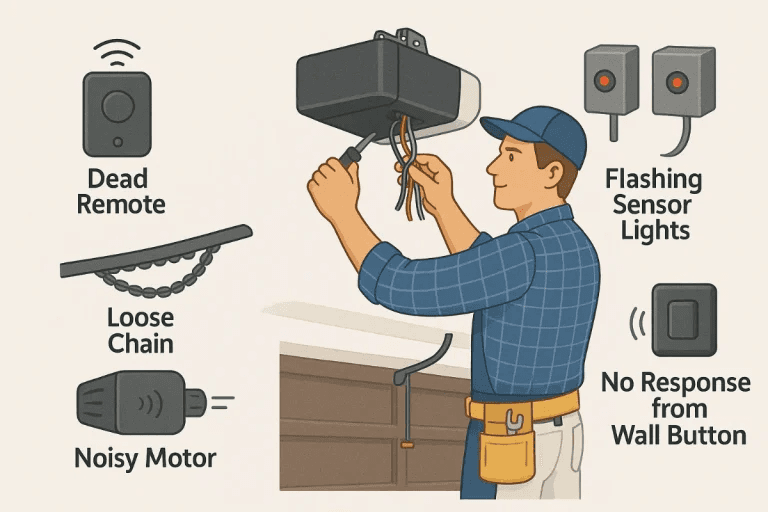
Before You Start: Safety First
Before troubleshooting any garage door opener system, observe these precautions:
Disconnect power before inspecting wiring, limit switches, or internal motor components.
Do not manually force a door that is under spring tension until you confirm the springs are intact. Broken torsion springs under load are a serious injury risk.
Verify that photo-eye sensors are not obstructed before testing the door in closing mode — obstruction safety reversals exist for a reason.
For commercial and industrial systems operating at 380V or with high-torque motors, qualified electrical and mechanical contractors should perform internal inspections.
With safety established, work through the fixes below in order — the list is roughly sequenced from simplest to most complex.
Fix #1: Check the Power Supply
Symptoms: The opener is completely unresponsive. No lights, no sounds, no reaction to remote or wall button.
This is the most common starting point, and it's frequently where the problem ends.
What to check:
Confirm the opener is plugged in (if plug-in style) or that the hardwired circuit breaker hasn't tripped.
Check the outlet itself by plugging in a phone charger or other device to confirm live power.
Inspect the GFCI outlet if the opener circuit runs through one — press the reset button if it has tripped.
For hardwired commercial systems, check the panel for tripped breakers or blown fuses on the opener's dedicated circuit.
Check for a lock-out/tag-out condition if the facility follows LOTO procedures.
For commercial facilities: Power fluctuations and phase irregularities are common in heavy industrial environments. A motor that trips repeatedly may indicate incoming power quality issues rather than a motor fault. Consider installing a line conditioner or surge protector on the opener circuit.
CHINA-DEVELOP note: Our sectional garage door motors and roll-up door systems include built-in surge protection circuitry. If your current commercial opener lacks this protection, repeated power-related failures are a signal to evaluate the unit for replacement.
Fix #2: Replace the Remote Batteries
Symptoms: The wall-mounted button works, but the remote does not trigger the door.
The remote is almost always the culprit when the wall button works fine. This is the most-overlooked fix in the field.
What to check:
Replace the batteries in the remote with fresh ones. Even batteries that test at 80% charge can fail to deliver the brief power spike a transmitter needs.
Confirm the remote LED flashes when a button is pressed — if it doesn't, the batteries or the remote itself is dead.
Test multiple remotes if available to isolate whether the issue is the remote or the opener's receiver.
For multi-unit facilities: If dozens of remotes are in circulation, establish a battery replacement schedule. Consider switching to keypads or app-based access for high-frequency environments to eliminate battery-related calls altogether.
Fix #3: Reprogram or Re-Sync the Remote
Symptoms: Remote has fresh batteries, LED flashes when pressed, but the door doesn't respond.
The opener's receiver may have lost the remote's rolling code — this can happen after a power outage, after a battery swap in the opener's control board, or if someone inadvertently cleared the remote memory.
What to do:
Locate the Learn button on the motor unit (typically on the back or side panel, colored yellow, purple, red, or green depending on brand and frequency).
Press and release the Learn button — the indicator LED will illuminate, signaling programming mode (usually 30 seconds).
Within 30 seconds, press and hold the remote button until the motor unit confirms pairing (typically with light flashes or a click).
Test the remote.
For commercial systems with multiple access points: Centralized remote management — via mobile app or BMS integration — eliminates individual remote programming entirely and provides an auditable access log. CHINA-DEVELOP's Wi-Fi-enabled commercial openers support remote-pair management through a unified control dashboard.
Fix #4: Inspect and Clean the Photo-Eye Safety Sensors
Symptoms: The opener runs when opening but refuses to close — or closes only when the wall button is held continuously.
This is one of the most frequent commercial and residential service calls, and it's nearly always the photo-eye sensors.
How the system works: Garage door openers are required by UL 325 safety standards to include photo-eye sensors — two infrared emitters and receivers mounted near the floor on either side of the door opening. If the beam between them is broken or misaligned, the safety reversal system prevents the door from closing.
What to check:
Visual obstruction: Look for objects, debris, spider webs, or ice blocking the sensor beam path.
Alignment: Both sensor units should have their indicator lights on and steady (not blinking). A blinking sensor indicates misalignment. Loosen the mounting bracket and carefully realign until both lights are solid.
Lens contamination: Wipe the sensor lenses with a dry cloth. Dust, oil, and water spots are common culprits in warehouse and industrial environments.
Sun interference: Direct sunlight shining into a sensor can cause false obstruction readings. Reposition or shield the sensor if this is the case.
Wiring: Inspect the thin sensor wires for nicks, breaks, or disconnection at the motor unit terminals.
For commercial facilities: In high-traffic industrial doors where forklifts and pallet jacks pass through constantly, sensor damage is common. Consider upgrading to heavy-duty sensor housings with metal guards to reduce service frequency.

Fix #5: Check and Adjust the Limit Switch Settings
Symptoms: Door opens or closes only partway. Door reverses before fully closing. Door continues running after reaching fully open or closed position. Motor hums but door barely moves.
Limit switches tell the motor how far to travel in the open and close directions. Incorrect settings are responsible for a large share of "partially working" opener complaints — especially after a new installation or a motor replacement.
What to check:
Locate the limit adjustment screws or dials on the motor unit (typically labeled OPEN and CLOSE, or UP and DOWN). Consult the model's installation manual for exact location.
If the door stops short of fully open: increase the OPEN limit slightly (usually one turn at a time = 2–3 inches of travel adjustment).
If the door reverses before fully closing: the CLOSE limit is set too far, or the down-force sensitivity is too high. Adjust the CLOSE limit downward incrementally.
If the door keeps running after reaching the endpoint: increase sensitivity or decrease the limit setting.
Important: Always re-test after each adjustment and watch the door through a full cycle before walking away.
For commercial high-cycle doors: Limit switch settings can drift over thousands of cycles as components wear. Build limit switch verification into quarterly maintenance routines for any commercial opener operating 20+ cycles per day.
Fix #6: Test and Reset the Force/Sensitivity Settings
Symptoms: Door reverses immediately when it hits the floor. Motor strains audibly but won't complete the closing cycle. Door reverses when encountering minor resistance.
Garage door openers include force sensing — the motor measures resistance during operation and reverses if resistance exceeds the configured threshold. This is a safety feature, but when set too sensitively, it triggers false reversals on doors that are simply stiff, unbalanced, or operating in cold weather.
What to check:
Locate the FORCE or SENSITIVITY adjustment on the motor unit (separate from limit switches). Increase the down-force setting incrementally.
Test: Place a 2x4 flat on the floor under the door. The door should contact it and reverse immediately. If it doesn't reverse, the force is set too high — a safety issue that requires correction before the force increase is made permanent.
Lubricate the door tracks, hinges, and rollers before adjusting force settings — a stiff door requires more force, and addressing friction directly is always better than masking it with increased motor force.
For cold climate facilities: Lubricants in hardware thicken at low temperatures, dramatically increasing door resistance. Use a low-temperature lubricant (silicone-based) on all moving parts in facilities operating below 40°F / 5°C.
Fix #7: Inspect the Door Springs
Symptoms: Motor runs but door barely moves or lifts only a few inches before stopping. Motor sounds strained. Door feels extremely heavy when tested manually.
This is not an opener problem — it's a door hardware problem. But it's frequently misdiagnosed as an opener failure.
How it works: Garage door torsion or extension springs counterbalance the door's weight, typically carrying 90–95% of the load. When springs are intact and properly tensioned, the opener motor is only moving 10–20 lbs of effective load. When a spring breaks or loses tension, the full door weight falls to the motor — often 150–300+ lbs for a commercial door — which the motor cannot sustain.
What to check:
Disconnect the opener and manually attempt to lift the door by hand. A balanced door should stay open at waist height on its own. A door that immediately falls is unbalanced — broken or worn springs are the likely cause.
Visually inspect the torsion spring (horizontal bar above the door) for a visible gap or separation — a clear sign of a broken spring.
Extension springs (running parallel to the horizontal tracks on each side) should show equal tension. A visibly sagging or detached spring on one side indicates failure.
Critical warning: Do not attempt to replace torsion springs without proper training and tools. Torsion springs are under extreme tension and can cause severe injury if mishandled. For commercial and industrial doors, spring service should be performed by certified door technicians only.
For commercial contractors: A motor that's consistently straining or burning out prematurely is often a symptom of unaddressed spring wear — not a motor defect. Always inspect spring condition before diagnosing or replacing the opener.
Fix #8: Check the Manual Disconnect
Symptoms: Motor runs and sounds normal, but the door doesn't move. Drive mechanism appears to be operating but nothing transfers to the door.
The emergency disconnect cord (the red pull cord hanging from the trolley) disconnects the door carriage from the drive chain or belt, allowing the door to be moved manually during a power outage. If this has been pulled — intentionally or accidentally — the motor will run freely without moving the door.
What to do:
Locate the red emergency release handle on the trolley (the moving part that runs along the drive rail).
With the door in the fully closed position, pull the cord back toward the motor unit — this re-engages the carriage with the drive mechanism.
Alternatively, simply activate the opener — many systems re-engage automatically on the first activation cycle after disconnection.
For commercial facilities: In shared spaces where multiple people have access, accidental disconnects are more common than expected. Label the disconnect cord clearly and train facility staff on proper manual operation procedures.
Fix #9: Inspect the Wiring and Control Board Connections
Symptoms: Intermittent operation — the opener works sometimes but not reliably. Random reversals. Wall button is unresponsive. Remote and wall button both fail.
Wiring faults and loose control board connections account for a significant share of intermittent opener failures — particularly in commercial environments where vibration, temperature cycling, and physical interference are more common.
What to inspect:
Check the low-voltage wiring between the wall button and the motor unit for breaks, loose terminals, or rodent damage.
Inspect the antenna wire hanging from the motor unit — it should hang freely, not be coiled, tucked into a metal enclosure, or cut short. A compromised antenna drastically reduces remote range.
Open the motor unit's terminal strip (with power off) and confirm all wiring connections are firmly seated. Vibration from high-cycle doors can cause terminal screws to loosen over time.
Look for signs of water intrusion, corrosion, or burnt components on the control board. Discoloration, melted insulation, or a burning odor indicates a board fault.
Control board replacement: For commercial systems with a burned or failed control board, replacing the board is generally more cost-effective than replacing the entire motor unit — provided the motor itself is sound. Verify parts availability for your specific model before committing to repair vs replacement.
CHINA-DEVELOP note: Our control boards for commercial roll-up door systems and sectional garage door motors are designed for field serviceability, with clearly labeled terminal blocks and modular board layouts that simplify replacement in the field.
Fix #10: Evaluate Motor Wear and Consider System Replacement
Symptoms: All of the above have been checked and the system is still unreliable. The motor runs hot. Noise levels have increased significantly. Response time has degraded. The system is 10+ years old.
When systematic troubleshooting eliminates all other causes, the motor unit itself may be the problem — through age, overload cycles, or component degradation.
Signs the motor needs replacement:
Excessive heat: A motor that runs hot to the touch after a single cycle is likely operating beyond its duty rating or has failing internal components.
Increased current draw: Commercial facilities with metered circuits can detect a rising current draw on the opener circuit — a sign of motor winding degradation.
Intermittent failure without clear cause: A motor that fails randomly with no consistent trigger is often suffering from failing capacitors or worn brushes (in brush-motor systems).
Age: Most residential-grade garage door openers have a service life of 10–15 years. Commercial and industrial-rated systems are designed for longer, but high-cycle applications accelerate wear significantly.
When replacement is smarter than repair:
For commercial and industrial applications, the economic calculus often favors replacement over continued repair when:
The unit is beyond its manufacturer-recommended service life
Parts availability is limited or lead times are long
Repair costs exceed 50–60% of replacement cost
The replacement unit offers significantly better features (smart control, higher duty cycle, better safety integration)
Upgrading to commercial-grade systems: Many facilities running residential-grade openers in light-commercial applications are consistently troubleshooting systems that were never designed for their use case. A commercial-rated motor with a higher duty cycle, hardened components, and integrated smart controls will dramatically reduce service calls and total cost of ownership.
CHINA-DEVELOP manufactures sectional garage door motors and roll-up door systems rated for commercial and industrial duty cycles, with built-in Wi-Fi control, intelligent safety reversal systems, and fail-safe electromagnetic braking for high-security and high-frequency applications. Explore our commercial opener solutions
Quick Diagnostic Reference Table
Symptom | Most Likely Cause | Fix # |
|---|---|---|
Completely unresponsive | No power / tripped breaker | Fix #1 |
Remote doesn't work, wall button does | Dead batteries | Fix #2 |
Remote has power but no response | Lost pairing / rolling code | Fix #3 |
Opens fine, won't close | Photo-eye sensor blocked or misaligned | Fix #4 |
Door stops partway in cycle | Limit switch miscalibration | Fix #5 |
Door reverses before floor contact | Force sensitivity too high / stiff door | Fix #6 |
Motor runs, door barely lifts | Broken or worn springs | Fix #7 |
Motor runs, drive moves, door still | Emergency disconnect engaged | Fix #8 |
Intermittent / random failures | Wiring fault / loose board connection | Fix #9 |
All above checked, still failing | Motor wear / end of service life | Fix #10 |
Preventive Maintenance Schedule for Commercial Facilities
The best troubleshooting is the kind you never have to do. For facility managers and property operators running commercial garage door systems, this quarterly maintenance schedule reduces unplanned failures significantly:
Monthly:
Lubricate all moving parts: hinges, rollers, tracks, torsion spring (not the opener drive mechanism itself)
Wipe photo-eye sensor lenses
Test manual disconnect and re-engage
Quarterly:
Verify limit switch calibration through a full open/close cycle
Check all terminal connections for tightness
Test safety reversal with a 2x4 board test
Inspect springs visually for wear or deformation
Review remote battery condition across all access devices
Annually:
Full motor inspection including heat check and current draw measurement
Spring tension professional verification
Control board visual inspection for corrosion or component degradation
Review cycle count vs. motor duty rating and log for replacement planning
Frequently Asked Questions
Q: My garage door opener makes a clicking noise but the door doesn't move. What's wrong?
The most likely cause is a disconnected drive carriage (Fix #8) or a broken spring (Fix #7). Check the emergency disconnect first — it's the easiest fix. If the door feels extremely heavy when manually lifted, suspect a spring issue.
Q: Why does my commercial garage door opener keep reversing on its own?
Three common causes: photo-eye sensors are obstructed or misaligned (Fix #4), force/sensitivity settings are too sensitive (Fix #6), or the limit switch is set so that the door contacts the floor with force before the motor stops (Fix #5). Work through these three in sequence.
Q: How do I know if my garage door opener remote is bad or if the receiver in the motor unit is bad?
If the wall button works but no remote does (even after battery replacement and reprogramming), the receiver antenna or control board is likely the issue. If some remotes work and others don't, individual remote failure is more probable.
Q: Can I use a residential-grade garage door opener in a commercial application?
Technically, yes — but it's not recommended. Residential openers are typically rated for 10–15 cycles per day. A facility with delivery vehicles, service staff, and employees may cycle a door 50–100+ times daily. Commercial-rated motors are engineered for these duty cycles, with reinforced components and higher heat tolerance.
Q: How do I reset a commercial garage door opener after a power outage?
Most commercial openers resume normal operation automatically when power is restored. If the door was disconnected manually during the outage, you'll need to re-engage the drive carriage (Fix #8). Some smart-enabled systems require a brief re-initialization sequence — consult the unit's manual.
Q: What's the typical service life of a commercial garage door motor?
A residential-grade unit used residentially: 10–15 years. A commercial-rated motor in appropriate commercial duty: 15–20+ years with proper maintenance. A residential-grade unit in commercial duty: 3–5 years before significant service frequency.
Conclusion: Diagnose Smart, Replace Strategically
Most garage door opener problems have simple causes. Working through this list systematically — starting with power and remote batteries before opening any control panels — resolves the majority of field issues quickly and without unnecessary parts replacement.
When the issue does point to motor wear or a system that was undersized for its application from the start, strategic replacement with a properly rated commercial unit is the most economical long-term decision. The labor cost of repeated service calls on an aging or underpowered system quickly exceeds the cost of a right-sized replacement.
CHINA-DEVELOP GROUP has been designing and manufacturing intelligent garage door motors, roll-up door systems, and access automation solutions since 2006. Our commercial and industrial-grade openers are engineered for high-cycle duty, built with integrated safety systems, and supported by OEM/ODM customization for distributors and contractors who need reliable products behind their brand.
Other Blogs


