Blog
What Is a Poultry House Roller Shutter? How Automatic Shutters Work in Chicken Farms
Author
Ray
Published
Category
Roller Shutter Motor
What a poultry house roller shutter is, how automatic shutters work in chicken farms, and how to choose the right motor, controls, torque, speed, and protection.

Author
Ray
An experienced automation specialist with a strong background in motor technology and industrial solutions. With years of expertise in central motors, tubular motors, and automation systems, the author is dedicated to sharing insights that connect engineering innovation with real-world applications. Passionate about advancing reliable, energy-efficient, and high-performance automation products for global markets.
What’s better than insider perks, pro tips, and surprises?
Sign up to get the most recent blog articles in your email every week.
Join now.
WHY I WRITE THIS
About my business
Our company’s main product lines include tubular motors, sliding gate motors, swing gate motors, roller shutter motors, and other door automation solutions, all manufactured by trusted partner factories we have worked with for many years.
Our Services
I help them with sales and export operations, while our company also provides sourcing and procurement services in China to help international clients solve supply-related challenges. If you need assistance with procurement, please feel free to contact us.
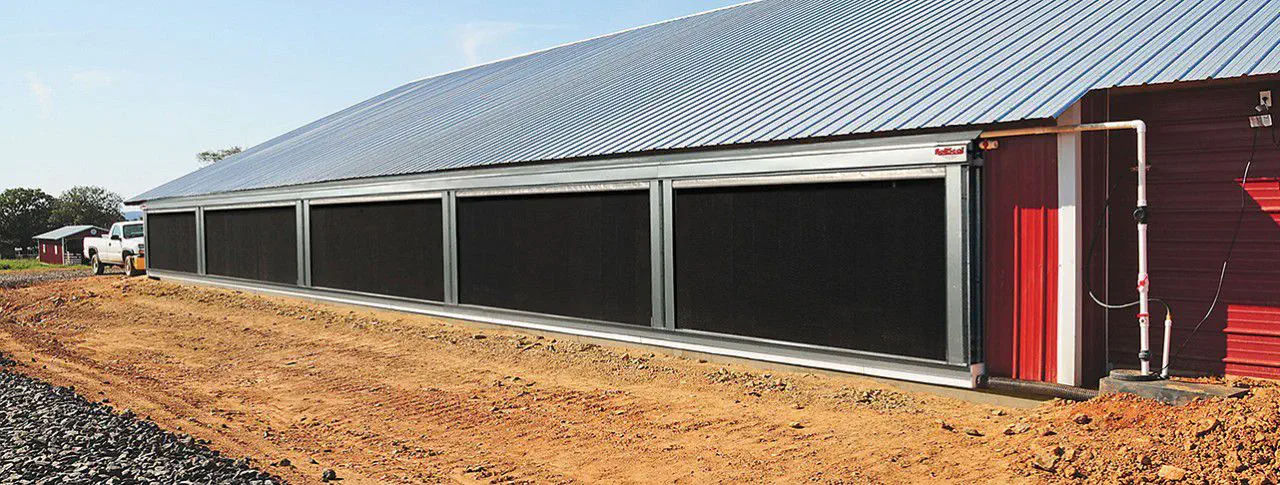
Modern poultry houses depend on controlled airflow, temperature management and reliable environmental equipment to maintain stable growing conditions. While fans, cooling pads and air inlets usually receive most of the attention, the shutters, curtains and motorized closures installed around poultry-house openings can also play an important role in controlling airflow, protecting openings and automating daily farm operation.
A poultry house roller shutter is a motorized or manually operated rolling closure used on selected openings of a chicken house, poultry farm or livestock building. Depending on the building design, it may be installed over a sidewall opening, ventilation opening, cooling-pad area, service opening or another section that needs to be opened and closed automatically.
Unlike a conventional warehouse roller shutter used mainly for security, a poultry-house shutter often operates as part of a larger environmental-control system.
The motor, roller tube, shutter or flexible curtain, limit controls, sensors and farm controller may all work together so that the opening can respond to changing temperature, ventilation requirements or operating schedules.
However, there is an important distinction:
“Poultry shutter” can describe several different products.
It may refer to:
a motorized roll-up sidewall curtain
a flexible poultry curtain wound around a roller tube
a rigid rolling shutter covering an opening
a cooling-pad protection shutter
a ventilation opening closure
or the smaller gravity shutters installed directly on ventilation fans
These systems are not mechanically identical.
This article focuses primarily on motorized rolling or roll-up poultry-house closures, rather than the small backdraft shutters attached directly to exhaust fans.
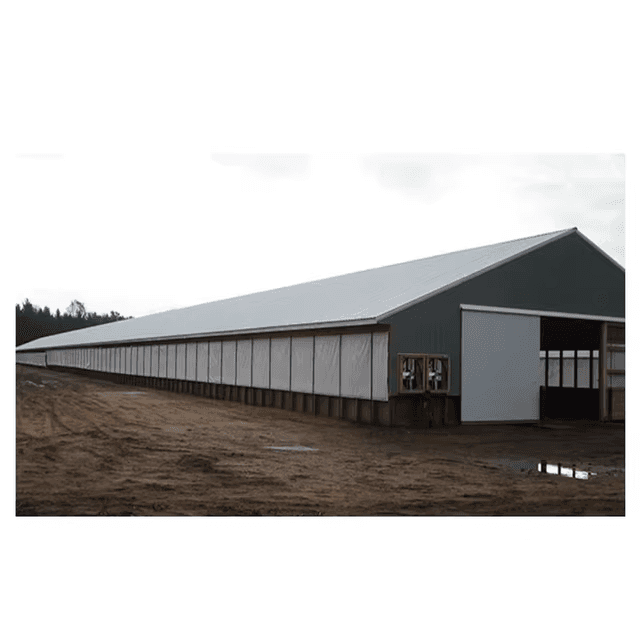
What Is a Poultry House Roller Shutter?
A poultry house roller shutter is an opening-control system in which a shutter curtain, flexible sheet or similar closure is rolled around a tube or shaft to open or close part of a poultry building.
A typical system may include:
roller tube or drive shaft
shutter curtain or flexible fabric
side guides or retaining structure
electric motor
gearbox
upper and lower limit switches
control box
manual override
environmental controller interface
temperature or humidity sensors
When the motor rotates the roller shaft, the shutter material winds upward or downward, changing the size of the opening.
The basic movement can be simplified as:
Motor → Gearbox → Roller Shaft → Shutter/Curtain Movement
When connected to an environmental controller, the system becomes:
Sensor → Farm Controller → Motor → Roller Shaft → Shutter Position
This allows the opening to be adjusted without workers manually operating each shutter.
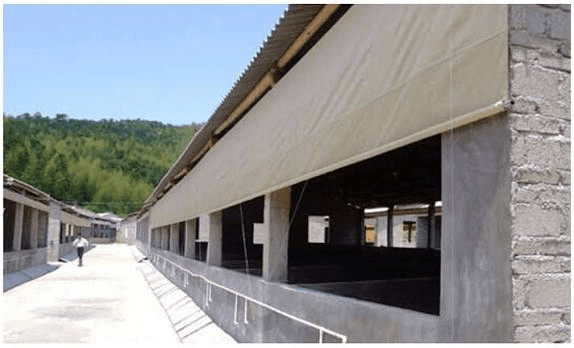
Are Poultry Roller Shutters the Same as Poultry Curtains?
Not always.
This distinction is important because the terminology used by poultry-equipment manufacturers varies considerably.
Flexible poultry curtain
A traditional poultry-house sidewall curtain is normally made from PE, PVC or another flexible fabric.
It may be:
pulled vertically
wound around a roller tube
raised by cables and pulleys
operated by a winch
or driven automatically by an electric motor.
Flexible sidewall curtains have been widely used in naturally ventilated and transitional poultry houses.
Roller shutter
A roller shutter generally refers to a closure that rolls around a shaft.
Depending on the application, the curtain can be flexible material or a more rigid shutter structure.
Fan shutter
A fan shutter is different.
These are the louvers installed over or behind poultry ventilation fans to reduce reverse airflow when the fan is not operating.
Research has shown that fan shutters themselves create airflow resistance, and dirty or only partially opening shutters can reduce ventilation performance.
Therefore:
Poultry roller shutter ≠ fan backdraft shutter.
The two should not be confused when specifying equipment.
Why Are Shutters Used in Poultry Houses?
The environmental conditions inside a commercial poultry house must be managed carefully.
Ventilation performs several important functions, including:
removing excess heat
controlling moisture
reducing ammonia and other contaminants
bringing oxygen into the building
controlling air velocity
improving temperature uniformity
University poultry-ventilation guidance explains that exhaust fans and controlled inlets work together to create the airflow pattern inside mechanically ventilated houses.
A motorized shutter can support this system by controlling selected openings.
Depending on the building design, the shutter may:
expose or cover an inlet area
protect cooling pads
close an opening during cold weather
regulate natural ventilation
isolate unused ventilation sections
prevent rain or wind from directly entering
provide automated opening based on temperature
provide a physical closure when the poultry house is not operating
The shutter therefore needs to be considered part of the building-envelope and ventilation-control strategy rather than simply a door.
How Does an Automatic Poultry House Roller Shutter Work?
A basic automatic poultry shutter has four functional layers.
1. Mechanical shutter system
The shutter itself consists of the closing material and supporting hardware.
Depending on the design, this may include:
flexible PVC or PE curtain
insulated roll-up material
aluminum or steel shutter material
roller tube
side tracks
brackets
bottom rail
The shutter is mechanically connected to the roller shaft.
2. Drive system
The electric motor produces rotational movement.
A gearbox reduces motor speed and increases usable output torque.
That torque is transferred to the shutter shaft.
The drive path can be represented as:
Electric Motor → Reduction Gearbox → Output Shaft → Roller Tube
3. Position control
The system needs to know when to stop.
Upper and lower limit switches prevent the shutter from continuing beyond its designed travel.
Depending on the motor and control system, intermediate positions may also be possible.
4. Environmental control
More advanced poultry-house automation can connect the shutter drive to:
temperature sensors
humidity sensors
timers
PLC systems
farm climate controllers
ventilation controllers
remote monitoring systems
Poultry-house environmental controllers already coordinate fans and air inlets based on temperature, timing and pressure conditions.
A compatible shutter motor can become another controllable actuator within that architecture.
Manual vs Automatic Poultry House Shutters
Traditional poultry-house curtains are often adjusted manually using:
hand winches
ropes
cables
pulleys
cranks
Manual systems remain practical for smaller or low-budget facilities.
However, larger farms may have very long houses and multiple openings.
Manual adjustment can become time-consuming and inconsistent.
Automatic operation allows shutters to respond more consistently to programmed conditions.
Feature | Manual Shutter | Automatic Shutter |
|---|---|---|
Initial cost | Lower | Higher |
Labor requirement | High | Low |
Automatic temperature response | No | Possible |
Remote operation | No | Possible |
Position repeatability | Operator dependent | More consistent |
Large farm suitability | Limited | Better |
Controller integration | No | Yes |
Emergency manual operation | Native | Should be designed in |
Commercial poultry curtain systems already use motorized drives together with pulleys, cables and automated controls for larger poultry facilities.
How Poultry House Roller Shutters Affect Ventilation
Opening size has a direct relationship with airflow.
In a naturally ventilated house, increasing the opening can increase the available natural airflow.
In mechanically ventilated poultry houses, the relationship becomes more complicated.
Exhaust fans create a pressure difference between the inside and outside of the building.
Fresh air then enters through designed openings.
The size and position of those openings influence:
inlet air velocity
air distribution
static pressure
bird-level air movement
University of Kentucky poultry ventilation guidance explains that air-inlet dimensions and airflow resistance affect how air enters mechanically ventilated buildings.
Therefore, an automatic shutter should not simply operate:
100% open / 100% closed
unless that is what the ventilation design requires.
Some systems benefit from controlled intermediate positions.
Why Partial Opening Can Matter
Suppose a poultry house requires only minimum ventilation during cool weather.
Opening a very large sidewall area could reduce inlet velocity.
Cool incoming air may then drop toward bird level too quickly instead of mixing with warmer air near the ceiling.
University of Georgia guidance notes that excessive inlet opening can lower incoming air velocity and contribute to cool air dropping prematurely into the occupied area.
For this reason, a poultry shutter used as part of ventilation control may require:
precise limit control
staged positioning
slow movement
controller compatibility
rather than simply maximum opening speed.
What Components Are Used in an Automatic Poultry Roller Shutter?
A reliable system normally includes more than the motor.
Roller shutter motor
The motor provides the rotational power.
The correct motor depends on:
shutter weight
roller diameter
shutter width
shutter height
operating frequency
environmental conditions
Gearbox
Many poultry shutter applications require relatively slow movement.
A reduction gearbox:
reduces motor rpm
increases available output torque
provides smoother operation
Roller tube or shaft
The shutter wraps around this component.
Its diameter affects the torque required from the motor.
Limit switches
Limit switches stop movement at predetermined positions.
A correctly configured limit system prevents:
over-rolling
excessive cable tension
mechanical impact
motor overrun
Brake
Some shutter motors incorporate a brake to help hold the shutter in position when the motor stops.
This can be important in larger shutters or where wind loads are present.
Control panel
The control panel processes commands from:
wall switch
remote controller
farm controller
timer
PLC
sensor system
Manual override
Poultry farms cannot always depend on electrical power.
A manual chain, hand crank or manual release can allow operation during:
power failure
controller failure
motor maintenance
emergency conditions
What Type of Motor Is Suitable for a Poultry House Roller Shutter?
There is no single motor type suitable for every poultry shutter.
China-Develop currently supplies several roller-shutter motor architectures, including tubular, central and side-mounted motors for different loads and applications.
For poultry applications, three categories are particularly relevant.
Tubular motors
A tubular motor is installed inside the roller tube.
Advantages can include:
compact installation
clean appearance
relatively quiet operation
fewer exposed components
It can be suitable for lighter rolling closures.
Central motors
A central motor is mounted around or close to the shutter shaft and commonly works with spring-assisted shutters.
China-Develop's current central motor range includes 180–260 Nm models for medium-duty rolling-shutter applications.
Whether a central motor is suitable for a poultry project depends on the actual shutter architecture.
Side-mounted motors
Side motors are mounted externally beside the roller shaft.
They are commonly used for:
heavier shutters
wider openings
higher loads
industrial applications
installations where maintenance access matters
China-Develop's industrial side-motor range includes models intended for significantly heavier rolling doors.
For large poultry-house rolling shutters, a side-mounted industrial motor may be more appropriate than a compact tubular motor.
How Much Motor Torque Does a Poultry Roller Shutter Need?
Torque is one of the most important specifications.
Torque is the rotational force available to turn the shutter shaft.
A simplified relationship is:
T = F × r
Where:
T = torque
F = effective lifting force
r = effective winding radius
For a simplified vertical load:
F ≈ m × g
Therefore:
T ≈ m × g × r
However, this equation should only be treated as an initial mechanical estimate.
Actual motor selection must also consider:
mechanical efficiency
shaft bearings
guide friction
changing roller diameter
shutter stiffness
wind loading
starting torque
transmission losses
safety margin
The effective radius also increases as shutter material accumulates around the roller tube.
Therefore, motor torque should not be selected from shutter weight alone.
China-Develop's existing roller-shutter motor engineering content likewise emphasizes matching torque with curtain weight, winding radius and actual mechanical conditions.
Why Roller Diameter Matters
Consider two poultry shutters with identical weight.
Shutter A winds around a 100 mm effective radius.
Shutter B winds around a 200 mm effective radius.
Using:
T = F × r
the second system theoretically requires approximately twice the shaft torque for the same lifting force before accounting for system losses.
This is why professional buyers should provide both:
shutter weight
and
roller/shaft dimensions
when requesting a motor recommendation.
Does Shutter Speed Matter?
Yes.
For ventilation shutters, faster is not always better.
A poultry-house closure normally requires:
controlled movement
predictable positioning
mechanical stability
rather than the very high opening speed expected from a logistics high-speed door.
Excessive speed can create:
material shock
higher acceleration loads
curtain oscillation
greater gearbox stress
stronger stopping forces
A reduction gearbox is therefore commonly used to provide relatively slow, controlled movement.
One current commercial poultry curtain system, for example, publishes movement speeds around 0.5–0.7 m/min for its motorized curtain arrangement. This is manufacturer-specific rather than a universal poultry standard, but it illustrates the relatively slow movement used in some systems.
Why Duty Cycle Matters
Poultry shutters may move more frequently than ordinary residential shutters.
A climate controller may make multiple adjustments during a day as:
outdoor temperature changes
birds produce more heat
ventilation stage changes
cooling systems activate
This means buyers should check:
starts per hour
cycles per day
maximum continuous running time
motor thermal protection
A motor capable of lifting the shutter does not automatically have the correct duty rating.
An undersized-duty motor may repeatedly overheat even if its torque is sufficient.
Why the Poultry-House Environment Is Difficult for Motors
A poultry house is not the same operating environment as a retail shop or residential garage.
Potential environmental challenges include:
Dust
Feed, feathers and litter can produce considerable airborne dust.
Dust can accumulate around:
ventilation equipment
motors
control boxes
limit mechanisms
Oklahoma State University notes that poultry-house dust readily accumulates on fans and shutters and can significantly reduce ventilation-system efficiency if equipment is not maintained.
Humidity
Ventilation equipment can be exposed to:
high relative humidity
condensation
washdown moisture
Electrical components should therefore have suitable protection.
Corrosive gases
Ammonia is a recognized poultry-house air contaminant.
Ventilation is used partly to control ammonia accumulation.
Long-term exposure can also be challenging for metals and electrical components.
Temperature
Motors may operate through:
hot summer conditions
cold winter conditions
large day/night temperature swings
For these reasons, poultry shutter motor selection should examine more than torque.
What IP Rating Should a Poultry Shutter Motor Have?
IP rating describes protection against solid particles and water.
For agricultural environments, buyers should evaluate:
installation location
exposure to dust
exposure to rain
washdown methods
humidity
enclosure design
An outdoor or exposed poultry-house motor generally requires more environmental protection than equipment installed inside a clean indoor enclosure.
However:
IP rating should not be interpreted as chemical-corrosion resistance.
A motor can have good dust/water ingress protection while still containing materials that may corrode under long-term agricultural chemical exposure.
For demanding poultry projects, buyers should therefore evaluate:
IP rating
housing material
coating
connectors
fasteners
cable glands
corrosion resistance
as separate specifications.
Why Thermal Protection Is Important
If a shutter:
becomes jammed
operates too frequently
is overloaded
encounters excessive resistance
the motor current and temperature can increase.
Thermal protection helps protect the winding against damaging overheating.
For poultry houses, thermal protection is particularly useful because a farm controller may continue issuing movement commands even if the shutter mechanism develops excessive resistance.
However, repeated activation of thermal protection is not normal operation.
It usually indicates a problem that should be investigated.
How Can a Poultry Shutter Connect to a Climate Controller?
The exact control interface depends on the motor and controller.
A common architecture may look like:
Temperature/Humidity Sensors
↓
Poultry Climate Controller
↓
Relay / Motor Control Panel
↓
Roller Shutter Motor
↓
Shutter Position
The controller may issue commands such as:
open
close
stop
move to staged position
More advanced systems may coordinate shutter position with:
exhaust fans
cooling pads
heating
air inlets
alarm systems
The motor itself does not decide the correct ventilation strategy.
That logic belongs to the poultry-house environmental control system.
Poultry Roller Shutter and Tunnel Ventilation
Tunnel ventilation is widely used for hot-weather poultry-house cooling.
Large exhaust fans are positioned at one end of the building, while air enters through the opposite end, often through evaporative cooling pads.
University of Kentucky poultry engineering guidance describes this negative-pressure airflow strategy and the role of fan and inlet resistance in system performance.
In this type of building, motorized shutters may potentially be used for:
exposing cooling-pad areas
isolating unused openings
protecting equipment during inactive periods
controlling selected air passages
But the shutter cannot be designed independently from the ventilation engineer's airflow calculations.
If the opening is too small, it may create excessive resistance.
If it is too large or opens incorrectly, the designed pressure and air distribution can also be affected.
Poultry House Roller Shutter vs Traditional Curtain
Which is better depends on the application.
Factor | Roller Shutter / Roll-Up System | Traditional Curtain |
|---|---|---|
Automation | Excellent | Excellent with motor/winch |
Wind stability | Potentially higher depending on construction | Depends on tension/support |
Mechanical complexity | Higher | Usually lower |
Sealing | Depends on guides/design | Depends on fabric and installation |
Initial cost | Often higher | Often lower |
Durability | Depends on shutter material | Depends on fabric quality |
Motor integration | Direct shaft drive possible | Often cable/winch drive |
Maintenance | Motor + guides + shaft | Fabric + cables + pulleys |
Large openings | Possible | Very common |
Precise rolling movement | Good | Depends on system |
A flexible curtain remains a highly practical solution for many poultry houses.
A rolling shutter becomes more attractive where the project requires:
controlled rolling movement
compact storage around a shaft
stronger mechanical guidance
automation
physical protection
better integration with an industrial drive
Where Can Poultry House Roller Shutters Be Used?
Broiler houses
Large broiler facilities may require automated opening control as part of ventilation and cooling strategies.
Layer houses
Roller shutters may be used where controlled sidewall or equipment-area closures are needed.
Breeder houses
Environmental control and lighting requirements can make controllable openings valuable.
Cooling-pad protection
A shutter can protect pad sections when the cooling system is not being used.
Natural-ventilation poultry houses
Automated sidewall openings can respond to temperature changes.
Farm storage and equipment openings
Poultry farms may also use conventional rolling shutters on:
feed storage rooms
equipment rooms
utility buildings
maintenance areas
In those applications, the motor may be selected more like a conventional industrial roller-shutter motor.
What Information Is Needed to Select a Poultry Shutter Motor?
A professional supplier should ask for more than:
“What is the shutter width?”
For accurate selection, provide:
Parameter | Required Information |
|---|---|
Opening width | mm / m |
Opening height | mm / m |
Shutter material | PVC, PE, aluminum, steel, etc. |
Total moving weight | kg |
Roller tube diameter | mm |
Maximum winding diameter | mm |
Number of shutters | Quantity |
Motor arrangement | One motor per shutter / shared drive |
Opening frequency | Cycles per hour/day |
Required speed | rpm or m/min |
Voltage | 110/120V, 220/230V, 380/400V |
Frequency | 50/60 Hz |
Installation environment | Indoor/outdoor |
Temperature range | °C |
Control method | Switch/controller/PLC |
Manual operation | Required/not required |
Safety requirements | Project-specific |
With this information, a motor manufacturer can evaluate:
output torque
gearbox ratio
motor power
duty rating
brake
limit system
environmental protection
Common Mistakes When Selecting a Poultry Roller Shutter Motor
Choosing only by motor watts
Higher wattage does not automatically mean higher usable output torque.
Gearbox ratio and output speed matter.
Ignoring roller diameter
Larger effective winding radius increases torque requirement.
Ignoring friction
Dirty, bent or poorly aligned side guides can dramatically increase load.
Using a residential-duty motor in a commercial poultry house
Agricultural automation may require frequent repositioning.
Duty cycle must be checked.
Ignoring dust and humidity
A mechanically adequate motor may still fail prematurely if the enclosure is unsuitable for the environment.
No emergency manual operation
Power failures can occur.
Farm staff should have a way to position critical closures manually where required by system design.
No limit-switch protection
Improper travel limits can cause:
over-winding
curtain damage
mechanical jams
motor overload
Poultry Shutter Maintenance
Maintenance should include more than checking whether the shutter still moves.
Inspect the shutter surface
Look for:
tears
cracks
deformation
corrosion
loose connections
Clean guides and moving components
Dust and litter should not be allowed to build up around the moving mechanism.
Check shaft bearings
Worn bearings increase resistance and motor load.
Inspect the motor
Check for:
unusual noise
overheating
vibration
water ingress
corrosion
Test travel limits
Verify that the shutter stops consistently at the correct upper and lower positions.
Test manual operation
Emergency manual systems should remain usable.
Check electrical connections
Loose or corroded terminals can create unreliable motor operation.
Common Poultry Roller Shutter Problems
Motor runs but shutter does not move
Possible causes include:
damaged coupling
gearbox problem
loose shaft connection
drive component failure
Shutter stops halfway
Check:
mechanical obstruction
thermal protection
incorrect limit setting
motor sizing
voltage
Shutter rolls unevenly
Possible causes:
uneven material tension
shaft misalignment
guide resistance
installation error
Motor overheats
Possible causes include:
excessive load
high cycle frequency
blocked shutter
wrong motor capacity
poor ventilation around motor
Shutter does not stop at the correct position
The travel limit system may require adjustment or repair.
What Should Poultry Equipment Distributors Look for in a Motor Supplier?
For distributors, integrators and OEM poultry-equipment manufacturers, motor sourcing should consider long-term product support.
Important factors include:
consistent motor torque
gearbox quality
voltage options
50 Hz / 60 Hz compatibility
limit-switch reliability
brake design
thermal protection
IP protection
manual operation
spare parts
OEM customization
control integration
technical documentation
The lowest motor purchase price does not necessarily produce the lowest system cost.
Field failures in a poultry farm can create:
emergency service calls
ventilation risk
labor costs
replacement costs
customer complaints
Reliability should therefore be considered together with price.
Can a Standard Roller Shutter Motor Be Used in a Poultry House?
Sometimes.
The important question is not whether the motor is called a “poultry motor.”
The important question is whether its technical characteristics match the poultry application.
A standard industrial roller-shutter motor may be suitable if it provides the required:
torque
speed
duty cycle
environmental protection
manual override
control interface
For large or demanding agricultural projects, a side-mounted industrial roller-shutter operator may provide advantages in torque, heat dissipation and maintenance access.
China-Develop's current side-mounted shutter motor range is designed for larger commercial and industrial rolling-door loads and can be evaluated for specialized agricultural automation projects where the shutter architecture is compatible.
Frequently Asked Questions
What is a poultry house roller shutter?
A poultry house roller shutter is a rolling closure used on selected openings of a chicken or poultry building. It may be manually or electrically operated and can be used for ventilation openings, sidewalls, cooling-pad protection or other farm applications.
What motor is used for a poultry house shutter?
The appropriate motor depends on shutter weight, width, roller diameter, required torque, movement speed and operating frequency. Tubular, central or side-mounted roller-shutter motors may be used depending on the system design.
Can poultry shutters open automatically?
Yes. A motorized shutter can be connected to a compatible control panel or poultry-house climate controller. The controller may command the shutter based on temperature, time or other environmental-control logic.
Are poultry roller shutters the same as sidewall curtains?
Not necessarily. Traditional poultry-house curtains are often flexible fabric systems moved by cables, winches or motors. A roller shutter specifically winds around a roller shaft, although flexible roll-up poultry curtains can share similar operating principles.
Why is torque important for a poultry shutter motor?
Torque determines the rotational force available at the shutter shaft. Required torque depends on shutter load, winding radius, friction and mechanical efficiency.
Is a higher-power motor always better?
No. Motor selection should consider output torque, speed, gearbox ratio and duty cycle, not watts alone.
Should poultry shutter motors have manual backup?
For critical or frequently used openings, manual emergency operation can be valuable because it allows the shutter to be moved if electrical power or control equipment fails.
Can poultry shutter motors work with temperature sensors?
Usually the sensor communicates with an environmental controller, which then sends an open or close command to the motor-control system. The exact interface must be compatible with both devices.
Why does a poultry shutter motor overheat?
Possible causes include overloading, excessive cycling, mechanical resistance, incorrect motor sizing or poor electrical conditions.
What should I provide when ordering a poultry shutter motor?
Provide opening dimensions, shutter weight and material, roller diameter, operating frequency, voltage, control method and environmental conditions.
Final Thoughts
A poultry house roller shutter is more than a motorized opening.
In a modern chicken farm, it can become part of the building's larger environmental-control system.
The complete operating chain may involve:
Sensors → Poultry Controller → Motor Control → Gear Motor → Roller Shaft → Shutter Position → Airflow
For that system to work reliably, the motor must be correctly matched to the mechanical and environmental conditions.
Important factors include:
shutter weight, roller diameter, output torque, speed, duty cycle, limit control, dust protection, humidity resistance, manual operation and controller compatibility.
The most common mistake is selecting a motor simply because it has enough nominal power to move the shutter.
A professional system instead evaluates the complete load, operating frequency and poultry-house environment.
For poultry equipment manufacturers, contractors and farm-automation distributors, this approach helps reduce motor overheating, uneven shutter movement, premature gearbox wear and unnecessary field maintenance.
China-Develop supplies tubular, central and side-mounted roller shutter motor solutions for residential, commercial and industrial automation applications. For specialized poultry-house shutter projects, motor selection can be based on the actual shutter dimensions, moving weight, roller size, voltage, cycle frequency and control requirements rather than using a one-size-fits-all model.
Other Blogs


