Blog
How Much Does a Garage Door Opener Cost? Complete 2026 Price Guide
Author
Ray
Published
Category
Guide
Learn how much a garage door opener costs in 2026, including unit prices, installation fees, drive types, smart features, and key cost factors.

Author
Ray
An experienced automation specialist with a strong background in motor technology and industrial solutions. With years of expertise in central motors, tubular motors, and automation systems, the author is dedicated to sharing insights that connect engineering innovation with real-world applications. Passionate about advancing reliable, energy-efficient, and high-performance automation products for global markets.
What’s better than insider perks, pro tips, and surprises?
Sign up to get the most recent blog articles in your email every week.
Join now.
WHY I WRITE THIS
About my business
Our company’s main product lines include tubular motors, sliding gate motors, swing gate motors, roller shutter motors, and other door automation solutions, all manufactured by trusted partner factories we have worked with for many years.
Our Services
I help them with sales and export operations, while our company also provides sourcing and procurement services in China to help international clients solve supply-related challenges. If you need assistance with procurement, please feel free to contact us.
The cost of a garage door opener can vary significantly depending on the drive system, motor capacity, smart features, installation requirements, and the condition of the existing garage door.
In 2026, homeowners in the United States commonly spend around $218 to $540 for professional garage door opener installation, with an average project cost of approximately $379. The opener itself can range from relatively affordable basic models to premium wall-mounted and smart systems costing several hundred dollars.
However, the lowest-priced garage door opener is not always the most economical choice over its entire service life. Noise level, motor and gearbox quality, drive type, replacement-part availability, safety features, installation quality, and expected operating frequency can all affect the true cost of ownership.
This 2026 garage door opener cost guide explains typical product prices, installation costs, chain drive vs belt drive pricing, smart opener costs, replacement expenses, and the factors homeowners and professional buyers should consider before choosing a system.
How Much Does a Garage Door Opener Cost in 2026?
For a typical residential installation in the United States, homeowners should generally expect a complete professionally installed garage door opener project to cost approximately $218 to $540.
Angi reports an average 2026 installation cost of about $379, while HomeAdvisor reports essentially the same national range and average.
The actual garage door opener itself may cost roughly $150 to $520 for many conventional models, although premium units and advanced systems can cost considerably more. Angi notes that some complete opener products can reach $900 or higher depending on technology and configuration.
This Old House estimates a typical garage door opener project in 2026 at approximately $213 to $371, with installation accounting for part of the total depending on the project and installation method.
These figures should be treated as market references rather than fixed prices. Local labor costs, door configuration, brand, accessories, installer rates, and regional availability can significantly change the final amount.
Garage Door Opener Cost at a Glance
Cost Category | Typical 2026 U.S. Price Range |
|---|---|
Professional opener installation project | $218–$540 |
Average professional project | About $379 |
Basic to mid-range opener unit | About $150–$520 |
Chain drive opener | About $150–$250 |
Belt drive opener | About $160–$350 |
Screw drive opener | About $150–$300 |
Direct drive opener | About $280–$500 |
Jackshaft / wall-mount opener | About $500–$750 |
Battery backup add-on | About $50–$150 |
Automatic lock | About $100–$300 |
Rail extension kit | About $45–$85 |
The figures above are based primarily on current 2026 Angi market estimates and should not be interpreted as manufacturer quotations.
Garage Door Opener Cost by Drive Type
The drive system is one of the biggest factors affecting garage door opener price.
Different drive types provide different combinations of noise, durability, maintenance, installation flexibility, and cost.
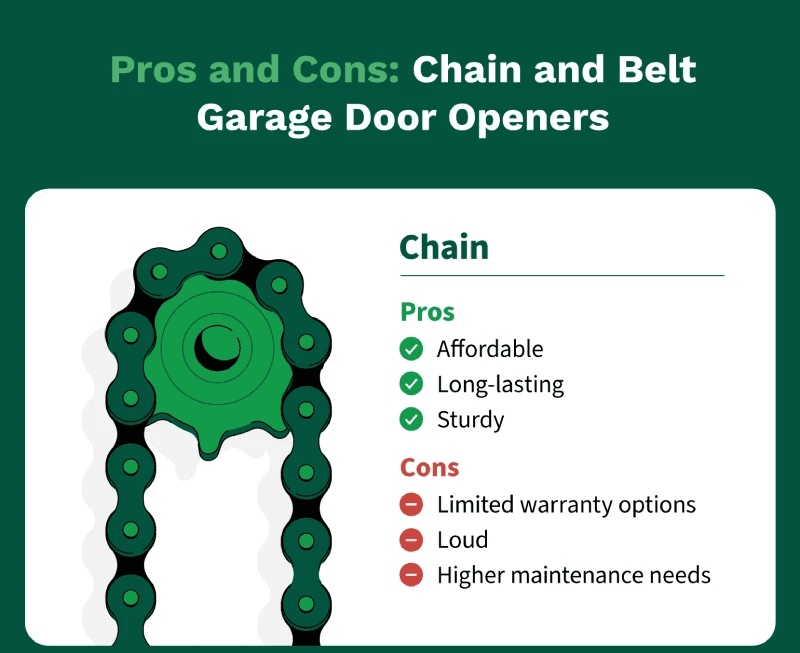
Chain Drive Garage Door Opener Cost
A chain drive garage door opener typically costs around $150 to $250 for the opener itself in current U.S. market estimates.
Chain drive systems use a metal chain to move the trolley along the opener rail. They have been widely used for decades because they provide reliable performance at a relatively affordable price.
Chain drive openers are particularly attractive for homeowners who prioritize value and strength over quiet operation.
They are commonly suitable for detached garages, standard residential installations, and applications where operating noise is not the primary consideration.
Although the initial purchase price is often lower, chain drive systems may require periodic maintenance and lubrication according to the manufacturer's instructions.
For buyers comparing products purely on purchase price, chain drive is often one of the most economical categories.
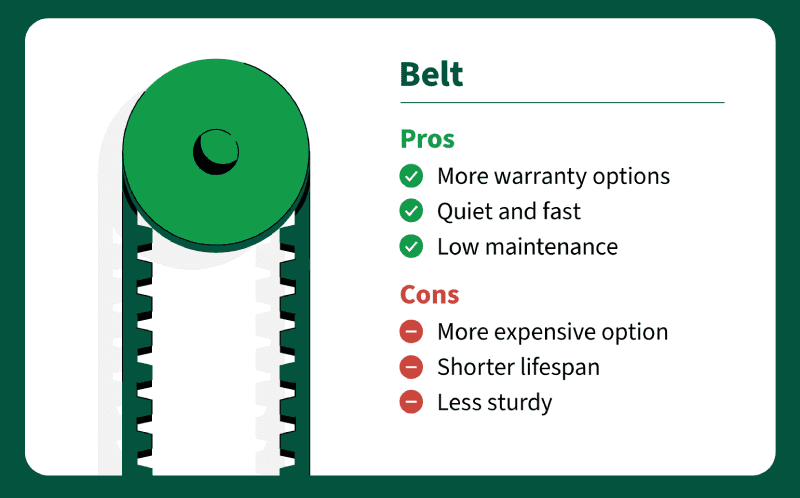
Belt Drive Garage Door Opener Cost
Belt drive garage door openers generally cost approximately $160 to $350 for the opener unit.
Instead of a metal chain, these openers use a reinforced belt to move the trolley.
The primary advantage is quieter and smoother operation.
Belt drive openers are therefore popular for garages attached directly to homes, particularly when bedrooms or living areas are located above or beside the garage.
The purchase price is usually somewhat higher than a basic chain drive model, but many homeowners consider the quieter operation worth the additional investment.
Price differences also depend on motor technology, battery backup, smart controls, integrated lighting, camera systems, and other features.
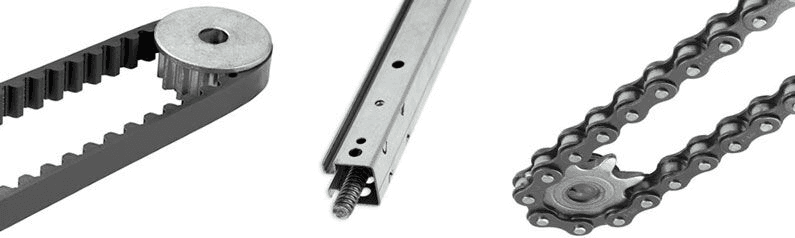
Screw Drive Garage Door Opener Cost
Current estimates place screw drive garage door openers at approximately $150 to $300.
A screw drive system uses a threaded rod to move the trolley.
The design contains fewer moving drive components than a traditional chain arrangement and can offer relatively fast operation.
However, noise characteristics and maintenance requirements vary by model and environment.
Screw drive openers are less dominant in the residential market than chain and belt systems, so homeowners should also consider replacement-part availability and local service support.
Direct Drive Garage Door Opener Cost
Direct drive garage door openers generally occupy a more premium price range.
Angi estimates unit pricing of approximately $280 to $500 for this category.
Direct drive systems are designed to minimize the number of moving components in the drive arrangement and are often promoted for quiet, smooth operation.
Their higher initial cost can make sense for homeowners who prioritize low noise and premium operating characteristics.
Wall-Mount or Jackshaft Garage Door Opener Cost
Wall-mounted or jackshaft garage door openers are generally among the more expensive residential options.
Current 2026 market estimates place these products at approximately $500 to $750 depending on features and configuration.
Instead of mounting the motor and rail on the ceiling, a jackshaft opener is installed beside the garage door and works with the torsion shaft.
This configuration provides several advantages.
It frees ceiling space, reduces overhead hardware, and can be useful for garages with high ceilings, storage systems, lifts, or architectural limitations.
Home Depot currently lists wall-mount smart models from several hundred dollars upward, confirming that this category typically sits above conventional ceiling-mounted systems in retail pricing.
Does Garage Door Opener Horsepower Affect Cost?
Yes.
Higher-capacity garage door openers often cost more because they may require larger or more capable motors, stronger drive components, different control systems, or additional engineering.
However, horsepower should not be considered in isolation.
A standard 1/2 HP residential opener will generally cost less than a premium high-capacity model, but drive type and features can have an even larger effect on price.
For example, a premium smart belt drive opener may cost more than a more powerful but basic chain drive opener.
Current Angi data notes that a basic 1/2 HP opener may begin near the lower end of the market, while much higher-power units can cost several hundred dollars.
For detailed sizing guidance, buyers should compare their door weight, construction, balance, and operating requirements rather than automatically purchasing the most powerful opener available.
1/2 HP Garage Door Opener Cost
A 1/2 HP garage door opener is generally positioned at the lower to middle end of residential opener pricing.
These units are commonly designed for standard residential sectional doors that are properly balanced.
The final price will depend heavily on whether the opener uses a chain, belt, smart controls, battery backup, or other premium features.
A basic chain drive 1/2 HP product will generally cost less than a smart belt drive model in the same nominal power category.
For many standard residential garages, 1/2 HP remains an economical option because additional lifting capacity may not be necessary.
3/4 HP Garage Door Opener Cost
A 3/4 HP opener generally costs more than a basic 1/2 HP unit when comparing similar drive systems and features.
These openers are commonly chosen for heavier doors, insulated doors, wider double doors, or garages with higher daily operating frequency.
However, the price difference is not determined by horsepower alone.
A simple 3/4 HP chain opener may still cost less than a feature-rich 1/2 HP-equivalent smart belt opener.
Buyers should therefore compare complete product specifications rather than horsepower labels only.
1 HP Garage Door Opener Cost
One-horsepower garage door openers are generally positioned toward the higher end of residential lifting capacity.
They may be selected for oversized or particularly heavy doors where the manufacturer recommends greater capacity.
These models tend to cost more than standard residential units, but price is still strongly affected by drive technology, control features, rail configuration, brand, and accessories.
Before paying more for 1 HP, homeowners should confirm that the garage door actually requires it.
A larger motor should not be used to compensate for a poorly balanced door or damaged spring system.
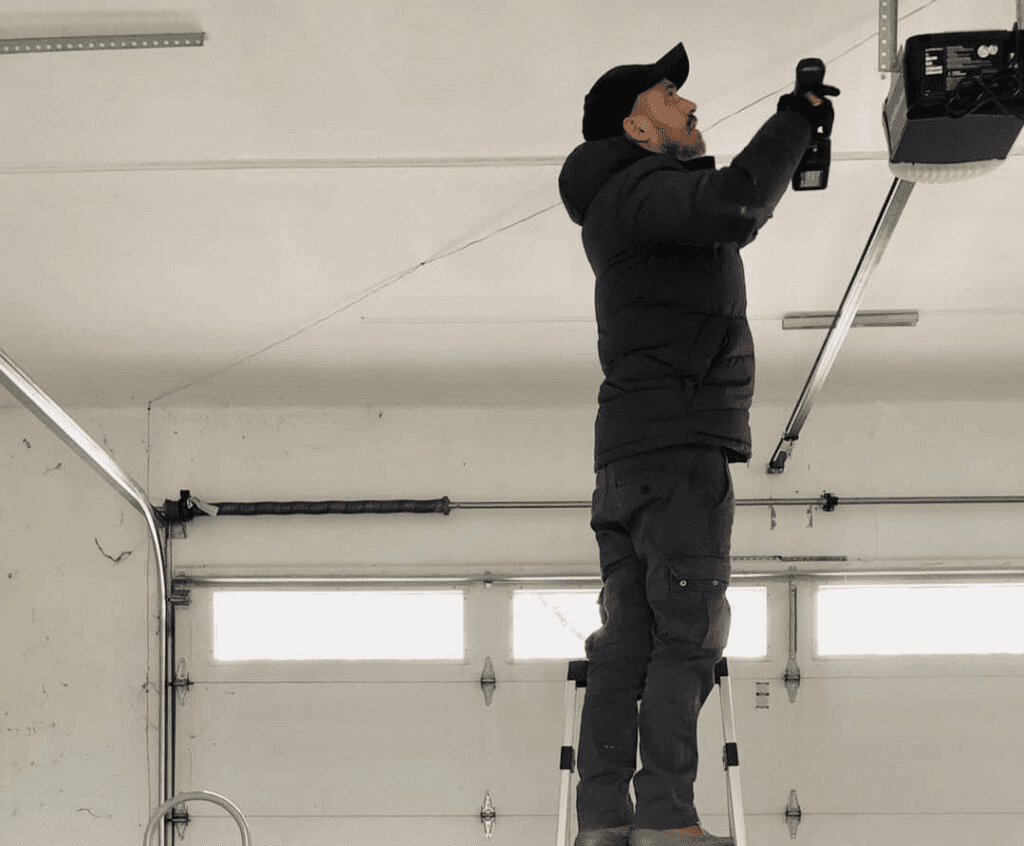
How Much Does Garage Door Opener Installation Cost?
Professional garage door opener installation in the United States typically costs several hundred dollars as a complete project.
Angi and HomeAdvisor currently report a common total range of approximately $218 to $540, with an average around $379.
Labor is only one component of this total.
Angi reports installation labor commonly around $65 to $85 per hour, and installation may require approximately two to six hours depending on project complexity.
A straightforward replacement can be relatively quick.
A new installation may require more work if the installer must add mounting supports, wiring, sensors, rail extensions, controls, electrical outlets, or structural components.
What Is Included in Professional Installation?
Professional garage door opener installation typically includes mounting the motor unit, installing or assembling the rail, connecting the opener to the garage door, installing controls and sensors, programming the system, and testing operation.
The installer should also verify proper travel limits and safety functions.
Some installers include removal of the old opener in the quoted price, while others may charge additional labor.
When comparing installation quotes, homeowners should confirm whether the price includes the opener, labor, old-unit removal, new sensors, remotes, programming, rail hardware, and disposal.
A low initial quotation can become considerably more expensive if these items are added later.
New Installation vs Garage Door Opener Replacement Cost
Replacing an existing garage door opener can sometimes cost less than installing a completely new system because electrical service and some structural mounting locations may already exist.
However, homeowners should not automatically assume that the old rail, sensors, wiring, or brackets can be reused.
Different opener manufacturers and models may use different rail systems, sensor requirements, brackets, and control wiring.
Angi specifically notes that old and new garage door opener rails are not universally interchangeable and recommends treating rail compatibility carefully during replacement.
Replacing the complete opener system can sometimes be more practical than attempting to adapt incompatible components.
How Much Does It Cost to Remove an Old Garage Door Opener?
Many professional installers include removal in the total installation price.
Where removal is charged separately, it may add additional labor time.
Angi suggests budgeting for roughly another half-hour of labor in situations where removal is not included.
The amount may increase if the existing opener is difficult to access, incorrectly mounted, damaged, or combined with obsolete hardware that must also be replaced.
Smart Garage Door Opener Cost
Smart technology can increase garage door opener cost significantly.
Basic smart functionality may include Wi-Fi connectivity and smartphone control.
More advanced systems can include integrated cameras, activity notifications, automatic locking, delivery monitoring, voice-assistant compatibility, LED lighting, battery backup, and wireless keypads.
Angi reports that openers with multiple premium features can reach approximately $400 to $600 in common retail configurations.
This Old House currently estimates that Wi-Fi-enabled and smartphone-controlled garage door opener products may range approximately $100 to $450, depending on the model and level of technology.
The right question is therefore not simply whether a smart garage door opener costs more.
Buyers should consider which features they will actually use.
A basic smartphone status function may be useful for many homeowners, while an integrated camera or automatic lock may be more relevant for certain security-focused applications.
How Much Does Battery Backup Add?
Battery backup is increasingly common in premium residential garage door openers.
Angi estimates a battery backup system can add approximately $50 to $150 depending on the opener and battery configuration.
Battery backup allows compatible openers to continue operating during certain power outages.
The feature can be particularly useful in areas affected by storms, grid interruptions, wildfire-related outages, or other situations where reliable garage access is important.
When comparing products, buyers should also check expected battery replacement intervals and replacement-battery availability.
How Much Do Garage Door Safety Sensors Cost?
Replacement safety sensors are relatively inexpensive compared with a complete opener.
Angi currently estimates approximately $25 to $50 for a pair of basic replacement sensors, although complete parts and installation costs may be higher depending on model and labor.
Compatibility is important.
Sensors should not be selected solely because they appear physically similar. The replacement must be compatible with the opener's control system and meet the manufacturer's installation requirements.
Safety sensors should never be permanently bypassed simply to avoid replacement cost.
How Much Does an Automatic Garage Door Lock Cost?
Automatic locking systems can add approximately $100 to $300 depending on the opener and accessory configuration.
These locks provide additional physical security by mechanically securing the garage door when it closes.
Some premium wall-mounted opener systems integrate automatic locking as part of the overall package.
For homeowners using the garage as a primary household entrance or storing valuable equipment inside, the added cost may be worthwhile.
Do Taller Garage Doors Cost More to Automate?
They can.
Standard opener rails are designed for common garage door heights.
A taller door may require an extension kit or longer rail system.
Angi currently estimates typical extension kits at approximately $45 to $85, depending on height and material.
This is why garage door height should be confirmed before purchasing an opener.
A motor may provide sufficient lifting capacity while the supplied rail is still too short for the installation.
What Factors Affect Garage Door Opener Cost?
Several variables influence the final project price.
Drive Type
Chain drive systems are generally among the least expensive.
Belt drive systems typically cost somewhat more because quiet operation is a premium feature.
Direct drive and wall-mounted systems tend to occupy higher price categories.
Motor Capacity
More powerful or higher-capacity opener systems may cost more, particularly when combined with stronger mechanical components.
However, price does not increase in a perfectly linear relationship with horsepower.
Door Size and Weight
Larger and heavier doors may require higher-capacity equipment.
This can increase both equipment cost and installation complexity.
Smart Features
Wi-Fi, cameras, app controls, smart-home integration, monitoring functions, and automatic locks can all increase price.
Battery Backup
Battery systems add both initial equipment cost and eventual replacement-battery expenses.
Installation Complexity
A straightforward replacement typically requires less labor than an installation requiring new wiring, structural supports, rail modifications, or electrical work.
Number of Garage Doors
A garage with two separate doors generally requires two opener systems.
Even if each door requires a smaller motor, the equipment and installation costs can be substantially higher than operating one double-width door with one opener.
Local Labor Rates
Installation costs vary by region.
Large metropolitan areas and markets with higher labor costs may exceed national averages.
Brand and Replacement Parts
Premium established brands may cost more initially.
However, replacement parts, remotes, sensors, and technical support may also be easier to obtain.
For long-term ownership, parts availability can influence total cost as much as the original purchase price.
DIY vs Professional Garage Door Opener Installation Cost
Installing a garage door opener yourself can reduce direct labor expenses if you already own the necessary tools and have appropriate installation experience.
However, DIY installation is not automatically cheaper in every situation.
The job can involve overhead mounting, mechanical alignment, low-voltage wiring, control programming, sensor positioning, and safety testing.
If additional tools, mounting hardware, electrical work, or corrective repairs are required, the expected savings may decrease quickly.
Professional installation also reduces the risk of improper rail alignment, mounting, travel adjustment, or safety-sensor configuration.
DIY installation may make sense for experienced homeowners replacing a straightforward compatible system.
Professional installation is generally preferable when the garage door itself has balance problems, structural changes are required, electrical work is needed, or the installer is unfamiliar with garage door automation systems.
Is a More Expensive Garage Door Opener Worth It?
Sometimes.
The cheapest opener can be perfectly adequate for a simple residential application.
However, paying more can make sense when the higher price provides meaningful improvements.
For example, homeowners with bedrooms above the garage may benefit from a quieter belt drive.
A property with limited ceiling space may benefit from a wall-mounted opener.
A homeowner in an area with frequent power outages may value battery backup.
A household using the garage as the primary entrance may benefit from a higher-capacity motor, smart notifications, or automatic locking.
A higher price is justified when it solves a real application requirement.
Paying extra purely for specifications that the garage door does not need provides much less value.
How Much Should You Spend on a Garage Door Opener?
For a typical residential garage door, homeowners do not necessarily need the most expensive opener available.
A practical budget should begin with the door itself.
Determine its size, weight, material, balance, operating frequency, and noise requirements.
Then determine whether you need smart controls, battery backup, additional security, or wall-mount installation.
For a basic detached residential garage, a chain drive system may offer excellent value.
For an attached garage where noise matters, paying more for a belt drive system can make sense.
For premium applications or garages where ceiling space must remain clear, a jackshaft system may justify its substantially higher initial cost.
The correct budget is therefore based on application rather than simply choosing a price category.
Garage Door Opener Repair vs Replacement Cost
Repair may be more economical when the problem involves a remote, sensor, wiring connection, minor drive component, or another replaceable part.
Angi currently reports garage door opener repair services commonly ranging from around $100 to $500, depending on the problem.
As repair costs approach the price of a new opener, replacement becomes more attractive.
Replacement should also be considered when the existing opener is old, repeatedly failing, lacks appropriate safety technology, has unavailable replacement parts, or no longer provides the features the homeowner requires.
The decision should consider expected remaining service life rather than repair cost alone.
Spending $250 to repair an opener likely to fail again soon may offer worse value than putting that money toward a modern replacement.
How Long Does a Garage Door Opener Last?
A quality garage door opener can commonly provide around 10 to 15 years of service with appropriate installation and maintenance, although actual lifespan varies significantly. Angi and This Old House both use roughly this range in their current cost guidance.
Operating frequency is a major factor.
An opener operating twice per day experiences far fewer cycles than an opener used as the primary household entrance and operating ten or more times daily.
Garage door balance also matters.
A poorly balanced door places unnecessary load on the motor, gearbox, rail, trolley, and drive mechanism.
Product quality, environment, maintenance, and electrical conditions also influence long-term reliability.
Is the Cheapest Garage Door Opener Really Cheaper?
Not always.
Initial price is only one part of total ownership cost.
Consider two opener systems.
One costs less but experiences frequent sensor issues, premature gear wear, remote-control failures, or unavailable spare parts.
Another costs slightly more but operates reliably for many years.
The second product may ultimately have the lower total cost.
For homeowners, the additional costs of failure include repair visits, replacement parts, inconvenience, and eventually premature replacement.
For distributors and installers, the financial impact is even greater because product failure can result in warranty claims, technician visits, replacements, logistics costs, and damage to customer relationships.
What Should Distributors Consider Beyond Garage Door Opener Unit Price?
For distributors, contractors, importers, and OEM buyers, comparing garage door opener quotations requires a completely different approach from comparing retail prices.
A factory unit price does not show the entire cost of supplying the product to a market.
Professional buyers should evaluate motor and gearbox quality, drive-system durability, control-board design, sensor reliability, remote-control technology, production consistency, certifications, packaging, spare parts, warranty support, firmware support, documentation, and supplier responsiveness.
A lower-cost unit with a higher field failure rate can become significantly more expensive after shipment.
Warranty returns can create international freight costs, technician expenses, replacement inventory requirements, customer complaints, and distributor reputation damage.
This is why professional buyers should evaluate total landed and lifecycle cost, not only the factory quotation.
How Drive Type Affects Distributor Pricing
Product mix also matters for distributors.
Chain drive models can provide an entry-level price point suitable for cost-sensitive residential markets.
Belt drive models can target homeowners who prioritize quiet operation and premium comfort.
Wall-mounted or jackshaft openers can serve premium projects, high-ceiling garages, and space-sensitive applications.
Smart openers can provide additional value through app control, connectivity, and security functions.
Rather than attempting to sell one opener configuration for every application, distributors can often achieve better market coverage by offering several clearly differentiated product levels.
Why Manufacturing Quality Matters More Than a Small Price Difference
Two garage door openers may appear nearly identical and carry similar lifting specifications while having very different production quality.
Differences can exist in motor windings, gearbox materials, bearings, chain or belt construction, PCB components, power supply design, remote-control systems, sensor stability, housing materials, and assembly consistency.
Production testing also matters.
Load testing, functional cycling, noise inspection, safety testing, electrical checks, and final inspection help identify defects before products reach the market.
For B2B buyers, reducing product failure by even a small percentage can be worth considerably more than saving a few dollars on the original unit price.
How OEM Customization Affects Garage Door Opener Cost
OEM and private-label customization can change product cost depending on the extent of modification.
Simple logo printing or customized packaging generally has a relatively limited impact compared with engineering changes.
More significant customization may include different housings, remote controls, rail lengths, motor specifications, voltage configurations, smart-control functions, firmware, sensors, accessories, instruction manuals, or certification requirements.
The larger the technical change, the greater the potential engineering, tooling, testing, certification, and minimum-order implications.
Professional buyers should therefore distinguish between basic branding and genuine product customization when comparing OEM quotations.
Frequently Asked Questions About Garage Door Opener Cost
How much should a garage door opener cost in 2026?
A typical professionally installed garage door opener project in the United States currently costs approximately $218 to $540, with an average around $379. Premium wall-mounted openers, smart systems, additional accessories, and complex installations can push the total significantly higher.
What is the cheapest type of garage door opener?
Chain drive garage door openers are generally among the most affordable options. Current U.S. market estimates place many chain drive units around $150 to $250. They provide reliable performance but are usually louder than belt drive systems.
How much does a belt drive garage door opener cost?
Current 2026 market estimates place many belt drive opener units around $160 to $350. Premium models with Wi-Fi, battery backup, cameras, or additional smart features may cost more.
How much does a wall-mounted garage door opener cost?
Wall-mount or jackshaft garage door openers are usually more expensive than conventional ceiling-mounted units. Current market estimates commonly place them around $500 to $750 depending on the brand and included features.
Does a 3/4 HP garage door opener cost more than a 1/2 HP opener?
Usually, a higher-capacity model costs more when comparing products with similar drive systems and features. However, drive type, smart controls, battery backup, brand, and other features can have a larger influence on price than horsepower alone.
Is professional garage door opener installation worth the cost?
Professional installation can be worthwhile when structural mounting, wiring, sensor alignment, travel adjustments, or safety testing are involved. Correct installation also helps prevent poor performance caused by misalignment or incorrect configuration.
How much does it cost to replace a garage door opener?
Replacement costs commonly fall within the same general $218 to $540 professional installation range, although the final total depends on the new opener, labor, removal of the old unit, accessories, and whether existing components can be reused.
Are smart garage door openers more expensive?
Yes. Wi-Fi connectivity, cameras, battery backup, automatic locking, smartphone control, and other smart features generally increase the purchase price. Feature-rich products can reach several hundred dollars before installation.
Is a belt drive garage door opener worth the higher price?
For an attached garage or a home with bedrooms near the garage, the quieter operation of a belt drive opener can justify the additional cost. For a detached garage where noise is less important, a chain drive system may provide better value.
Should I repair or replace an old garage door opener?
Repair makes sense when the problem is minor and the opener remains in good overall condition. Replacement becomes more attractive when repairs are expensive, failures are recurring, parts are unavailable, or the opener is approaching the end of its useful service life.
Final Thoughts
In 2026, most U.S. homeowners can expect a professionally installed garage door opener project to cost roughly $218 to $540, although premium products and complex installations can cost considerably more.
Chain drive openers generally provide the lowest entry price.
Belt drive systems cost somewhat more but offer quieter operation.
Direct drive and wall-mounted systems typically occupy the premium end of the residential market.
Smart features, battery backup, motor capacity, rail extensions, security accessories, and installation complexity can all increase the final price.
The most important lesson is that the best garage door opener is not necessarily the cheapest or the most expensive.
It is the opener that correctly matches the garage door, operating frequency, noise requirements, safety needs, desired features, and expected service life.
For homeowners, considering total value rather than initial price can reduce repair and replacement costs over time.
For distributors, installers, contractors, and OEM buyers, the same principle becomes even more important. Product reliability, manufacturing quality, spare-part support, certifications, warranty performance, and consistent supply can have a much greater impact on long-term cost than a small difference in factory unit price.
Looking for Reliable Garage Door Opener Solutions?
CHINA-DEVELOP provides garage door opener and automation solutions for residential, commercial, distributor, installer, and OEM applications.
Different motor capacities, drive systems, control technologies, smart functions, rail configurations, and customization options can be selected according to the target door system and market requirements.
For professional buyers, garage door opener sourcing should be evaluated not only by purchase price, but also by product compatibility, manufacturing quality, safety performance, technical support, OEM capability, spare-part availability, and long-term supply reliability.
Other Blogs