Blog
Automatic Sliding Door Maintenance: Common Problems and Practical Solutions
Author
Ray
Published
Category
Design & Inspiration
Learn how to maintain automatic sliding doors, troubleshoot common problems, inspect key components, and determine when repairs or replacement may be necessary.

Author
Ray
An experienced automation specialist with a strong background in motor technology and industrial solutions. With years of expertise in central motors, tubular motors, and automation systems, the author is dedicated to sharing insights that connect engineering innovation with real-world applications. Passionate about advancing reliable, energy-efficient, and high-performance automation products for global markets.
What’s better than insider perks, pro tips, and surprises?
Sign up to get the most recent blog articles in your email every week.
Join now.
WHY I WRITE THIS
About my business
Our company’s main product lines include tubular motors, sliding gate motors, swing gate motors, roller shutter motors, and other door automation solutions, all manufactured by trusted partner factories we have worked with for many years.
Our Services
I help them with sales and export operations, while our company also provides sourcing and procurement services in China to help international clients solve supply-related challenges. If you need assistance with procurement, please feel free to contact us.
Introduction
Automatic sliding doors are widely used in retail stores, office buildings, hospitals, hotels, and other commercial facilities. With frequent daily operation, even a well-designed system can develop problems if its mechanical and electronic components are not inspected regularly.
Routine maintenance helps keep the door moving smoothly, supports reliable sensor performance, and allows potential problems to be identified before they cause unexpected downtime.
For installers, facility managers, and building operators, understanding the basic maintenance requirements can make it easier to keep automatic sliding doors safe and dependable.
Why Automatic Sliding Door Maintenance Matters
Regular maintenance is not only about fixing problems after they occur. It also helps maintain consistent door performance over time.
Reducing Unexpected Downtime
A malfunctioning automatic door can disrupt normal access to a commercial building. This can be particularly inconvenient in busy locations where the entrance is used continuously throughout the day.
Regular inspections can help identify worn components, loose connections, or abnormal operation before they develop into larger problems.
Maintaining Safe Operation
Automatic sliding doors combine moving mechanical parts, sensors, and electronic controls.
Maintenance should therefore confirm that:
The door opens and closes correctly
Sensors detect users properly
Safety functions respond as expected
Moving components remain secure
This is especially important in entrances with heavy pedestrian traffic.
Automatic Sliding Door Maintenance Checklist
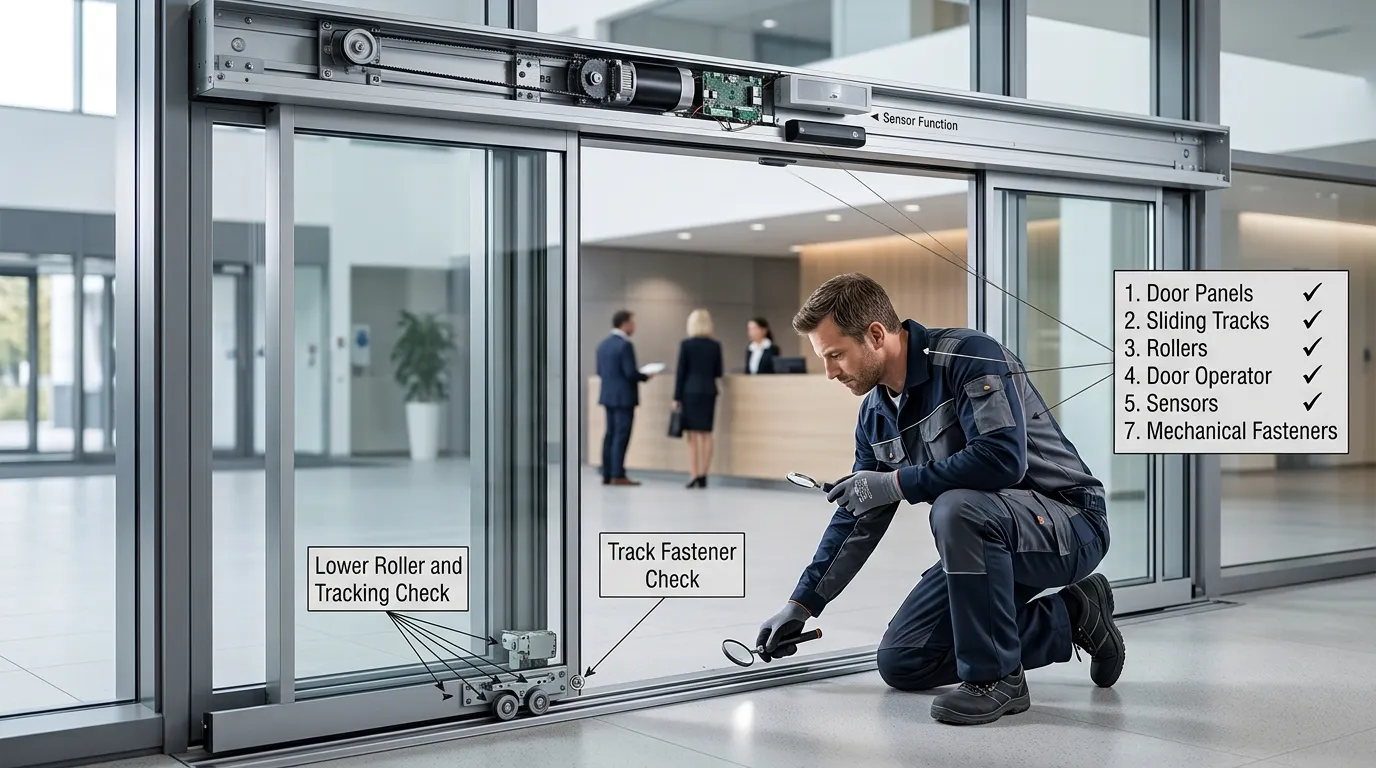
A basic maintenance inspection should cover the door's mechanical components as well as its sensors and control equipment.
Inspect the Door Panels and Tracks
The door panels should move smoothly along the tracks without excessive resistance or vibration.
Inspect the tracks for:
Dust and debris
Foreign objects
Physical damage
Signs of excessive wear
Keeping the track area clean can help reduce unnecessary resistance during operation.
Check Rollers and Moving Components
Rollers support the movement of the sliding door panels and may gradually wear through repeated use.
During inspection, look for:
Uneven movement
Excessive vibration
Visible wear
If a roller or other mechanical component shows significant wear, it should be evaluated and replaced when necessary.
Inspect Sensors
Sensors play an important role in both automatic activation and safe door operation.
Check that the sensors:
Detect approaching users correctly
Maintain an appropriate detection range
Remain securely positioned
Have a clear sensing area
Dust, accidental movement, or incorrect positioning can affect sensor performance.
Common Automatic Sliding Door Problems
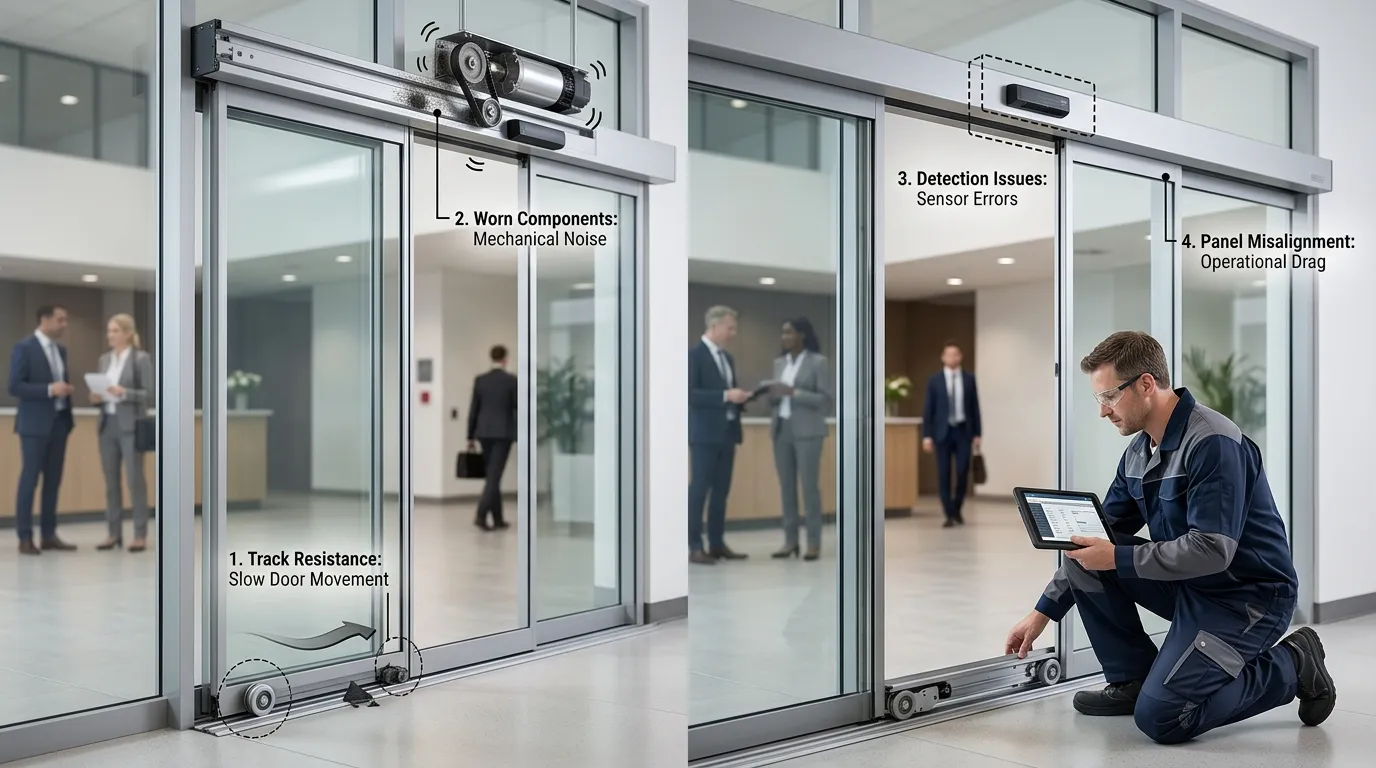
Even with regular maintenance, automatic sliding doors may eventually develop operational issues. Identifying the symptoms can help maintenance teams determine which part of the system needs further inspection.
The Door Does Not Open
If the door does not respond when a person approaches, the problem may involve the sensor, power supply, controller, operator, or a mechanical obstruction.
Start by checking whether the system has power and whether the sensor is responding correctly. If the sensor is functioning normally, inspect the door track and moving components for anything that could prevent the panels from moving.
The cause should be identified before replacing major components, as a simple obstruction or sensor issue may not require a costly repair.
The Door Moves Slowly
A sliding door that moves more slowly than usual may be experiencing mechanical resistance or an adjustment problem.
Possible causes include:
Dirty or obstructed tracks
Worn rollers
Door alignment issues
Operator adjustment problems
Cleaning the track and checking the mechanical components should be part of the initial inspection.
The Door Makes Unusual Noise
Grinding, rattling, clicking, or other unusual sounds can indicate that a mechanical component requires attention.
Common areas to inspect include the rollers, tracks, fasteners, and other moving parts.
Ignoring unusual noise may allow a relatively minor mechanical problem to develop into more extensive wear.
The Door Does Not Close Properly
An automatic sliding door may fail to close completely because of sensor activation, incorrect adjustment, mechanical resistance, or an obstruction in the doorway.
Check whether the sensor continues to detect movement after the user has passed through the entrance. The door track and panels should also be inspected to make sure nothing is preventing normal closing movement.
The Door Opens or Closes Repeatedly
Repeated or unexpected opening and closing can affect both user experience and system efficiency.
Possible causes include:
Incorrect sensor detection
Objects moving within the detection area
Control system issues
Mechanical problems
The detection area should be checked first, followed by the sensor settings and other system components.
How to Keep Automatic Sliding Doors Operating Reliably
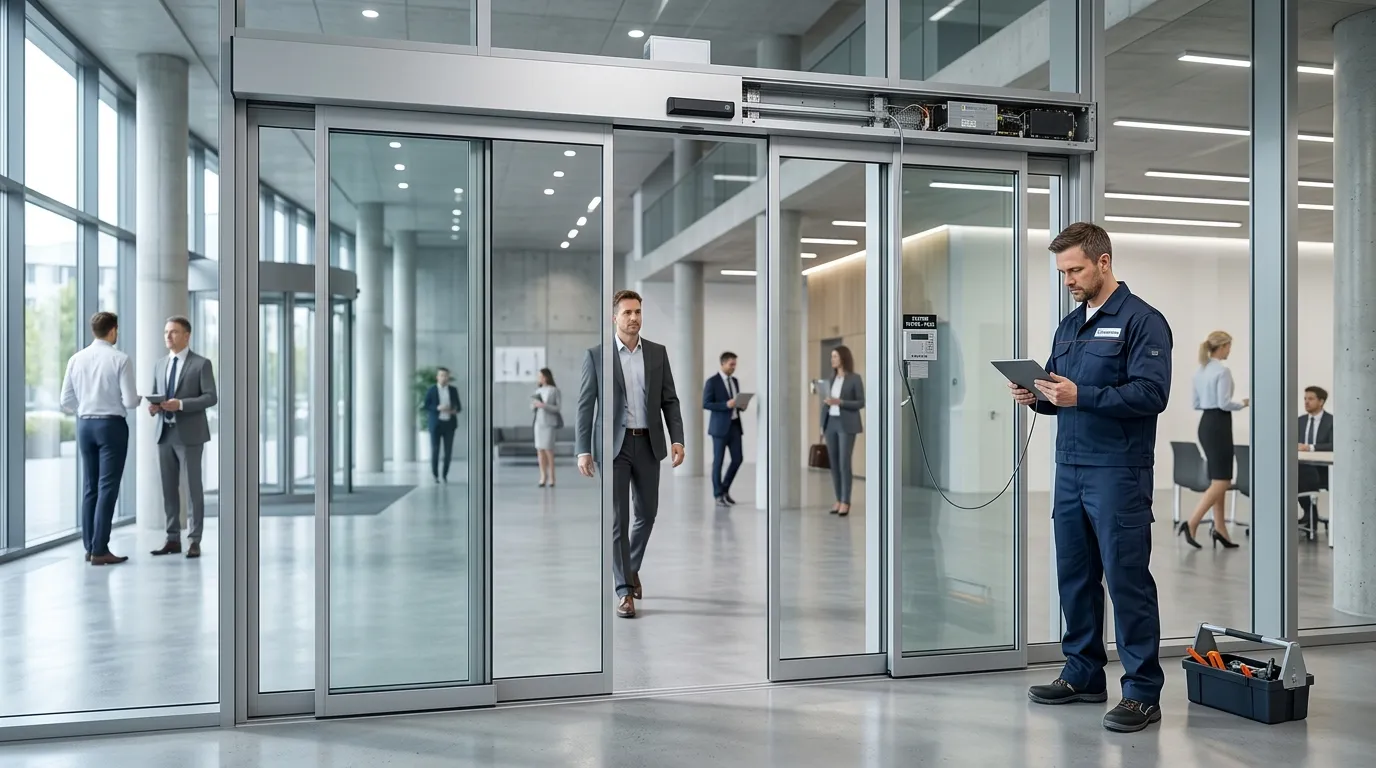
Good maintenance involves more than responding to visible problems. A consistent maintenance routine can help reduce recurring failures and extend the useful life of the system.
Establish a Regular Inspection Schedule
The appropriate inspection frequency depends on how often the door is used and the environment in which it operates.
Factors to consider include:
Daily traffic volume
Building type
Operating hours
Indoor or outdoor installation
High-traffic entrances generally require closer monitoring because their components experience more frequent operating cycles.
Keep Maintenance Records
Recording inspections and repairs makes it easier to identify recurring problems.
Maintenance records can include:
Inspection dates
Identified problems
Sensor adjustments
Repair work completed
These records can help facility managers plan preventive maintenance instead of waiting for a complete system failure.
Keep the Door Area Clean
The area around an automatic sliding door should remain free from objects and debris that could interfere with operation.
Tracks, sensor areas, and surrounding floor spaces should be inspected regularly, particularly in entrances exposed to dust, dirt, or heavy pedestrian activity.
When Should Automatic Door Components Be Replaced?
Regular maintenance can extend the service life of an automatic sliding door, but individual components will eventually require replacement. Identifying worn parts early can help prevent more serious system problems.
Replace Worn Components When Necessary
Components such as rollers, sensors, belts, and other mechanical or electrical parts can deteriorate through repeated use.
Replacement may be appropriate when a component shows:
Excessive wear
Repeated performance issues
Physical damage
Unusual noise
Replacement parts should be compatible with the existing automatic door system and installed according to the manufacturer's requirements.
Consider System Replacement for Persistent Problems
A complete system replacement may be worth considering when major problems continue despite regular maintenance and component replacement.
Factors that may influence the decision include:
Age of the automatic door system
Frequency of repairs
Availability of replacement parts
Operating requirements
Overall maintenance costs
The goal should be to determine whether continued repair or a new automatic door system provides the more practical long-term solution.
Frequently Asked Questions
Q1: How often should automatic sliding doors be serviced?
The appropriate maintenance frequency depends on usage, operating conditions, and the installation environment. High-traffic commercial entrances generally require more frequent inspection than doors with limited daily use.
Q2: Why is my automatic sliding door moving slowly?
Slow movement may be caused by dirty tracks, worn rollers, excessive friction, door alignment problems, or operator adjustment issues. These components should be inspected before replacing major system parts.
Q3: Why does my automatic sliding door make noise?
Unusual noise may come from worn rollers, debris in the track, loose components, or other mechanical problems. The source of the noise should be identified and inspected promptly.
Q4: Why does my automatic sliding door keep opening and closing?
Repeated operation can result from sensor misalignment, objects within the detection area, incorrect sensor settings, or control system problems.
Q5: Can automatic sliding door sensors be cleaned?
Yes. Keeping the sensor area clean can help maintain reliable detection. Cleaning should be carried out carefully according to the sensor manufacturer's instructions.
Q6: What should I check if an automatic sliding door does not open?
Check the power supply, sensor response, door track, mechanical components, and operator system. A qualified technician should investigate electrical or control-system faults when necessary.
Q7: How do I know if automatic door rollers need to be replaced?
Excessive noise, uneven movement, vibration, visible wear, or increasing resistance during operation can indicate that rollers require inspection or replacement.
Q8: Should automatic door tracks be lubricated?
Maintenance requirements vary by door system and component design. Follow the manufacturer's maintenance instructions rather than applying lubricant to components that are not designed to be lubricated.
Q9: When should an automatic sliding door be replaced instead of repaired?
Replacement may be more practical when the system has persistent failures, requires frequent repairs, has limited replacement-part availability, or no longer meets the building's operating requirements.
Q10: Who should maintain an automatic sliding door system?
Routine visual checks can often be handled by trained facility staff, while technical adjustments, electrical work, component replacement, and safety testing should be performed by qualified automatic-door professionals.
Conclusion
Automatic sliding door maintenance helps protect system performance, safety, and long-term reliability. Regular inspection of tracks, rollers, sensors, operators, and control components can help identify problems before they result in unexpected downtime.
For commercial buildings, a combination of routine inspection, timely component replacement, and professional servicing can keep automatic sliding doors operating smoothly while reducing unnecessary repair costs.
Other Blogs


