Blog
Industrial Sectional Door Motors Explained: Applications, Types, and Selection Guide
Author
Ray
Published
Category
Design & Inspiration
Learn how industrial sectional door motors work, explore their applications and types, and discover key factors for selecting the right motor for warehouses, factories, and commercial facilities.
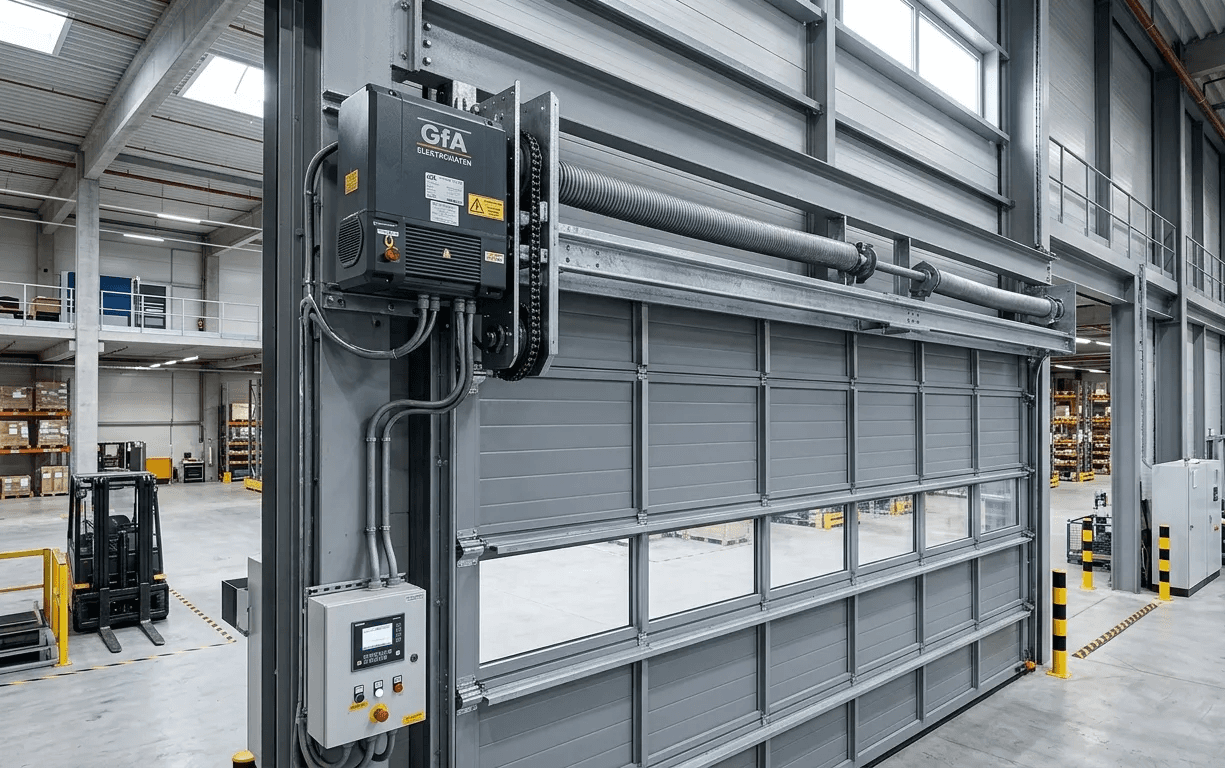

Author
Ray
An experienced automation specialist with a strong background in motor technology and industrial solutions. With years of expertise in central motors, tubular motors, and automation systems, the author is dedicated to sharing insights that connect engineering innovation with real-world applications. Passionate about advancing reliable, energy-efficient, and high-performance automation products for global markets.
What’s better than insider perks, pro tips, and surprises?
Sign up to get the most recent blog articles in your email every week.
Join now.
WHY I WRITE THIS
About my business
Our company’s main product lines include tubular motors, sliding gate motors, swing gate motors, roller shutter motors, and other door automation solutions, all manufactured by trusted partner factories we have worked with for many years.
Our Services
I help them with sales and export operations, while our company also provides sourcing and procurement services in China to help international clients solve supply-related challenges. If you need assistance with procurement, please feel free to contact us.
Introduction
Industrial sectional doors are widely used in warehouses, logistics centers, manufacturing facilities, and commercial buildings where reliable access control and efficient operation are required.
Unlike manual doors, sectional doors rely on motorized systems to control opening and closing movement. The motor provides the driving force, while control components and safety devices work together to ensure stable operation.
Choosing the right industrial sectional door motor is important because different applications have different requirements. Factors such as door size, weight, operating frequency, installation conditions, and safety requirements all influence the final selection.
For installers, distributors, and project suppliers, understanding how sectional door motors work and how to select suitable solutions helps create more reliable industrial automation systems.
What Is an Industrial Sectional Door Motor?
An industrial sectional door motor is an automation component designed to control the movement of large sectional doors through an electric drive system.
Unlike residential garage door openers, industrial sectional door motors are usually designed for heavier doors, higher operating frequency, and more demanding working environments.
Motor Function in Sectional Door Systems
The main function of the motor is to provide the force required to lift and lower the sectional door.
During operation, the motor transfers power through the drive mechanism, allowing the door panels to move along the guide tracks. A properly selected motor helps maintain smooth movement while reducing unnecessary stress on mechanical components.
Because industrial sectional doors are often larger and heavier than residential doors, motor performance needs to match the actual door structure and workload.
Relationship Between Motor and Door Structure
The motor does not work independently. It must operate together with other parts of the sectional door system, including springs, shafts, tracks, controllers, and safety devices.
Factors such as door balance, panel weight, and mechanical condition can affect the actual force required during operation.
For this reason, selecting a sectional door motor should always consider the complete system rather than focusing only on motor power.
How Industrial Sectional Door Motors Work
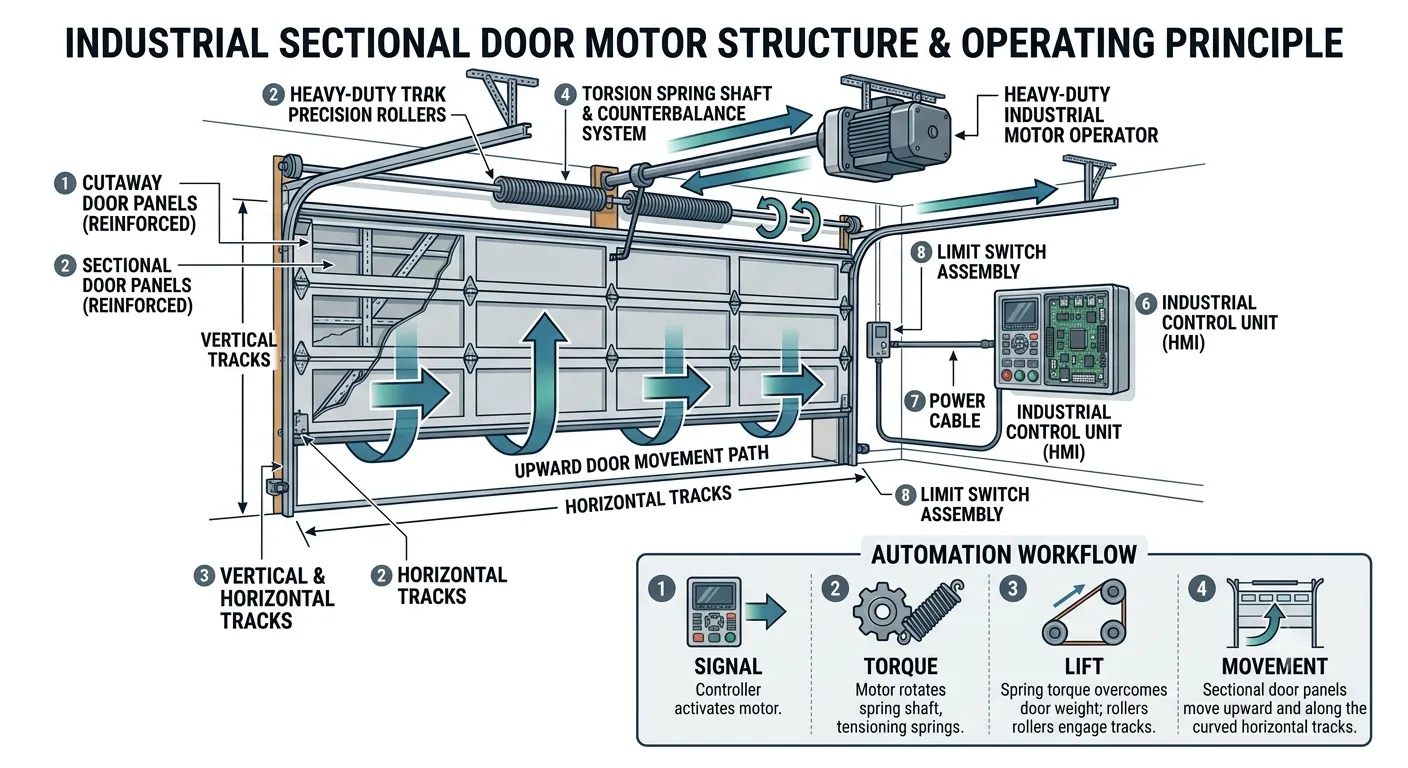
The operation of an industrial sectional door motor involves coordination between electrical control components and mechanical systems.
Drive Mechanism and Movement Control
When a user sends an opening or closing command, the control system processes the signal and activates the motor.
The motor then generates rotational force, which is transferred through the drive mechanism to move the door along its track system.
During movement, the motor needs to maintain controlled speed and stable operation to prevent unnecessary impact on the door structure.
Control System and Safety Components
Modern industrial sectional door systems usually include control units and safety components to improve reliability.
The controller manages communication between the motor, remote controls, sensors, and other connected devices. Safety components help monitor operating conditions and reduce potential risks during door movement.
For industrial environments, effective coordination between these components is important because doors may operate frequently throughout the day.
Types of Industrial Sectional Door Motors
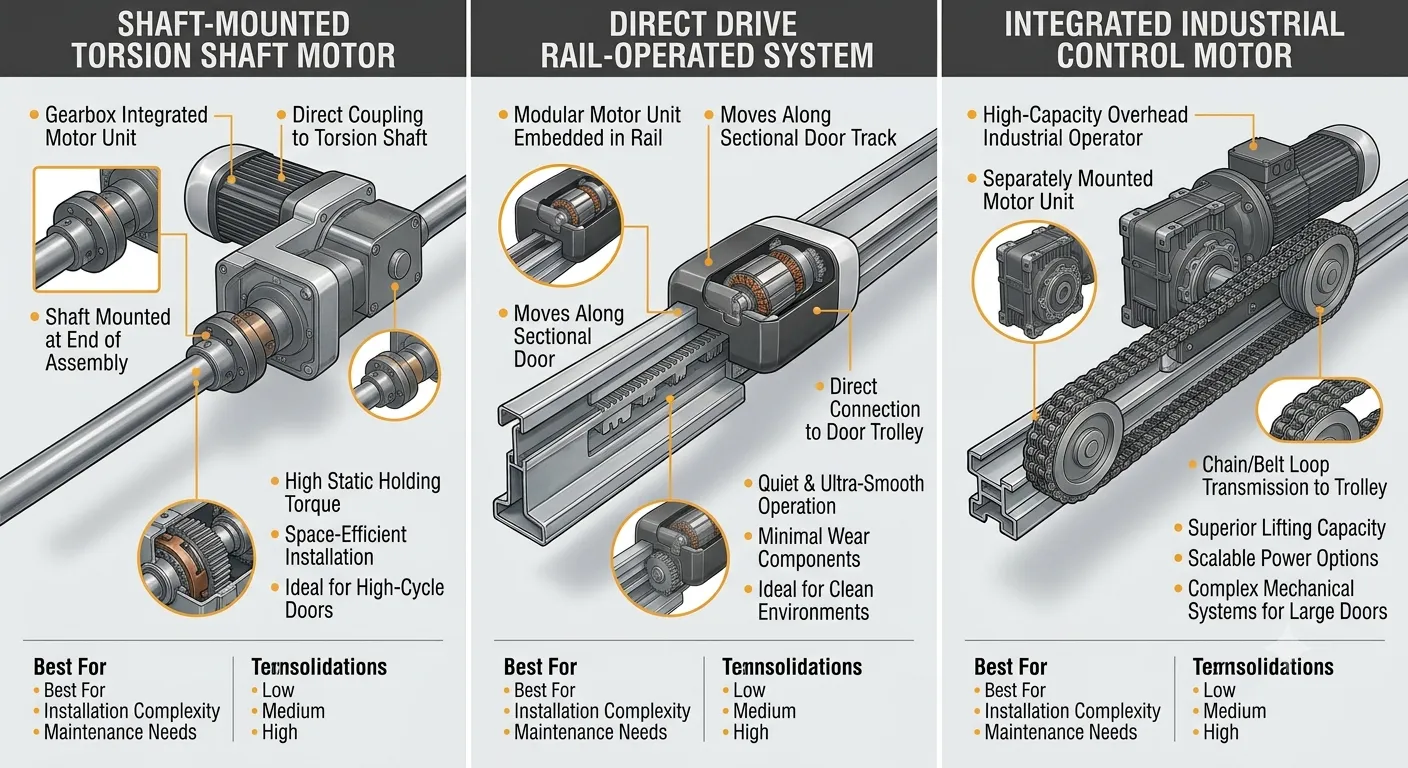
Different industrial applications may require different motor solutions depending on door design, usage frequency, and installation requirements.
Shaft-Mounted Sectional Door Motors
Shaft-mounted motors are commonly used for industrial sectional doors because they can provide direct control of the door shaft system.
This type of motor is often suitable for larger doors where stable torque output and reliable operation are important.
The motor works together with the shaft and lifting mechanism to control the movement of the sectional door efficiently.
Direct Drive Sectional Door Motors
Direct drive motors use a simplified transmission structure to transfer power more directly to the door system.
Because they reduce the number of mechanical components involved, these motors can provide smooth operation and lower mechanical complexity.
They are suitable for applications where reliable performance and efficient movement control are required.
Types of Industrial Sectional Door Motors
Other Motor Solutions for Industrial Doors
Besides shaft-mounted and direct drive solutions, some industrial sectional door systems may use different motor configurations depending on the door design and application requirements.
The suitable motor solution depends on factors such as available installation space, door dimensions, operating cycles, and required control functions.
For complex industrial projects, the motor should be selected together with the complete door system to ensure compatibility between mechanical components and automation controls.
Applications of Industrial Sectional Door Motors
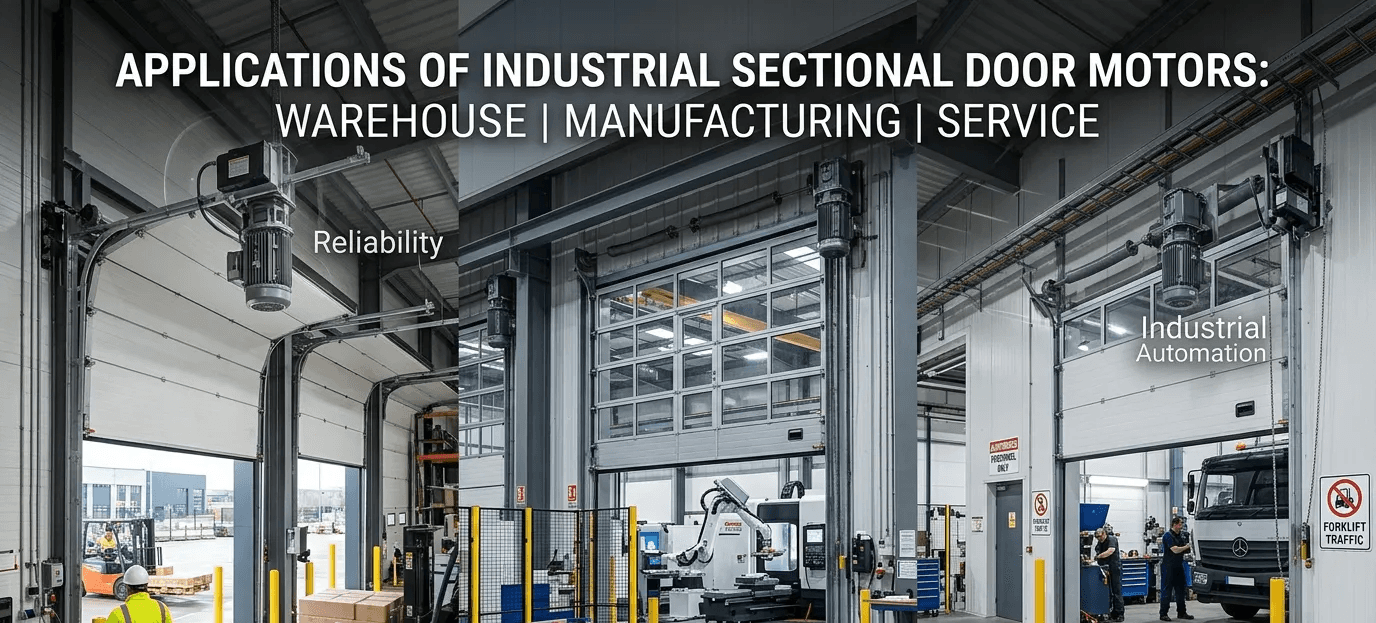
Industrial sectional door motors are commonly used in environments where large doors require frequent and reliable operation.
Different applications may have different requirements depending on workload, environmental conditions, and access needs.
Warehouses and Logistics Centers
Warehouses and logistics facilities often rely on sectional doors to support the movement of goods, vehicles, and personnel.
In these environments, doors may operate many times throughout the day. The selected motor needs to provide stable performance while handling repeated opening and closing cycles.
A suitable industrial sectional door motor helps maintain efficient workflow and reduces potential interruptions caused by unreliable door operation.
Manufacturing Facilities
Manufacturing facilities often require sectional doors for material transportation, equipment access, and separation between different working areas.
These environments may involve dust, temperature changes, and continuous operation, which means motor durability and environmental adaptability are important considerations.
Selecting a motor based on actual working conditions helps improve system reliability and supports daily production activities.
Commercial and Service Buildings
Large commercial buildings, service areas, and storage facilities may also use industrial sectional doors for controlled access.
In these applications, the motor needs to balance performance, convenience, and long-term reliability.
A properly selected solution can provide smooth operation while meeting the access requirements of different commercial environments.
How to Choose the Right Industrial Sectional Door Motor
Selecting an industrial sectional door motor requires evaluating the complete application rather than choosing a motor based on a single specification.
Consider Door Size and Weight
Door dimensions and weight directly influence motor requirements.
Larger sectional doors require motors with sufficient driving capability to maintain stable movement. However, motor selection should also consider door balance, shaft design, and mechanical resistance.
A properly matched motor helps reduce unnecessary stress and improves overall system performance.
Evaluate Operating Frequency
The expected operating frequency is another important selection factor.
A sectional door in a warehouse or logistics center may operate continuously throughout the day, while a lower-traffic facility may have different requirements.
Choosing a motor according to actual workload helps ensure reliable operation and longer service life.
Check Installation Conditions
The installation environment can affect motor performance and maintenance requirements.
Industrial facilities may expose equipment to dust, moisture, temperature changes, and other challenging conditions.
Considering these factors during selection helps ensure that the motor can maintain stable operation in the intended environment.
Consider Safety and Integration Requirements
Modern sectional door systems often need to work with sensors, controllers, remote controls, and other automation components.
The motor should be compatible with these systems to ensure effective communication and coordinated operation.
For industrial applications, proper integration helps improve safety, efficiency, and long-term reliability.
Common Mistakes When Selecting Sectional Door Motors
One common mistake is selecting a motor only according to power rating.
A higher-power motor does not always provide better results if it does not match the door structure, operating conditions, or control system.
Another mistake is ignoring future usage requirements. Industrial facilities may increase operating frequency over time, making a flexible and reliable solution more valuable.
Some projects also overlook environmental conditions. A motor that works well in a controlled environment may not provide the same performance in demanding industrial locations.
A successful selection process should evaluate the complete sectional door system rather than focusing on individual components.
Frequently Asked Questions
Q1: What is an industrial sectional door motor used for?
A: An industrial sectional door motor is used to automate the opening and closing movement of large sectional doors in warehouses, factories, logistics centers, and commercial facilities.
Q2: How do I choose the right sectional door motor?
A: The selection should consider door size, weight, operating frequency, installation environment, and compatibility with the complete automation system.
Q3: Are industrial sectional door motors different from residential garage door openers?
A: Yes. Industrial sectional door motors are generally designed for larger doors, higher operating cycles, and more demanding environments compared with residential solutions.
Q4: Why is motor compatibility important in sectional door systems?
A: The motor needs to work correctly with the door structure, control system, and safety components. Proper compatibility helps improve reliability and reduce operational issues.
Q5: Do industrial sectional door motors require maintenance?
A: Yes. Regular inspection and maintenance help ensure stable operation, identify potential issues early, and extend the service life of the automation system.
Conclusion
Industrial sectional door motors play an important role in creating reliable automation solutions for warehouses, manufacturing facilities, commercial buildings, and other demanding environments.
Choosing the right motor requires considering the complete door system, including door structure, workload, installation conditions, and control requirements.
For installers, distributors, and project suppliers, a properly selected sectional door motor can improve operational stability, reduce maintenance needs, and support long-term performance.
Other Blogs


