Blog
Barrier Gate Systems Explained: How They Work, Types, Applications, and Selection
Author
Ray
Published
Category
Design & Inspiration
Learn how barrier gate systems work, explore their types and applications, and discover key factors for selecting reliable vehicle access control solutions.

Author
Ray
An experienced automation specialist with a strong background in motor technology and industrial solutions. With years of expertise in central motors, tubular motors, and automation systems, the author is dedicated to sharing insights that connect engineering innovation with real-world applications. Passionate about advancing reliable, energy-efficient, and high-performance automation products for global markets.
What’s better than insider perks, pro tips, and surprises?
Sign up to get the most recent blog articles in your email every week.
Join now.
WHY I WRITE THIS
About my business
Our company’s main product lines include tubular motors, sliding gate motors, swing gate motors, roller shutter motors, and other door automation solutions, all manufactured by trusted partner factories we have worked with for many years.
Our Services
I help them with sales and export operations, while our company also provides sourcing and procurement services in China to help international clients solve supply-related challenges. If you need assistance with procurement, please feel free to contact us.
Introduction
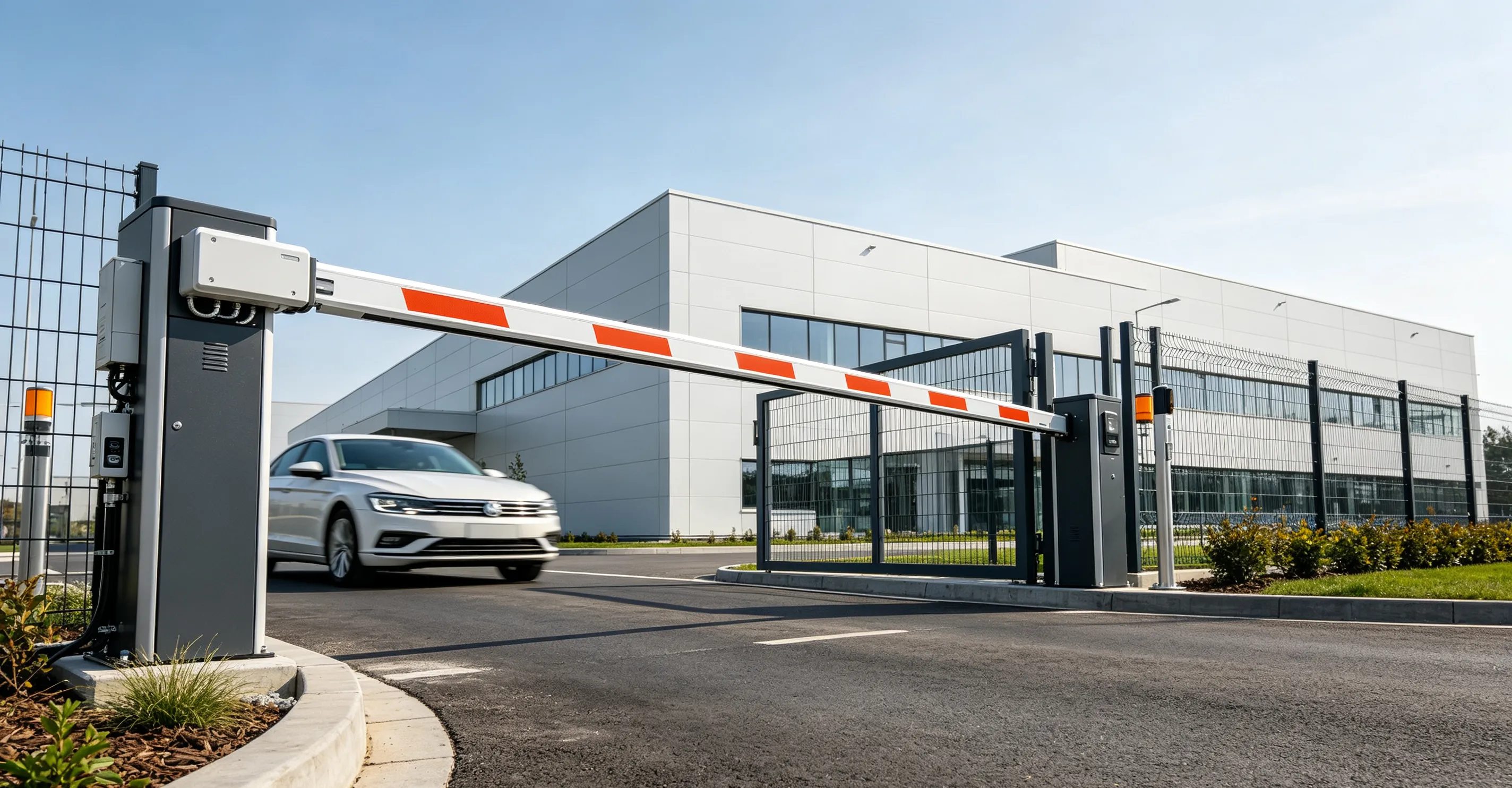
Barrier gate systems are widely used to control vehicle access at entrances where efficient and organized traffic management is required.
Unlike sliding and swing gates, barrier gates use a lifting arm to control vehicle passage. This makes them particularly suitable for parking facilities, commercial entrances, industrial sites, and other locations where vehicles need to enter and exit frequently.
A complete barrier gate system usually combines a barrier gate motor, control unit, access devices, and safety components. The performance of the system depends on how well these components work together.
For installers, distributors, and project suppliers, understanding how barrier gate systems work and how to select the right solution can help create more reliable and efficient vehicle access control systems.
What Is a Barrier Gate System?
A barrier gate system is an automated vehicle access solution that controls entry and exit using a movable barrier arm.
When an authorized access signal is received, the system activates the motor and raises the barrier arm. After the vehicle passes, the arm can lower automatically according to the programmed control settings.
Barrier gates are different from conventional gates because they do not completely block an entrance with a gate panel. Instead, they provide controlled vehicle access while allowing fast movement through the entrance.
Main Components of a Barrier Gate System
A typical barrier gate system includes several components that work together to control vehicle movement.
The barrier gate motor provides the driving force required to raise and lower the arm. The control unit processes signals from access devices and manages the movement of the barrier.
Other components may include remote controls, vehicle detection sensors, photocells, warning lights, and access control equipment.
The exact configuration depends on the application and the required level of access management.
How Barrier Gate Systems Work
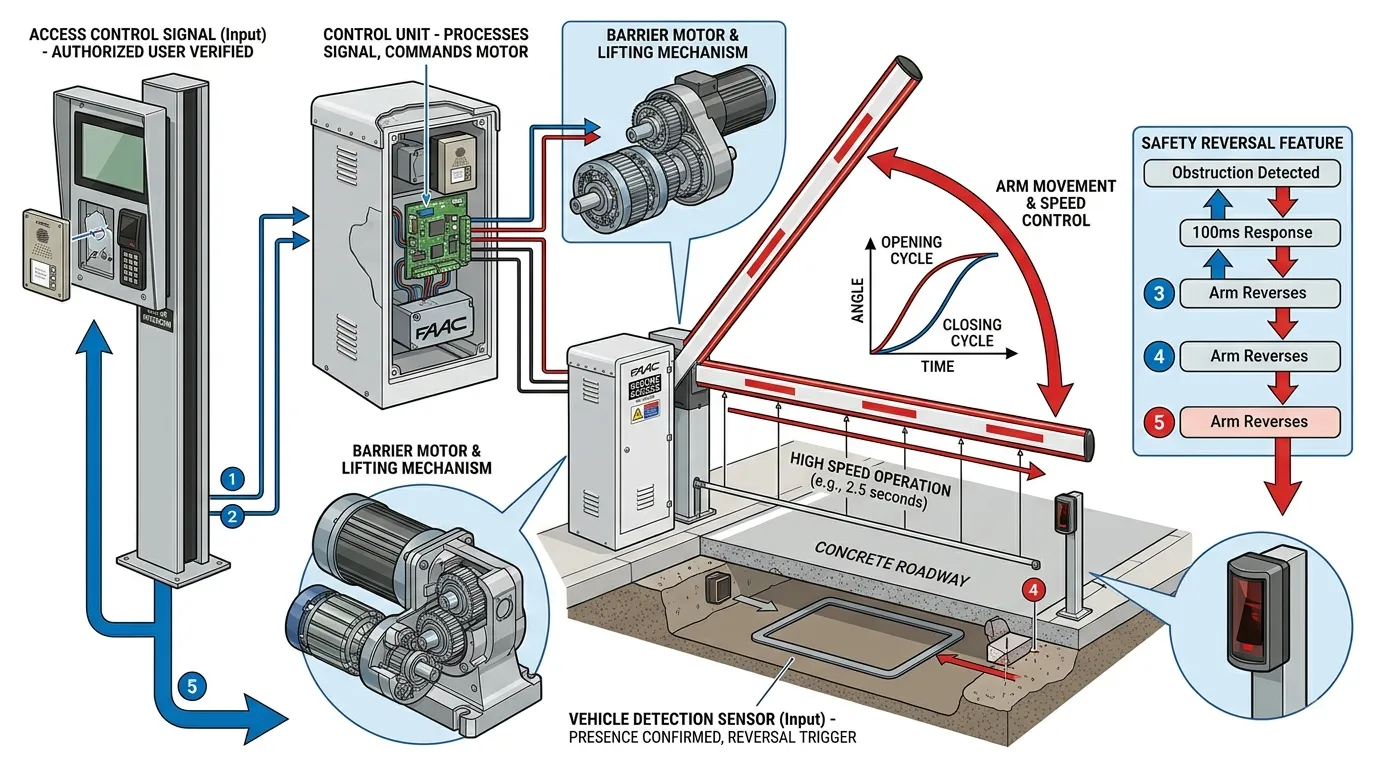
Barrier gates operate through coordinated communication between the motor, controller, access devices, and safety components.
When a vehicle approaches the entrance, the system receives an opening command through a remote control, access card, keypad, ticketing system, or other control device.
Opening and Closing Process
After receiving a valid signal, the control unit activates the motor.
The motor drives the mechanical mechanism that raises the barrier arm to allow the vehicle to pass. Once the vehicle has cleared the entrance, the control system can activate the closing process.
The operating speed and timing depend on the barrier gate design and system configuration.
Vehicle Detection and Safety
Safety components help prevent the barrier from closing when a vehicle or obstacle is still within the movement area.
Photocells, vehicle loops, and other detection devices can be integrated into the system to improve operational safety.
For busy entrances, these components are particularly important because barrier gates may operate continuously throughout the day.
Types of Barrier Gate Systems
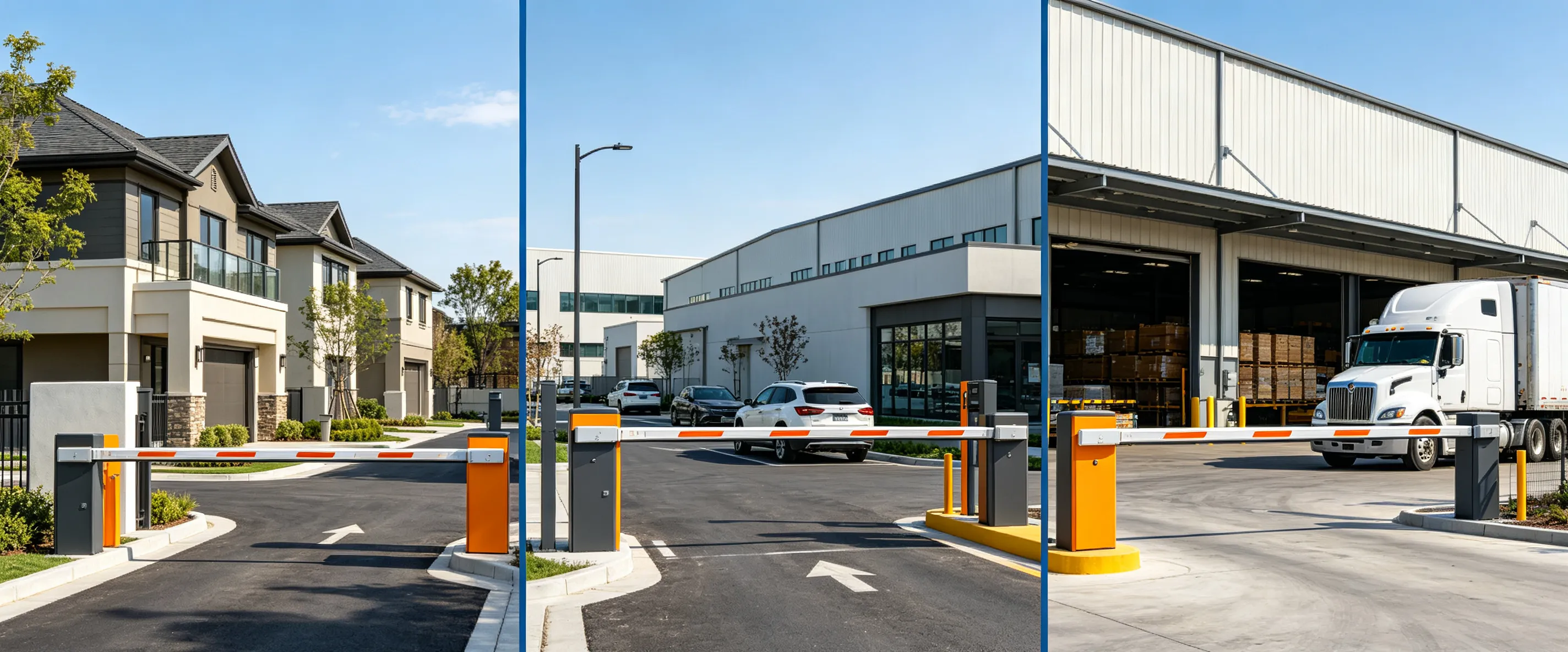
Barrier gate systems can be designed for different operating conditions and vehicle traffic requirements.
Standard Barrier Gates
Standard barrier gates are commonly used for residential communities, small parking areas, and commercial entrances.
They are suitable for applications with moderate traffic where reliable vehicle access control is required.
These systems typically focus on simple operation, convenient access control, and practical installation.
High-Speed Barrier Gates
High-speed barrier gates are designed for entrances where vehicles need to pass through quickly.
They are often used in parking facilities, logistics centers, commercial properties, and other locations with higher traffic volumes.
A faster opening and closing cycle can help reduce vehicle queues and improve overall traffic efficiency.
Heavy-Duty Barrier Gates
Heavy-duty barrier gates are designed for demanding applications with frequent operation or larger barrier arms.
They may be used in industrial facilities, logistics centers, and other locations where the equipment needs to withstand repeated operating cycles.
For these applications, motor durability, mechanical strength, and control reliability are important selection factors.
Barrier Gate Applications
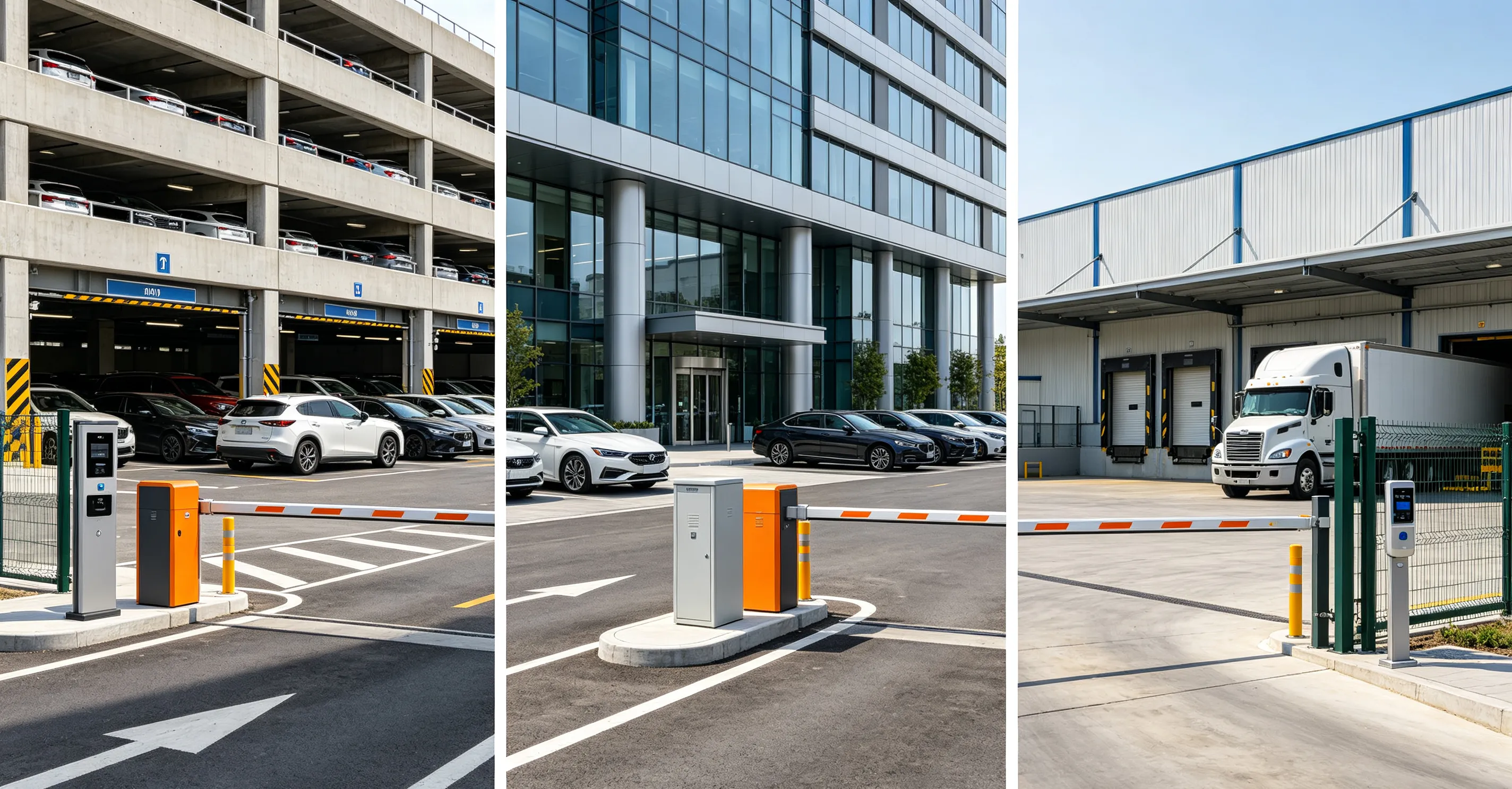
Barrier gate systems are mainly used where controlled vehicle access and efficient traffic flow are required.
Different locations may have different requirements for opening speed, operating frequency, and access control integration.
Parking Facilities
Parking facilities are one of the most common applications for barrier gates.
Barrier systems can work with ticket machines, card readers, license plate recognition systems, or other access devices to manage vehicle entry and exit.
For busy parking areas, opening speed and reliable repeated operation are especially important because delays at the entrance can quickly create vehicle queues.
Commercial and Residential Properties
Commercial buildings, office parks, and residential communities may use barrier gates to control vehicle access.
These systems can be integrated with remote controls, access cards, keypads, or other security equipment.
The required barrier gate capacity depends on factors such as traffic volume, entrance width, and expected daily operating cycles.
Industrial and Logistics Facilities
Industrial sites and logistics centers often require more durable vehicle access solutions.
Barrier gates may be used at warehouse entrances, factory access points, and restricted industrial areas where vehicles enter and leave frequently.
In these environments, reliability, operating frequency, environmental conditions, and integration with other security systems should be considered carefully.
How to Choose the Right Barrier Gate System
Selecting a barrier gate requires evaluating the complete access application rather than choosing a motor based only on opening speed.
Consider Traffic Flow and Operating Frequency
The expected vehicle flow is one of the most important factors.
A low-traffic entrance may work well with a standard barrier gate, while busy parking facilities and logistics sites may require high-speed or heavy-duty solutions.
Understanding the expected number of operating cycles helps ensure that the selected system can handle daily usage.
Evaluate Barrier Arm Length
Barrier arm length should match the width of the vehicle entrance.
A longer arm may be required for wider entrances, but increasing arm length can also affect the mechanical load placed on the motor.
The barrier gate should therefore be selected according to both the required coverage and the motor's rated capability.
Consider Access Control Integration
Modern barrier gates can work with various access control technologies.
Depending on the project, the system may need to connect with RFID cards, license plate recognition, ticketing systems, remote controls, or other access devices.
For commercial and industrial projects, checking compatibility before installation helps create a more complete access management system.
Consider Safety and Installation Environment
Barrier gates are often installed outdoors, where they may be exposed to rain, dust, temperature changes, and other environmental conditions.
Safety sensors and vehicle detection systems should also be considered, particularly at busy entrances.
Choosing equipment suitable for the actual environment can improve reliability and reduce maintenance requirements.
Common Mistakes When Choosing a Barrier Gate
One common mistake is choosing a barrier gate based only on its opening speed.
A fast barrier is not necessarily the best option if it cannot handle the expected operating frequency or environmental conditions.
Another mistake is selecting a barrier arm without considering entrance width and motor capacity. The arm length and mechanical load need to be compatible with the complete system.
Ignoring access control compatibility can also create installation problems later. The barrier gate should be evaluated together with the devices that will control and monitor vehicle access.
Finally, safety components should not be treated as optional additions. Proper vehicle detection and obstacle protection are important parts of a reliable barrier gate system.
Frequently Asked Questions
Q1: What is a barrier gate system used for?
A: Barrier gate systems are mainly used to control vehicle access at parking facilities, commercial properties, residential communities, and industrial entrances.
Q2: How does a barrier gate work?
A: A motor-driven mechanism raises and lowers a barrier arm according to commands from the control system and connected access devices.
Q3: What is the difference between a standard and high-speed barrier gate?
A: A high-speed barrier gate is designed for faster opening and closing cycles, making it more suitable for entrances with higher vehicle traffic.
Q4: How do I choose the right barrier arm length?
A: The barrier arm should be long enough to cover the entrance width while remaining within the motor and mechanical system's rated capacity.
Q5: Can barrier gates integrate with access control systems?
A: Yes. Barrier gates can commonly integrate with remote controls, RFID systems, ticketing equipment, license plate recognition, vehicle sensors, and other access control technologies.
Conclusion
Barrier gate systems provide an efficient solution for managing vehicle access at residential, commercial, parking, and industrial entrances.
The right system depends on factors such as traffic flow, operating frequency, barrier arm length, access control requirements, and installation environment.
By evaluating these factors together, installers and project suppliers can select a barrier gate solution that provides reliable operation, efficient vehicle management, and suitable long-term performance.
Other Blogs


