Blog
How to Choose the Right Automatic Door Sensors for Commercial Applications
Author
Ray
Published
Category
Design & Inspiration
Explore automatic door sensor types, including motion, microwave, infrared, and presence sensors, and learn how to choose the right sensor for commercial applications.


Author
Ray
An experienced automation specialist with a strong background in motor technology and industrial solutions. With years of expertise in central motors, tubular motors, and automation systems, the author is dedicated to sharing insights that connect engineering innovation with real-world applications. Passionate about advancing reliable, energy-efficient, and high-performance automation products for global markets.
What’s better than insider perks, pro tips, and surprises?
Sign up to get the most recent blog articles in your email every week.
Join now.
WHY I WRITE THIS
About my business
Our company’s main product lines include tubular motors, sliding gate motors, swing gate motors, roller shutter motors, and other door automation solutions, all manufactured by trusted partner factories we have worked with for many years.
Our Services
I help them with sales and export operations, while our company also provides sourcing and procurement services in China to help international clients solve supply-related challenges. If you need assistance with procurement, please feel free to contact us.
Introduction
Automatic door systems rely on multiple components working together to provide smooth, safe, and reliable operation. Among these components, sensors play an important role because they determine when and how the door responds to users.
An automatic door sensor detects movement or the presence of people near the entrance and sends signals to the control system. Based on these signals, the door operator can open or close the door at the appropriate time.
For commercial buildings, choosing the right sensor is important because different environments have different requirements. A retail store with continuous customer traffic, a hospital entrance, and an office building may all require different sensor solutions.
Understanding how automatic door sensors work, the available types, and their applications can help installers, distributors, and project suppliers select more suitable automation solutions.
What Is an Automatic Door Sensor?
An automatic door sensor is a device used to detect approaching people, movement, or presence near an automated door.
The sensor works together with the door controller and motor system. When a person approaches the entrance, the sensor sends a signal to the controller, which activates the door operator and starts the opening process.
The Role of Sensors in Automatic Door Systems
Sensors are responsible for providing the information needed for automatic operation.
In a typical automatic door system:
The sensor detects user movement or presence
The controller processes the signal
The motor drives the door movement
Safety components help prevent accidents during operation
Without a suitable sensor, an automatic door may not respond correctly or may fail to provide the expected level of convenience and safety.
Why Sensor Selection Matters
Different automatic door applications require different sensing methods.
For example, a busy shopping entrance may need a sensor that can detect fast-moving pedestrians, while a healthcare facility may require more precise presence detection to improve safety.
Selecting the wrong sensor type can lead to issues such as:
Delayed door opening
Unnecessary door operation
Reduced user experience
Safety concerns
For this reason, sensor selection should be considered together with the door type, installation environment, and expected usage conditions.
Types of Automatic Door Sensors
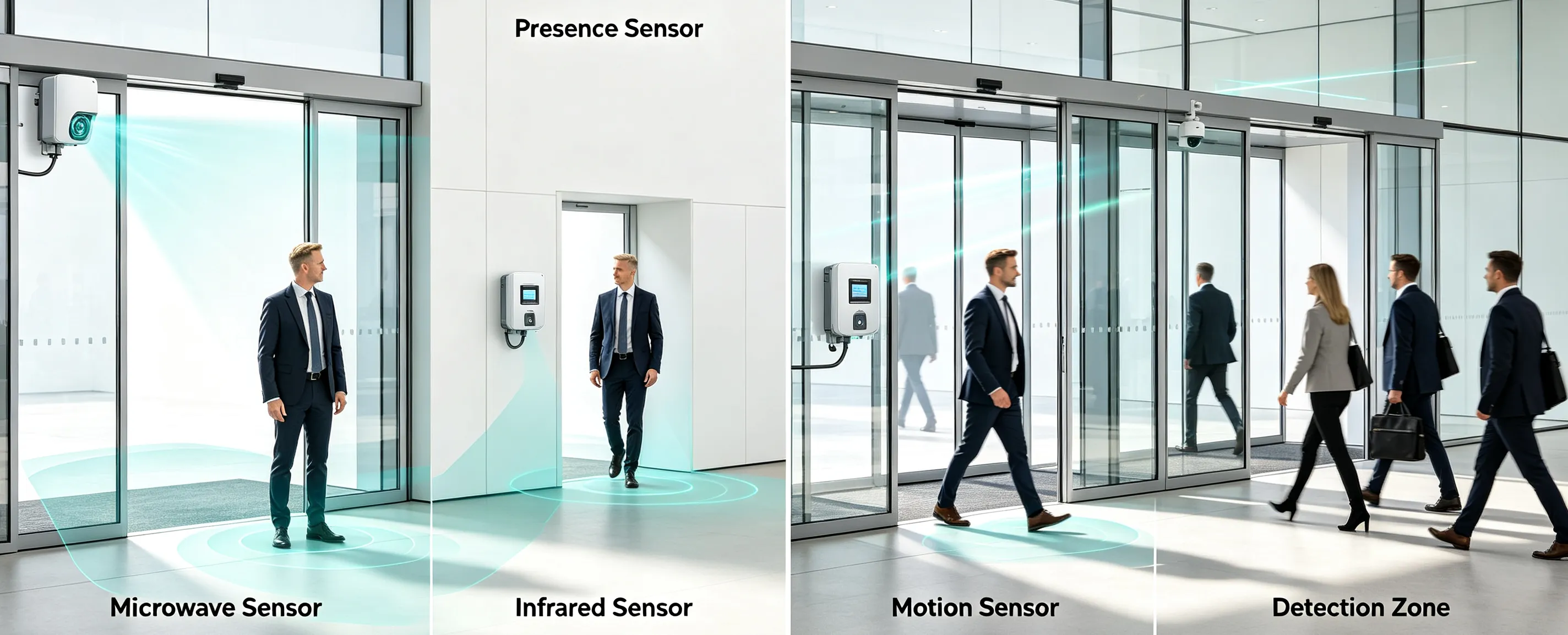
Automatic door sensors can be classified based on their detection technology and application purpose.
Although different sensors use different detection methods, their main goal is the same: ensuring that the door operates at the right time while maintaining safety and efficiency.
Motion Sensors
Motion sensors detect movement near the entrance and activate the automatic door when a person approaches.
How Motion Sensors Work
Motion sensors typically monitor the area around the doorway and identify changes caused by moving objects.
When movement is detected within the sensing range, the sensor sends a signal to the door control system, allowing the door to open automatically.
Common Applications
Motion sensors are commonly used in:
Retail stores
Office entrances
Commercial buildings
Public facilities
They are suitable for entrances where users approach the door naturally and expect quick automatic access.
Microwave Sensors
Microwave sensors are one of the common technologies used in automatic door systems.
They use microwave signals to detect movement and are often selected for entrances requiring reliable pedestrian detection.
Advantages of Microwave Sensors
Microwave sensors can provide:
Fast response to approaching movement
Wide detection coverage
Reliable operation in many commercial environments
Because of these characteristics, they are often used in high-traffic areas where doors need to respond quickly to frequent movement.
Considerations for Installation
The performance of microwave sensors can be influenced by installation height, detection angle, and surrounding conditions.
Proper adjustment is important to ensure that the sensor detects users accurately without causing unnecessary door activation.
Infrared Sensors
Infrared sensors use infrared technology to detect objects or people near an automatic door.
Compared with simple motion detection, infrared-based systems can provide more precise detection in specific areas around the entrance.
How Infrared Sensors Work
Infrared sensors detect changes in infrared signals within a defined detection zone.
When a person enters the sensing area, the sensor identifies the change and sends a signal to the door controller.
Depending on the sensor design, infrared technology can be used for:
Activation detection
Presence detection
Safety monitoring
Common Applications
Infrared sensors are widely used in locations where controlled detection is important, including:
Hospitals
Office buildings
Commercial entrances
Accessibility-focused facilities
They are especially useful where reliable detection and safe door operation are priorities.
Presence Sensors
Presence sensors are designed to detect whether a person or object remains within a specific area near the door.
Unlike basic motion sensors that mainly detect movement, presence sensors focus on maintaining awareness of stationary objects within the detection zone.
Improving Door Safety
Presence detection can help reduce the risk of the door closing while someone is still passing through the entrance.
This is particularly important in environments such as:
Hospitals
Public buildings
Facilities with frequent pedestrian traffic
Supporting Reliable Operation
By continuously monitoring the doorway area, presence sensors can help automatic doors operate more smoothly and safely.
For high-use entrances, this additional detection capability can improve both user experience and system reliability.
How Automatic Door Sensors Improve Safety and Convenience
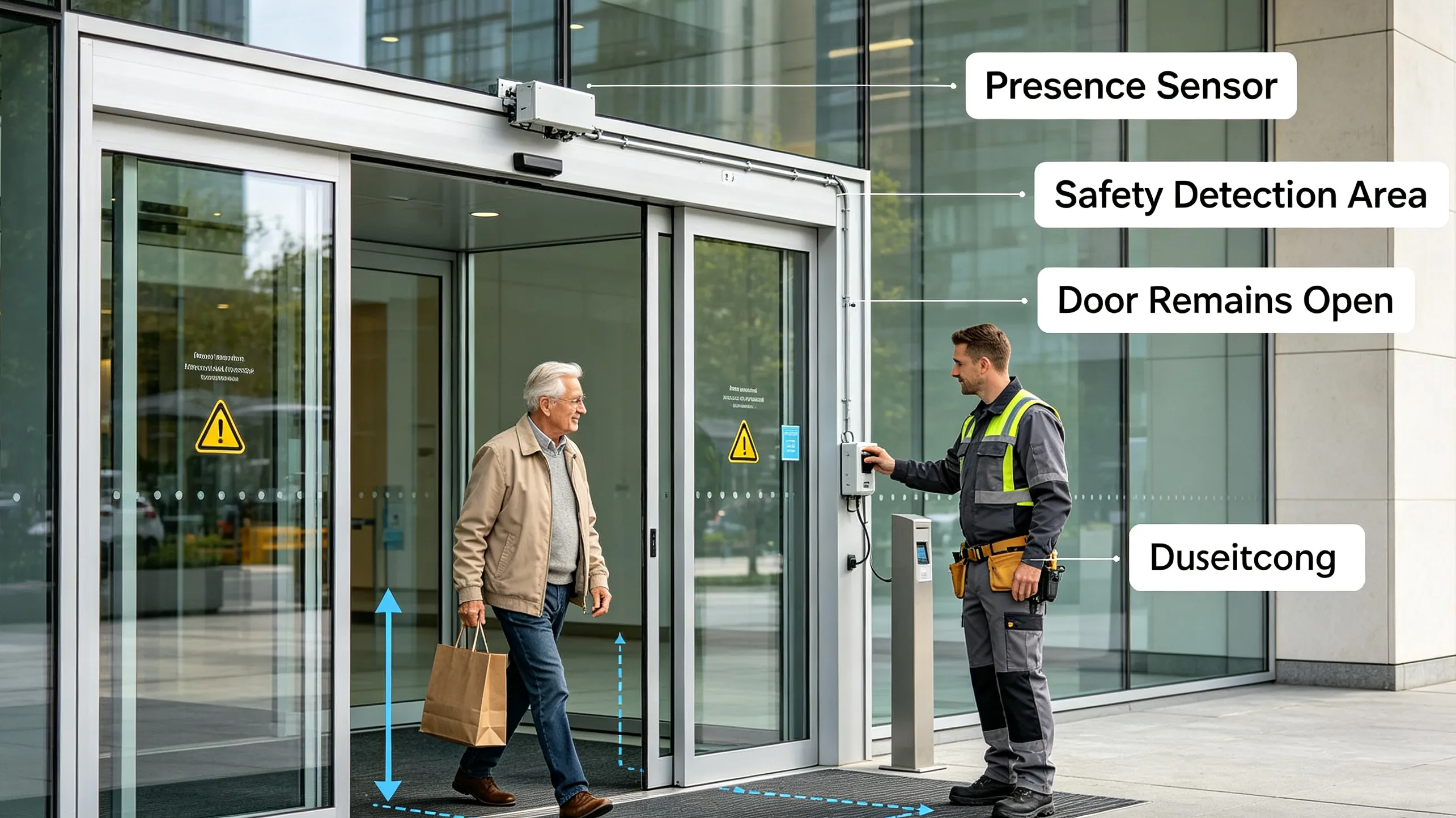
Automatic door sensors do more than activate opening movement. They also contribute to safer and more convenient access control.
Detecting Approaching Users
The primary function of a sensor is to identify when someone needs to pass through the entrance.
A properly adjusted sensor allows the door to open before the user reaches the doorway, creating a smoother walking experience.
This is especially valuable in commercial environments where many people pass through entrances every day.
Preventing Door Closing Accidents
Safety-focused sensors help detect whether people or objects remain in the doorway area.
By providing additional information to the control system, these sensors can help prevent the door from closing at an unsafe moment.
This is important for:
Elderly users
People with limited mobility
Customers carrying items
Healthcare environments
A suitable sensor configuration helps balance convenience, safety, and efficient door operation.
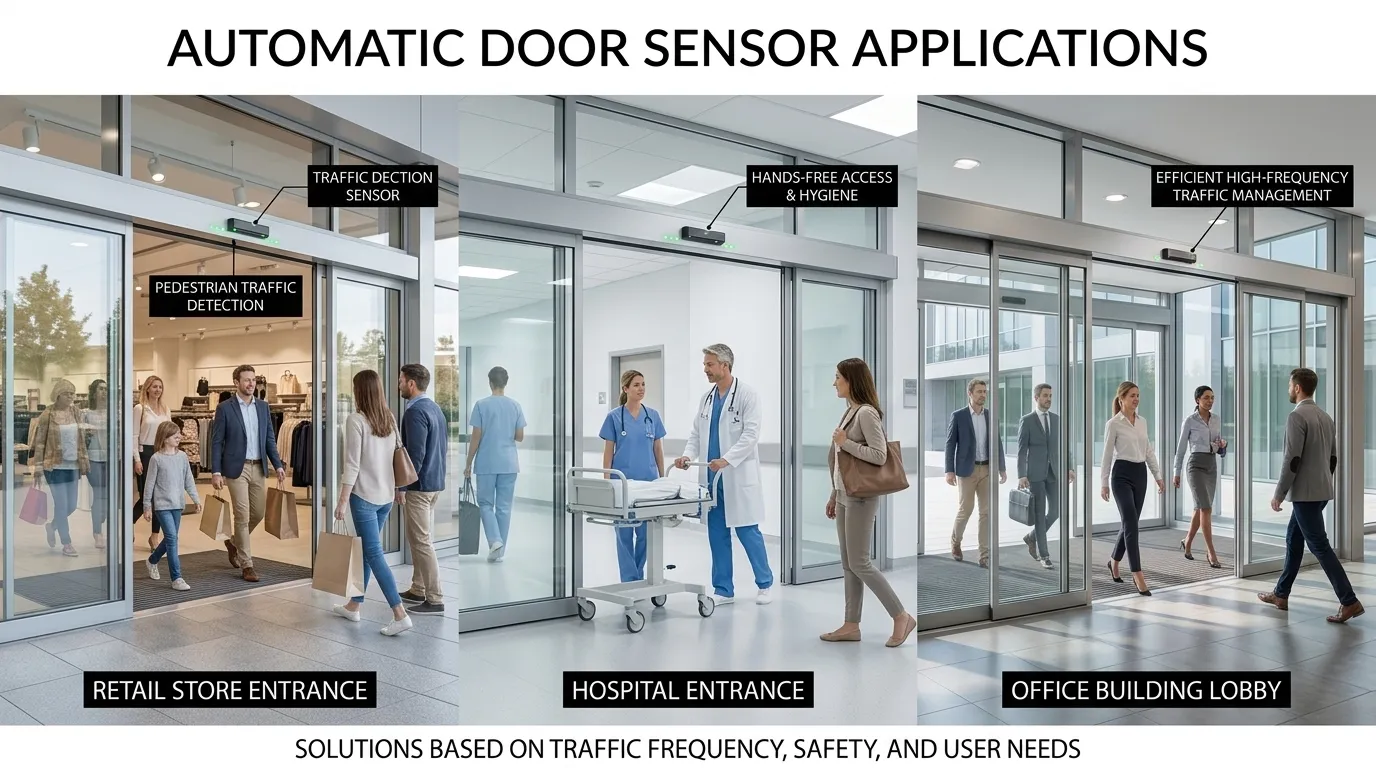
Applications of Automatic Door Sensors
Automatic door sensors are used across many commercial and public environments.
The most suitable sensor solution depends on traffic patterns, safety requirements, and the type of automatic door system.
Retail Stores
Retail entrances often experience frequent pedestrian movement throughout the day.
Automatic door sensors help customers enter and exit without manually operating the door, improving convenience and supporting smooth traffic flow.
For busy stores, sensors should provide reliable detection while avoiding unnecessary opening cycles.
Hospitals and Healthcare Facilities
Healthcare environments require a high level of safety and accessibility.
Automatic door sensors help provide hands-free access for patients, medical staff, and visitors.
In these applications, reliable presence detection and safe operation are often more important than simple movement detection.
Office Buildings and Public Facilities
Office buildings and public facilities typically require automatic doors that can handle regular daily traffic.
Sensors help manage entrance operation by detecting users efficiently and supporting controlled access.
For larger facilities, sensor selection should consider both user volume and long-term operating requirements.
How to Choose the Right Automatic Door Sensor
Choosing an automatic door sensor requires more than selecting the newest or most advanced technology. The right solution depends on the building environment, traffic conditions, door type, and safety requirements.
A suitable sensor should provide reliable detection while supporting smooth operation and long-term system performance.
Consider Traffic Conditions
The amount and type of traffic around the entrance are important factors when selecting a sensor.
A retail store with constant customer movement may require a sensor with a wider detection range and fast response.
In contrast, a low-traffic office entrance may require a different configuration focused on controlled access and energy efficiency.
Before selection, consider:
Number of daily users
Peak traffic periods
User movement patterns
Entrance location
Understanding how people interact with the entrance helps determine the most suitable sensor type.
Check Compatibility with the Door System
The sensor must work properly with the complete automatic door system.
Compatibility should be evaluated between:
Sensor
Door controller
Safety components
A sensor that is not properly matched with the control system may cause delayed response, unnecessary opening cycles, or unreliable operation.
For this reason, installers should confirm technical compatibility before installation.
Evaluate Safety Requirements
Safety requirements can vary significantly depending on the application.
For example, a shopping mall entrance may require different detection capabilities compared with a hospital entrance.
Important considerations include:
Presence detection capability
Door closing safety
Detection accuracy
Installation environment
Selecting a sensor based on safety requirements helps create a more reliable automatic door system.
Common Mistakes When Selecting Door Sensors
Choosing an unsuitable sensor can affect door performance and user experience.
Although sensors are small components, they play an important role in the overall automation system.
Choosing Based Only on Price
Lower-cost sensors may appear attractive, but price alone should not determine the final decision.
A sensor should be evaluated based on:
Reliability
Compatibility
Long-term operating requirements
A suitable sensor can help reduce maintenance issues and improve system stability.
Ignoring Installation Environment
The surrounding environment can affect sensor performance.
Factors such as:
Reflections
Temperature changes
Nearby moving objects
may influence detection accuracy depending on the sensor technology.
Considering the installation environment helps prevent unnecessary adjustments after installation.
Overlooking Maintenance
Like other automatic door components, sensors require regular inspection.
Dust, incorrect alignment, or changes around the entrance may affect detection performance over time.
Regular maintenance helps ensure that the sensor continues to provide reliable operation.
Frequently Asked Questions
Q1: What is the purpose of an automatic door sensor?
A: An automatic door sensor detects approaching users or objects and sends signals to the door control system to activate opening and closing movements.
Q2: What are the main types of automatic door sensors?
A: Common types include motion sensors, microwave sensors, infrared sensors, and presence sensors. Each type uses different detection methods for different applications.
Q3: Are microwave sensors better than infrared sensors?
A: Neither type is universally better. The right choice depends on the application, detection requirements, installation environment, and safety needs.
Q4: Why are presence sensors important for automatic doors?
A: Presence sensors help detect people or objects remaining near the doorway, which can improve safety by reducing the risk of accidental door closing.
Q5: How often should automatic door sensors be maintained?
A: Maintenance frequency depends on the operating environment and usage level. High-traffic entrances usually require more frequent inspection.
Conclusion
Automatic door sensors are essential components that influence the performance, safety, and convenience of automated entrance systems.
Different sensor technologies provide different advantages, and the best choice depends on factors such as traffic conditions, building type, door configuration, and safety requirements.
For installers, distributors, and project suppliers, selecting the right sensor as part of a complete automatic door solution can help improve reliability, user experience, and long-term system performance.
Other Blogs


